Bitcoin in Your Pocket: Using a Mobile Wallet for BTC Storage and Payments
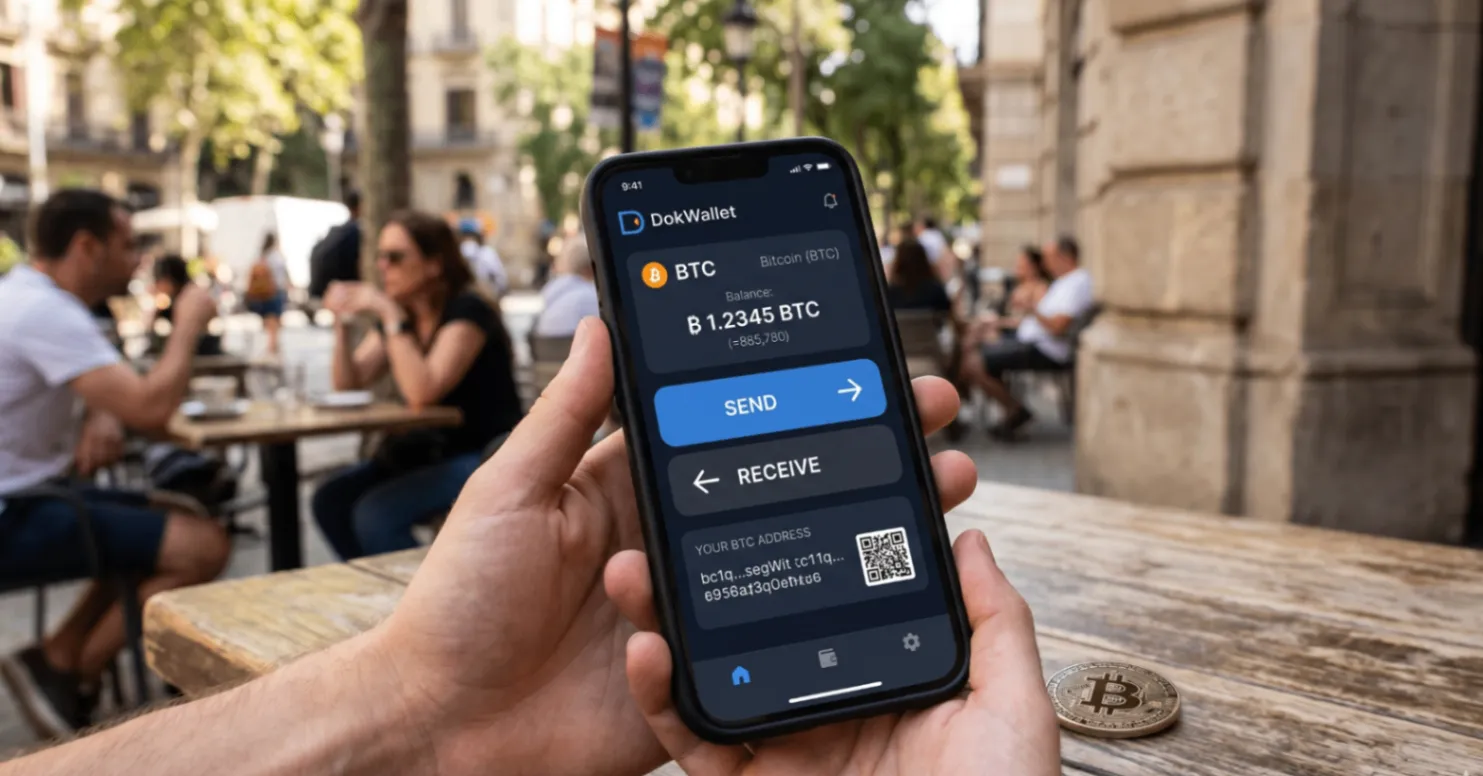
Bitcoin remains the most widely held cryptocurrency in the world. Despite the growth of thousands of alternative assets, BTC continues to occupy a unique position — a fixed-supply, decentralised store of value that is recognised and accepted globally. For anyone holding Bitcoin, the question of how and where to store it is one of the most important decisions they will make. A mobile wallet puts BTC directly in your pocket, accessible at any time, secured by your own private keys rather than a third-party custodian.
This guide covers what you need to know to use a mobile Bitcoin wallet effectively: the different address types and why they matter, how transaction fees work, the practical mechanics of sending and receiving BTC, and how DokWallet handles Bitcoin for everyday use and medium-term storage.
Why Use a Mobile Bitcoin Wallet?
A mobile Bitcoin wallet offers a level of accessibility that hardware wallets simply cannot match. A hardware wallet requires the physical device to be present before you can sign a transaction — useful for long-term cold storage, but impractical for everyday spending or spontaneous transfers. A mobile wallet is always with you, and that accessibility makes it the right tool for day-to-day Bitcoin activity.
The critical distinction between a mobile wallet and leaving Bitcoin on an exchange is key custody. When Bitcoin sits on an exchange, the exchange holds the private keys. You hold an IOU, not actual Bitcoin. Exchange insolvencies, hacks, and account freezes are real risks that have affected millions of users. A non-custodial mobile wallet like DokWallet means your private keys are generated and stored on your own device — the wallet software never transmits them to any server.
The practical trade-off is worth understanding clearly. A mobile device is connected to the internet and therefore more exposed to online threats than a hardware wallet kept offline. This makes mobile wallets ideal for medium-term holdings and spending amounts — the BTC you actively use — while large, long-term reserves are better suited to cold storage. The right architecture for most Bitcoin users is a combination: a hardware wallet for savings, a mobile wallet for the amounts you actively transact.
Bitcoin Address Types — Legacy, SegWit, and Native SegWit
Bitcoin has evolved through several address formats over its history, and understanding the differences matters for fees, compatibility, and efficiency. Legacy addresses (P2PKH) begin with the number 1 and represent the original Bitcoin address format. They are universally compatible but carry higher transaction fees because legacy transactions take up more block space. If you are sending to or receiving from an older service that only supports legacy addresses, you will encounter this format.
SegWit addresses (P2SH), which begin with the number 3, introduced the Segregated Witness upgrade in a wrapped format that maintained backward compatibility. This allowed wallets and services to adopt SegWit benefits — reduced transaction sizes and lower fees — without requiring every party in the network to upgrade simultaneously. Most exchanges and services moved to P2SH SegWit as their standard format and many still use it today.
Native SegWit addresses (Bech32), which begin with bc1, represent the most efficient and modern Bitcoin address format. Transactions using Native SegWit are smaller in terms of byte size, which directly translates to lower fees. They also benefit from improved error detection compared to older formats. DokWallet uses Native SegWit by default, which means users automatically benefit from lower transaction fees and faster confirmation without any configuration required.
Bitcoin Transaction Fees and the Mempool
Bitcoin transaction fees work differently from most payment systems. There is no fixed fee schedule — fees are set by the sender and paid to the miners who include transactions in blocks. The key metric is the fee rate, measured in satoshis per virtual byte (sat/vB). A higher fee rate incentivises miners to prioritise your transaction over others, resulting in faster confirmation. A lower fee rate means your transaction will wait longer before being picked up.
The mempool — short for memory pool — is the holding area for unconfirmed transactions waiting to be included in a block. Every Bitcoin full node maintains its own mempool. When you broadcast a transaction, it enters the mempool and sits there until a miner selects it. Miners naturally pick the transactions with the highest fee rates first, as this maximises their revenue per block. During periods of high network demand — bull markets, large on-chain events, or periods of intense NFT or inscription activity — the mempool fills rapidly and fee rates spike. Transactions submitted with low fees during these periods can wait hours or even days for confirmation.
DokWallet provides fee estimation with slow, medium, and fast options to make this practical for users who are not manually tracking mempool conditions. Selecting "fast" means your transaction is priced to confirm within the next one or two blocks. "Slow" uses a lower fee rate appropriate for non-urgent transfers where you are willing to wait longer in exchange for a lower cost. For most everyday transactions, the medium option provides a reasonable balance.
Sending and Receiving Bitcoin
Receiving Bitcoin is straightforward: share your wallet address or QR code with the sender. Bitcoin addresses can be reused multiple times — a single address will correctly receive any number of transactions sent to it. However, privacy-conscious users typically generate a new receive address for each incoming transaction. This prevents observers from linking all of your incoming payments to a single address on the public blockchain. HD (hierarchical deterministic) wallets support this natively, generating a fresh address from the same seed phrase each time you tap "receive." DokWallet uses HD wallet architecture, so this capability is built in.
Sending Bitcoin involves a few key steps. Enter the recipient's address — by typing, pasting, or scanning a QR code — then enter the amount in BTC or its fiat equivalent. Select your preferred fee speed and review the transaction details before confirming. One habit worth building: always verify the first several characters and the last several characters of the recipient address before confirming. Clipboard malware that substitutes a different address is a real attack vector. Checking both ends of the address provides a meaningful check against this threat.
Confirmation time depends on network conditions and the fee rate you chose. One confirmation — meaning one block has been mined that includes your transaction — typically takes around ten minutes under normal conditions. Most recipients consider a transaction sufficiently settled after one to three confirmations. High-value transfers between exchanges often require six confirmations, which represents roughly one hour. DokWallet displays confirmation status in real time so you can track progress without leaving the app.
Bitcoin Privacy Considerations on Mobile
Bitcoin transactions are recorded permanently on a public blockchain. Every transaction — sender address, recipient address, amount, and timestamp — is visible to anyone who inspects the chain. This is a fundamental property of Bitcoin's design, not a flaw in any specific wallet. It means that Bitcoin offers pseudonymity rather than anonymity: addresses do not carry names by default, but linking an address to a real identity is often possible through on-chain analysis, exchange KYC records, or other contextual information.
The most accessible privacy practice for everyday users is address reuse avoidance. When you use a different receive address for each incoming transaction, it becomes harder for observers to build a complete picture of your activity by tracking a single address. HD wallets generate these fresh addresses automatically from the same seed phrase, so the user does not need to manage multiple wallets to benefit. DokWallet's HD architecture supports this with no extra steps required from the user.
For users with more advanced privacy requirements, additional techniques exist — including coin selection strategies and privacy-enhancing protocols — but these go beyond what most mobile wallet users need to engage with. For the majority of use cases, fresh addresses per transaction combined with a non-custodial wallet that does not log your activity is a solid privacy foundation.
Security for Mobile BTC Storage
Mobile Bitcoin security starts with basic device hygiene. Enable an app lock — PIN, password, or biometric authentication — so that physical access to your phone does not immediately mean access to your funds. Keep your device operating system updated, as security patches address vulnerabilities that could otherwise be exploited. Avoid installing apps from untrusted sources, and be cautious about what permissions you grant to other applications.
The most important security action for any non-custodial wallet is correctly handling the seed phrase. Write it down on paper — do not store it in a note-taking app, cloud service, or photo library. Store it in a physically secure location, ideally away from your primary residence or in a fireproof container. The seed phrase is the master key to all funds in the wallet. Anyone who obtains it has complete and irrevocable access to your Bitcoin. DokWallet's setup flow emphasises this clearly, but the ongoing responsibility for seed phrase security rests entirely with the user.
Enable remote wipe capability on your phone through your device's built-in find-my-device features. If your phone is lost or stolen, remote wipe prevents physical access from becoming a security breach. Finally, maintain the appropriate sizing discipline: a mobile wallet is for spending amounts and medium-term holdings, not for the entirety of a long-term Bitcoin position. Large reserves belong in cold storage. This single principle eliminates the largest risk that mobile storage introduces.
DokWallet for Bitcoin
DokWallet is fully non-custodial for Bitcoin: private keys are generated directly on your device during wallet creation and are never transmitted to DokWallet's servers at any point. The open-source codebase — publicly available on GitHub — allows anyone to verify exactly how Bitcoin keys are generated, stored, and used to sign transactions. This is not a claim that requires trust in the developer's word; it is independently verifiable.
Native SegWit (Bech32) is used by default for Bitcoin addresses in DokWallet, providing users with the lowest available transaction fees without requiring any manual configuration. Fee estimation is built into the send flow with slow, medium, and fast options, so users can choose a fee rate appropriate to their situation rather than guessing or accepting a fixed default.
One of the practical advantages of DokWallet is its multi-chain architecture. Bitcoin sits alongside Ethereum, BNB Chain, Polygon, and other supported networks in a single application, all secured by the same seed phrase. Users who hold BTC alongside other crypto assets do not need a separate wallet for each network. This reduces complexity and the number of seed phrases to manage, which is itself a meaningful security benefit.
Getting Started
For anyone ready to move their Bitcoin into genuine self-custody, the steps are straightforward. Download DokWallet on iOS or Android, create a new wallet, write down the seed phrase carefully and store it offline, and your Bitcoin wallet is ready to use. No account creation, no KYC, and no email address required. The entire setup takes a few minutes, and from that point your Bitcoin keys belong to you — not to any platform or service.
Whether you are using Bitcoin as a long-term store of value, making regular payments, or simply moving away from exchange custody, DokWallet provides the infrastructure to do it securely and efficiently. Native SegWit addressing, built-in fee estimation, HD wallet architecture for address privacy, and multi-chain support in a single app make it a practical choice for everyday Bitcoin use.