
Cross-Chain Crypto Transfers: How Bridges Work and When to Use Them
Blockchain networks are, by design, independent systems. Bitcoin does not natively understand Ethereum. Ethereum cannot read the Solana blockchain. Each network operates its own rules, its own validators, and its own ledger. This independence is a core security property — but it creates a challenge for users who want to move value between chains.
Cross-chain transfers and blockchain bridges are the technologies that address this challenge. Understanding how they work, what risks they carry, and when it makes sense to use them is increasingly important knowledge for any multi-chain crypto user.
Why Cross-Chain Movement Is Necessary
The fragmentation of the crypto ecosystem across multiple blockchains creates a practical problem: assets locked on one chain cannot directly access opportunities or applications on another. Common scenarios where cross-chain transfers become necessary include:
- Moving USDT from the Ethereum network to BNB Chain to access lower transaction fees
- Transferring assets to a chain that hosts a specific DeFi protocol or yield opportunity
- Moving from a congested, expensive network to a faster, cheaper alternative during periods of high gas fees
- Accessing NFT markets or gaming applications that exist on specific chains
Without bridges or cross-chain solutions, users are trapped within whatever chain they started on, regardless of where the best opportunities are.
How Blockchain Bridges Work
The Lock-and-Mint Model
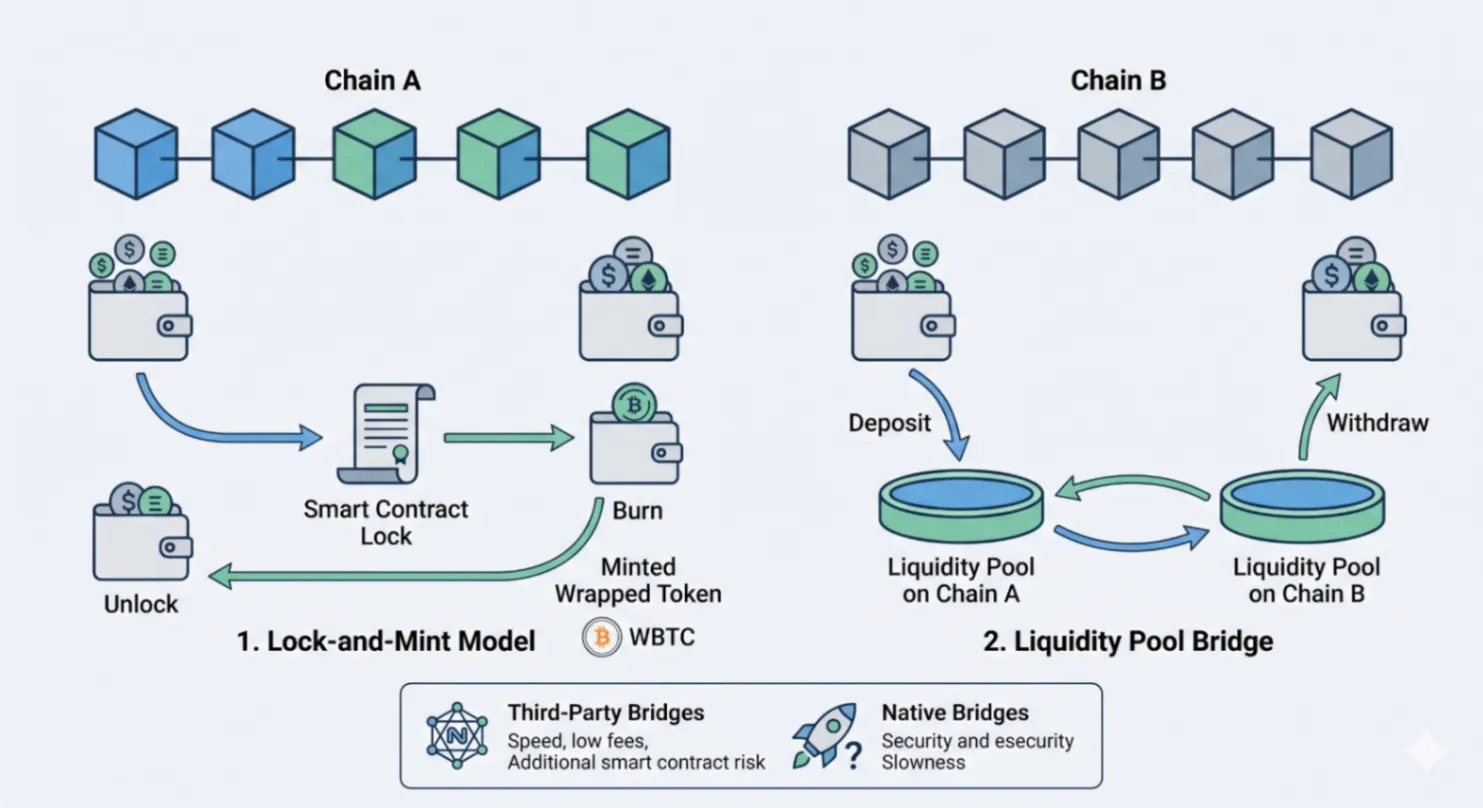
The most common bridge architecture works on a lock-and-mint basis. When you bridge an asset from Chain A to Chain B, your original tokens are locked (held in a smart contract) on Chain A. An equivalent number of "wrapped" tokens are then minted on Chain B, representing your claim on the locked originals. To bridge back, the wrapped tokens are burned and the originals are unlocked.
For example, Wrapped Bitcoin (WBTC) on Ethereum follows this model — actual Bitcoin is locked in custody, and an ERC-20 token is issued on Ethereum representing it.
Liquidity Pool Bridges
An alternative architecture uses liquidity pools on both chains. When you transfer assets, you are actually withdrawing from a pool on the destination chain while depositing into a pool on the source chain. This model is faster but depends on available liquidity — if a pool is depleted on one side, transfers may be delayed or more expensive.
Native Bridge vs. Third-Party Bridge
Many blockchain networks operate their own official bridge (the native bridge) for transferring assets to and from their chain. Third-party bridges may offer faster speeds, lower fees, or support for more chains but introduce additional smart contract risk. Native bridges are generally considered more secure but can be slower.
Cross-Chain Risks to Understand
Important: Bridges represent some of the most significant security risks in the crypto ecosystem. Some of the largest hacks in crypto history have targeted bridge smart contracts.
Smart Contract Risk
Bridges are complex smart contracts, and complex smart contracts can have vulnerabilities. Several bridges have been exploited for hundreds of millions of dollars. When selecting a bridge, prioritise those that have undergone multiple independent security audits.
Wrapped Asset Risk
Wrapped tokens depend on the continued security of the bridge that issued them. If a bridge is compromised and locked assets are stolen, the wrapped tokens on the destination chain become worthless. Understanding whether an asset is native or wrapped is important context.
Finality and Confirmation Time
Cross-chain transfers typically take longer than on-chain transactions. Some bridges require waiting for multiple block confirmations on the source chain before releasing funds on the destination. This can range from minutes to hours depending on the networks involved.
When Does Cross-Chain Transfer Make Sense?
- When the cost saving from moving to a cheaper chain exceeds the bridge fee
- When a specific DeFi opportunity on another chain justifies the complexity
- When managing a multi-asset portfolio that genuinely spans multiple networks
- When onboarding from a chain where you received assets into the ecosystem where you operate most
For many casual crypto users, cross-chain transfers are not a frequent necessity. For power users managing assets across ecosystems, they are a routine part of portfolio management.
Managing Cross-Chain Assets with a Multi Asset Crypto Wallet
A multi asset crypto wallet like DokWallet simplifies cross-chain asset management by providing a unified view of holdings across all supported blockchains. While the bridging transactions themselves happen through bridge protocols, having all assets visible in a single interface makes it practical to track balances, monitor transactions, and manage the full portfolio.
DokWallet's non-custodial architecture means that as you move assets across chains, you maintain self-custody throughout. No intermediary takes control of your funds during the process.
Conclusion
Cross-chain crypto transfers are a powerful capability that unlocks the full potential of a multi-blockchain ecosystem. They come with genuine risks — primarily smart contract risk in bridge protocols — but those risks can be managed through careful bridge selection, size management, and understanding the mechanics before transacting.
For users with a multi-chain portfolio, pairing bridge knowledge with a robust multi asset crypto wallet like DokWallet provides both the operational capability and the self-custody security needed to navigate the cross-chain landscape confidently.