How to Choose the Best Mobile Crypto Wallet
Your choice of mobile crypto wallet is arguably the most important decision in your crypto setup. It is the interface through which you manage, send, receive, and interact with your digital assets every day. Get it right and you have a secure, capable tool that grows with your needs. Get it wrong and you face compromised security, poor user experience, or both.
This guide covers every relevant criterion for evaluating a mobile crypto wallet app in 2026 and explains what separates genuinely excellent options from mediocre ones.
The Non-Negotiable Criteria
1. Non-Custodial Architecture
The best mobile crypto wallet must be non-custodial. This is the baseline requirement, not a premium feature. A custodial mobile wallet simply recreates the risk of an exchange app — the company controls your keys, and you are trusting a third party with your assets.
In a non-custodial wallet, your private keys are generated and stored on your device. The wallet application never transmits them. This is the only architecture consistent with actual crypto ownership.
2. Open-Source Codebase
Security claims require verification. A wallet claiming to be secure cannot prove that claim unless its source code is publicly available for independent audit. Open-source wallets can be reviewed by security researchers worldwide, and vulnerabilities discovered can be reported and fixed transparently.
Closed-source wallets ask you to trust their security on faith. Given what is at stake, open-source is the appropriate standard for any serious blockchain wallet app.
3. Multi-Chain Support
In 2026, a mobile crypto wallet that only supports one or two blockchains is already out of date. The ecosystem spans dozens of significant networks and thousands of tokens. Your wallet should support Bitcoin, Ethereum, major EVM-compatible chains (BNB Chain, Polygon, Avalanche, etc.), and ideally continue expanding its network support.
4. Seed Phrase Security
Every non-custodial wallet uses a seed phrase. What matters is how the wallet handles it: it should be generated on-device, displayed once for you to write down, and never stored or transmitted by the application. Look for wallets that explicitly disable screenshots during seed phrase display — a small but meaningful security detail.
Usability Criteria That Actually Matter
Onboarding Experience
The best mobile crypto wallets make setup fast, guided, and secure. You should be able to create a wallet, back up your seed phrase, and receive your first asset within five minutes. Complexity that is not necessary during onboarding is a product failure.
Transaction Clarity
Every transaction should be clearly presented before you confirm it: recipient address, amount, network fee, and which chain the transaction is on. Ambiguous transaction details are how users make costly mistakes.
Fee Estimation
Good wallets offer clear gas fee estimation and, ideally, options to adjust speed vs. cost. This is particularly important on Ethereum, where gas fees can vary dramatically. Some wallets also support fee-bumping for pending transactions — an important feature for EVM chain users.
Token Management
The wallet should automatically detect and display tokens when they are deposited, rather than requiring users to manually add contract addresses for every asset. Custom token support is important for users of newer or more obscure assets.
Advanced Features Worth Evaluating
WalletConnect Support
WalletConnect allows you to connect your mobile wallet to desktop DApps by scanning a QR code. This is how you use DeFi protocols, NFT platforms, and other decentralised applications without ever exposing your private keys. A modern blockchain wallet app without WalletConnect is missing a fundamental capability.
Built-in Swap Functionality
Many mobile wallets now offer in-app swaps — trading one token for another without leaving the wallet interface. This adds significant convenience for portfolio management, though users should compare rates against standalone DEX aggregators for larger swaps.
Buy Crypto Integration
A wallet that integrates fiat-to-crypto purchase options (via card payment through third-party providers) provides a more complete experience. It removes the need to use an exchange and then transfer funds to your wallet for every purchase.
Multiple Wallet Support
Power users often manage multiple wallets for different purposes — separate wallets for DeFi activity, long-term storage, day-to-day spending, and so on. A wallet that supports multiple wallets within a single app, each with its own keys, is a significant practical advantage.
Red Flags to Avoid
- Wallets that claim to be non-custodial but have no open-source codebase to verify the claim
- Applications with a history of security incidents that were not transparently communicated
- Wallets that require excessive permissions on your device beyond what is necessary
- Platforms that charge ongoing subscription fees for basic wallet functionality
- Applications with no customer support documentation and no community presence
Why DokWallet Stands Out
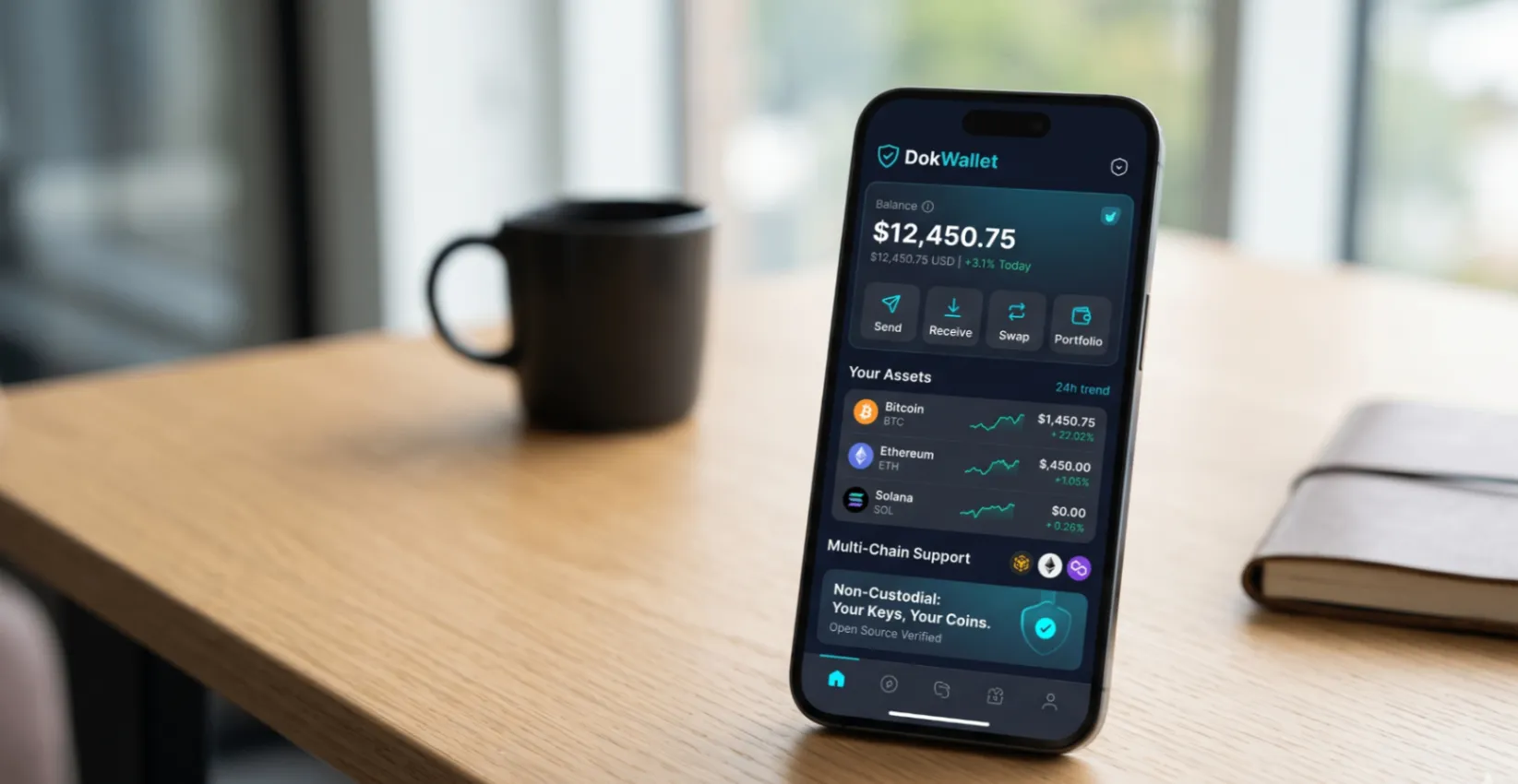
DokWallet is a non-custodial, open-source mobile crypto wallet available on iOS and Android. Its code is publicly available on GitHub for independent review. It supports Bitcoin, Ethereum, and a broad range of tokens across multiple chains in a unified, clean interface.
Key practical features include: multiple wallet support within a single app, WalletConnect integration for DApp connectivity, built-in swap functionality, buy crypto via credit card through vetted third-party providers, and HD wallet technology generating a single seed phrase that covers all supported chains.
The onboarding experience is designed to be genuinely accessible — the steps to create, secure, and start using a DokWallet take minutes, not hours.
Conclusion
The best mobile crypto wallet in 2026 is non-custodial, open-source, multi-chain, and genuinely easy to use without compromising on security. These are not contradictory requirements — they are what well-designed wallet applications deliver.
Evaluate your options against these criteria, and you will find the choices narrow considerably. What remains is a short list of applications that take both security and usability seriously. DokWallet is built to meet every criterion on that list.