Cross-Chain Crypto Wallets Explained
One of the most significant limitations in the early development of cryptocurrency was the siloed nature of individual blockchains. Bitcoin existed on the Bitcoin network. Ethereum assets existed on the Ethereum network. Moving value between these ecosystems required going through centralised exchanges, a process that introduced friction, cost, custodial risk, and significant delays.
Cross-chain technology has fundamentally changed this. Today it is possible to move assets between different blockchain networks directly, without relying on centralised intermediaries. A cross-chain crypto wallet puts this capability in the hands of every user, making the entire blockchain ecosystem more interconnected, more accessible, and more useful.
What Does Cross-Chain Mean?
The term cross-chain refers to the ability to transfer assets, data, or value between two or more different blockchain networks. Because blockchains are fundamentally independent systems with their own protocols, consensus mechanisms, and native assets, they do not natively communicate with each other. Cross-chain technology builds bridges between these isolated networks.
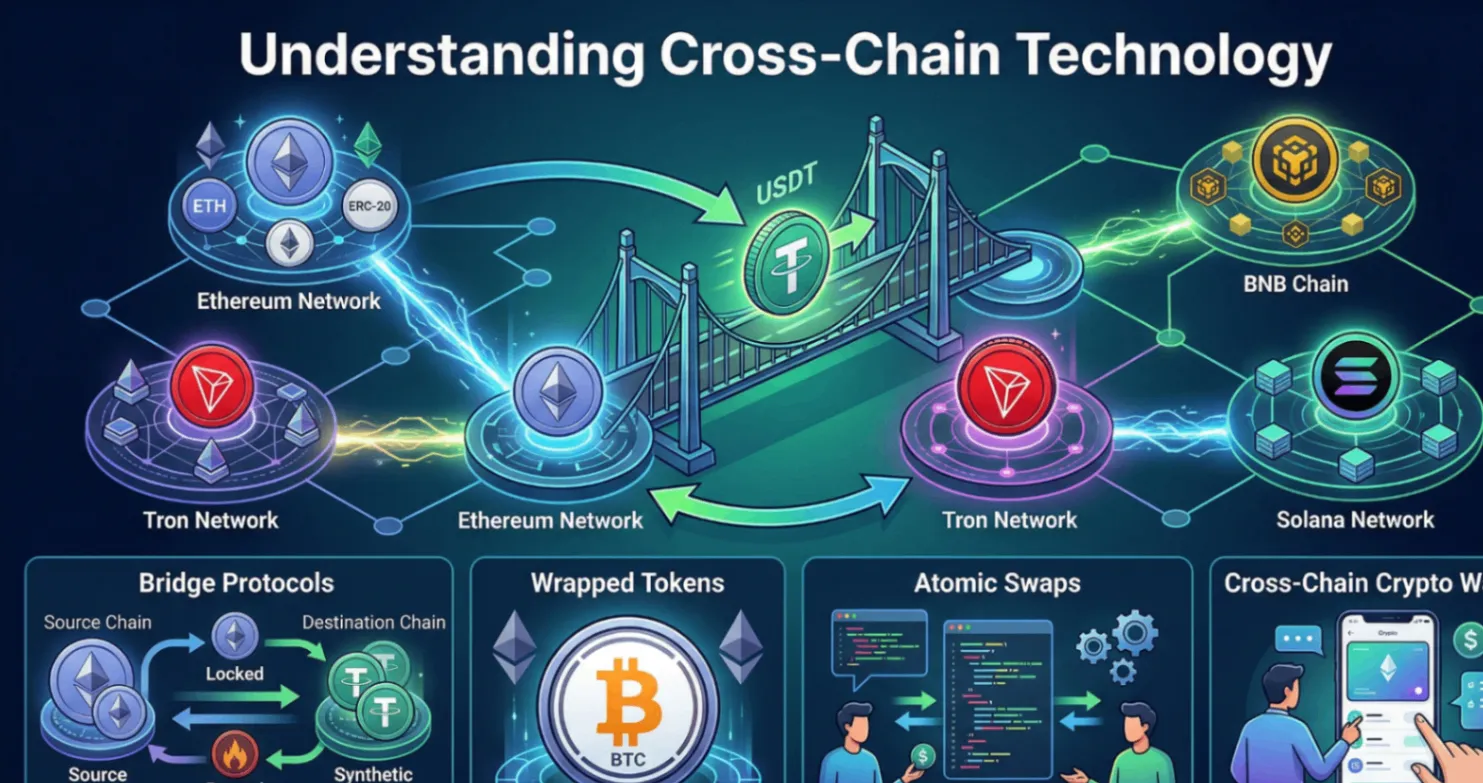
To illustrate why this matters, USDT is one of the most widely used stablecoins in the world, but it exists on multiple blockchains simultaneously, including Ethereum, Tron, BNB Chain, and Solana. Moving USDT from the Ethereum network to the Tron network is a cross-chain transaction. Without cross-chain capability, this transfer would require converting to another asset, sending to an exchange, converting again, and withdrawing to the destination network. Cross-chain technology enables this transfer to happen directly, with dramatically reduced friction.
How Cross-Chain Transfers Work
Bridge protocols are the most widely used mechanism for cross-chain transfers. A bridge locks assets on the source blockchain and issues equivalent representations of those assets on the destination blockchain. When you want to move assets back, the process reverses. The assets on the destination chain are burned or returned, and the locked assets on the source chain are released.
Wrapped tokens represent another approach, where assets from one blockchain are represented as tokens on another. Wrapped Bitcoin on Ethereum is an ERC-20 token backed one to one by Bitcoin, enabling Bitcoin's value to be used within Ethereum's DeFi ecosystem.
Atomic swaps enable direct peer-to-peer exchanges between different blockchain assets without any intermediary, using smart contracts that ensure either both sides of the trade complete or neither does.
A well-designed cross-chain crypto wallet abstracts much of this technical complexity, enabling users to initiate cross-chain transfers through a simple, unified interface without needing to understand the underlying mechanisms in detail.
Why Cross-Chain Capability Matters
For traders and investors, cross-chain capability means that assets are not trapped in a single ecosystem. Capital can flow to wherever the best opportunities exist, whether that is a DeFi protocol on Ethereum, a yield farming opportunity on Avalanche, or a trading pair on BNB Chain.
For DeFi participants, cross-chain access dramatically expands the range of protocols and opportunities available. Rather than being limited to what is available on a single blockchain, users can engage with the full landscape of decentralised finance across multiple networks.
For businesses and payment applications, cross-chain capability enables the acceptance and management of assets across multiple networks, which is increasingly important as different user communities operate on different blockchains. To understand the full payment picture, explore our guide on cross-border crypto payments and how DokWallet supports them.
The Multi-Asset Dimension
Cross-chain capability and multi-asset support are closely related but distinct concepts. A multi-asset crypto wallet supports multiple types of assets, including different tokens on the same blockchain. A cross-chain wallet extends this further by enabling movement between different blockchain networks.
DokWallet combines both capabilities within a single application. Users benefit from broad asset support across all supported networks, as well as the cross-chain mobility necessary for full participation in the modern crypto ecosystem.
Evaluating Cross-Chain Wallet Security
Cross-chain technology introduces specific security considerations that users should understand. Bridge protocols have been targets of significant exploits in the history of DeFi, with several high-profile bridge incidents resulting in substantial losses.
When evaluating a cross-chain crypto wallet, relevant security considerations include the audit history of bridge protocols used for cross-chain transfers, the degree to which cross-chain operations require trust in a centralised operator versus operating in a truly decentralised manner, and the transparency of the cross-chain mechanisms used.
DokWallet's approach to cross-chain functionality is grounded in the same non-custodial security principles that govern the rest of the application. Users retain control of their private keys throughout every operation. For more on how DokWallet handles security across its full feature set, visitdokwallet.com.
Cross-Chain Transfers in Practice
For a user of DokWallet, initiating a cross-chain transfer involves selecting the asset you wish to move, the source network it currently resides on, and the destination network you wish to move it to. The application handles the technical complexity of the cross-chain operation, presenting the user with clear information about fees, estimated transfer times, and the expected outcome before any operation is confirmed.
This streamlined experience is what distinguishes a well-designed cross-chain wallet from attempting to navigate cross-chain transfers manually using browser-based bridges, which are considerably more complex and error-prone for the average user.
Final Thoughts
A cross-chain crypto wallet is no longer a specialist tool for advanced users. It is the practical foundation for engaging with a multi-blockchain world where the most valuable applications, assets, and opportunities are distributed across different networks.
DokWallet provides cross-chain capability within a non-custodial, mobile-first application designed for real-world use, making the full scope of the blockchain ecosystem accessible to every user regardless of their technical background.
Download DokWallet at dokwallet.com and move assets across blockchains with confidence and simplicity..
Frequently Asked Questions
What does cross-chain mean in crypto?
Cross-chain refers to the ability to transfer assets or data between two different blockchain networks. Because blockchains are independent systems that do not natively communicate with each other, cross-chain technology builds bridges between them to enable direct asset movement.
How does a cross-chain transfer work?
Most cross-chain transfers use bridge protocols that lock assets on the source blockchain and issue equivalent representations on the destination blockchain. When you reverse the transfer, the destination assets are returned and the locked source assets are released.
Are cross-chain transfers safe?
Cross-chain bridge protocols have been targets of significant exploits historically. DokWallet’s approach to cross-chain functionality is grounded in non-custodial security principles, and all transaction details including fees, transfer times, and expected outcomes are shown clearly before you confirm any operation.
What is the difference between a multi-chain wallet and a cross-chain wallet?
A multi-chain wallet manages assets across multiple blockchain networks. A cross-chain wallet additionally enables you to move those assets between networks. DokWallet combines both capabilities, letting you manage and transfer assets across all supported chains from a single application.
Can I move USDT between different blockchains using DokWallet?
Yes. USDT exists on multiple blockchain networks including Ethereum, Tron, BNB Chain, and others. DokWallet’s cross-chain functionality enables you to move stablecoins like USDT between supported networks directly from within the application.