Decentralized Crypto Wallet vs Custodial: Which Is Actually Right for You?
The choice between a decentralized crypto wallet and a custodial alternative is one of the most consequential decisions you will make as a crypto user. It determines who controls your assets, what risks you carry, what privacy you retain, and what happens to your funds when something goes wrong. It is not a technical question — it is a question about values, risk tolerance, and how seriously you take ownership.
This article walks through both models in depth, explains the real-world implications of each, and helps you determine which approach fits your circumstances.
Defining the Models
What Is a Custodial Wallet?
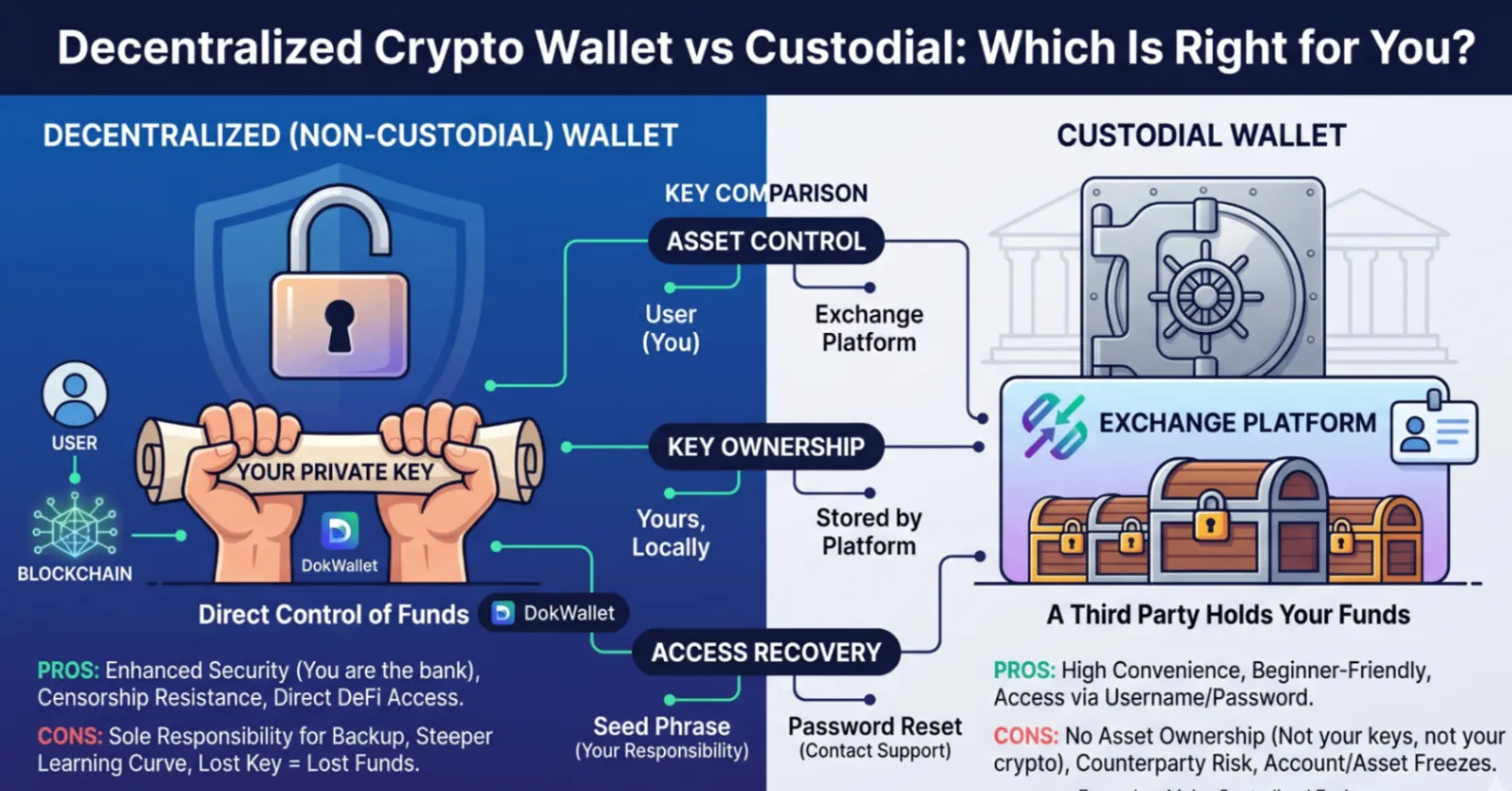
A custodial wallet is one where a third party — typically a centralised cryptocurrency exchange — holds your private keys on your behalf. You log in with a username and password, see a balance, and can request the platform to execute transactions. But the underlying assets are controlled by the platform, not by you.
Examples include wallets provided by major exchanges. They are convenient, support easy fiat on-ramps, and can reset access if you forget your password. They also mean you are trusting the platform with your funds.
What Is a Decentralized Crypto Wallet?
A decentralized crypto wallet, also called a non-custodial wallet, gives you direct control of your private keys. There is no company holding your assets. Transactions are signed locally on your device. The wallet application (such as DokWallet) is software that helps you interact with blockchains, but it holds no authority over your funds.
Comparing the Two Models Across Key Dimensions
Asset Control
In a custodial wallet, the platform controls your crypto. If they decide to freeze your account — due to regulatory pressure, suspicious activity flags, or their own operational decisions — you lose access. There have been multiple documented cases of exchanges freezing accounts with no clear explanation and no immediate recourse.
In a decentralized wallet, no one can freeze your assets. There is no account to lock. Transactions require your private key, which only you hold.
Security Model
Custodial platforms concentrate risk. A successful hack of an exchange affects every user simultaneously. The history of crypto includes numerous exchange hacks resulting in significant user fund losses.
Decentralized wallets distribute risk to individuals. An attacker would need to compromise your specific device or extract your specific seed phrase — a targeted attack rather than a mass breach.
Privacy
Custodial platforms require Know Your Customer (KYC) verification — submitting government ID, proof of address, sometimes a selfie. Your transaction history is known to the platform and potentially shared with regulatory bodies.
A decentralized wallet app like DokWallet requires no identity verification whatsoever. You download the app, generate a wallet, and start using it — anonymously.
Recovery
Forget your exchange password? The platform has a reset mechanism. This is convenient, but it is convenient because the platform controls your account. They can grant you access, which means they can also revoke it.
Forget your decentralized wallet password? You use your seed phrase to recover. The seed phrase is the only recovery mechanism — there is no customer service, no reset email, and no appeal process. This is both the strength and the responsibility of self-custody.
DeFi and DApp Compatibility
Decentralized finance protocols, NFT platforms, and blockchain-based games require you to connect your own wallet. Custodial exchange wallets are not compatible with DApps. If you want to use the decentralized ecosystem, you need a decentralized wallet.
DokWallet supports WalletConnect, allowing you to connect to DApps by scanning a QR code — no typing of private keys, no complex configuration.
When a Custodial Wallet Makes Sense
There are legitimate use cases for custodial accounts:
- Active trading: If you are day-trading on an exchange, keeping some funds in a custodial account on that exchange is operationally necessary
- Fiat on-ramps: Buying crypto with a bank card or bank transfer typically requires a custodial platform
- Beginners who are not yet ready to manage seed phrase security
The key point is that custodial accounts should be used for what they are designed for — trading and purchasing. Long-term holdings belong in self-custody.
When a Decentralized Wallet Is the Right Choice
For most serious crypto users, a decentralized crypto wallet is the correct long-term answer:
- Holding assets for months or years without actively trading
- Interacting with DeFi, DApps, or NFT platforms
- Prioritising privacy and not wanting to submit KYC documentation
- Managing assets across multiple blockchains in a single interface
- Anyone who cannot afford to lose access to funds due to platform decisions
DokWallet: A Non-Custodial Wallet App Built for Everyday Use
DokWallet is designed to remove every unnecessary barrier between the user and self-custody. Available on iOS and Android, it supports Bitcoin, Ethereum, and a broad range of tokens and chains in a single application. The codebase is open source, the design is mobile-first, and the setup process — including seed phrase generation and backup — takes less than five minutes.
For users who want the security of self-custody without the complexity often associated with it, DokWallet represents the practical middle ground: professional-grade security in an accessible, everyday interface.
Conclusion
The debate between custodial and decentralized wallets ultimately comes down to a single question: how much do you trust a third party with your assets? For those who have experienced or studied the history of exchange failures, hacks, and account freezes, the answer tends to be: not enough.
Self-custody through a decentralized wallet is the only model that gives you genuine ownership of your crypto. DokWallet makes that ownership accessible, private, and practical — regardless of your technical background.