DeFi Wallets Explained: How to Safely Connect to Decentralized Finance
Decentralized finance has created an entirely new financial system — one that operates without banks, brokers, or intermediaries. Lending, borrowing, trading, and earning yield are all available to anyone with an internet connection and a crypto wallet. But participating in DeFi requires the right wallet, a clear understanding of how connections work, and a realistic view of the risks involved.
This guide explains what DeFi is, what makes a wallet capable of accessing it, how WalletConnect works in practice, and the security practices that separate users who thrive in DeFi from those who lose funds to avoidable mistakes.
What Is DeFi and Why Does It Matter?
Decentralized finance refers to financial services built on blockchain smart contracts rather than traditional institutions. There is no bank issuing loans, no exchange holding your funds, and no company setting the rules. Instead, protocols run autonomously by code execute every transaction according to rules that are publicly visible and immutable once deployed. When you swap tokens on a decentralized exchange, the trade executes through a smart contract — no company needs to approve or process it.
The key categories of DeFi cover almost every financial function that traditionally required an institution. Decentralized exchanges (DEXs) allow token swaps without a centralized order book. Lending and borrowing protocols let users earn interest on deposits or take out loans against crypto collateral. Yield farming involves providing liquidity to protocols in exchange for token rewards. Derivatives platforms offer exposure to price movements without holding underlying assets. Each of these services runs on-chain, with no application form, no credit check, and no jurisdiction restriction.
The significance of this is difficult to overstate. Anyone with a compatible wallet can participate in global financial markets that previously required institutional access. A user in any country can lend stablecoins and earn yield, swap tokens at market rates, or provide liquidity to a pool — all within minutes of setting up a non-custodial wallet. DeFi is not a niche experiment; it handles billions of dollars in daily transaction volume across dozens of major protocols.
What Makes a Wallet a DeFi Wallet?
The term "DeFi wallet" is not a technical category — it is a description of capability. Any non-custodial wallet that supports WalletConnect and EVM-compatible chains can function as a DeFi wallet. The critical requirements are: you must control the private keys (non-custodial), the wallet must support the chains where DeFi protocols live, and it must be able to sign and broadcast smart contract transactions on your behalf.
A common misconception is that DeFi wallets store your DeFi positions. They do not. When you deposit tokens into Aave, your position exists in the Aave smart contract on the Ethereum blockchain — not in your wallet app. Your wallet holds the private key that proves ownership of the address which has that Aave position. The wallet is the interface and the signing key; the state of your DeFi holdings lives on-chain and will remain there regardless of which wallet app you use to access it. If you lose your wallet app but retain your seed phrase, you can restore access to all your DeFi positions from any compatible wallet.
This architecture has important implications. Switching wallets does not move your DeFi positions — it just changes the tool you use to interact with them. And compromising your seed phrase gives an attacker access to every DeFi position associated with your address, not just the tokens sitting idle in your wallet. Seed phrase security is DeFi security.
How WalletConnect Works
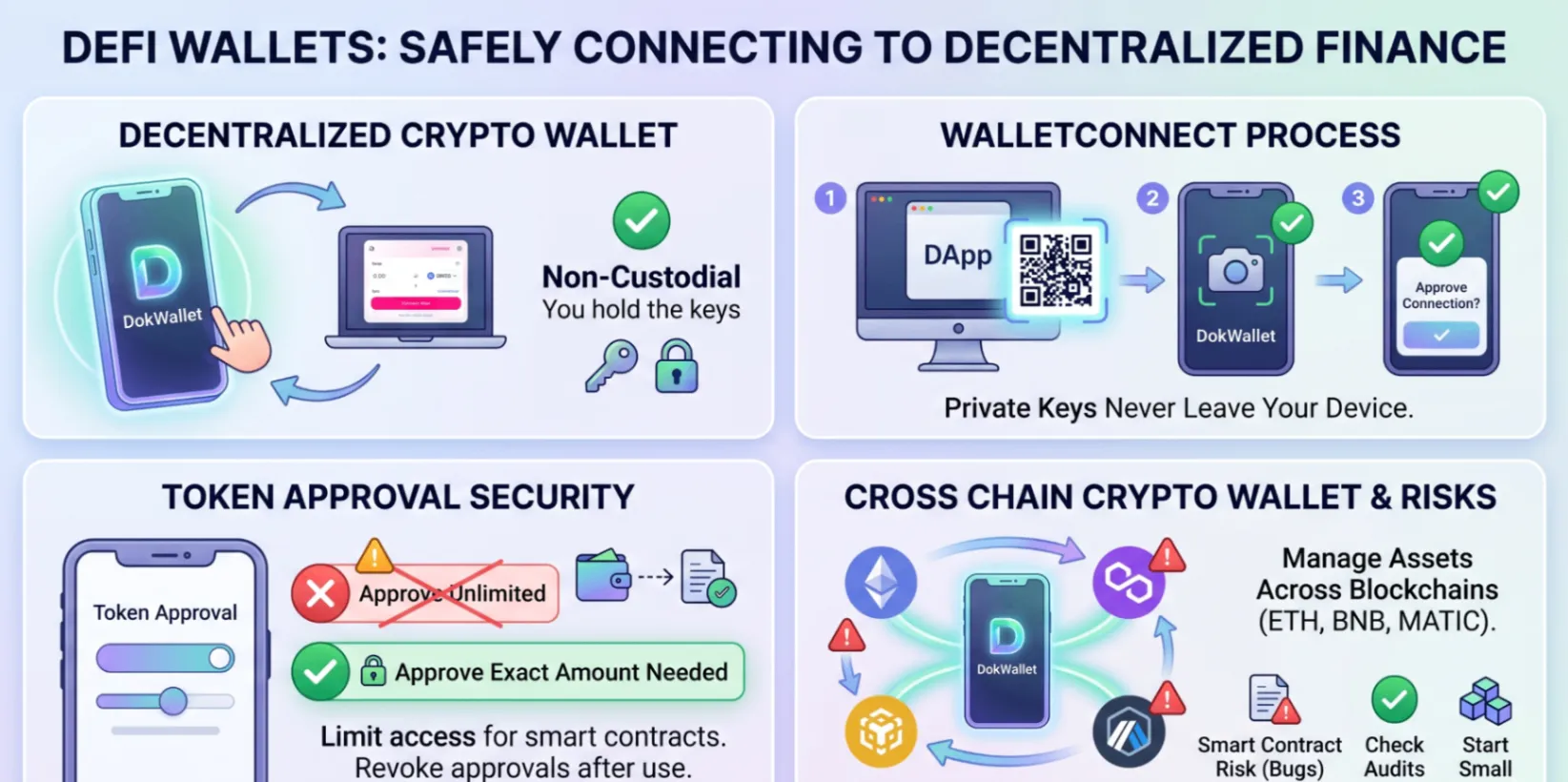
WalletConnect is an open protocol that allows mobile wallets to communicate securely with web-based decentralized applications. Rather than requiring you to import your private key into a browser extension, WalletConnect lets your mobile wallet remain the secure signing authority while a DApp on any device can request transactions from it. The private key never leaves your wallet under any circumstances — the DApp only ever receives the signed transaction output.
The connection process works as follows. When you visit a DeFi protocol and click to connect your wallet, the DApp generates a QR code or a WalletConnect URI. You scan this QR code with your mobile wallet app, or paste the URI into the wallet if connecting on the same device. This establishes an encrypted peer-to-peer session between the DApp and your wallet. From that point, any action you take on the DApp that requires a transaction — a swap, a deposit, an approval — generates a signing request that appears on your wallet for review. You see the transaction details and choose to sign or reject it. If you sign, the wallet broadcasts the signed transaction to the blockchain. If you reject, nothing happens.
DokWallet supports WalletConnect v2, which is the current protocol version and is required by all major DeFi protocols. This means users can connect DokWallet to Uniswap, Aave, Curve, Compound, and hundreds of other protocols without any additional configuration. The session persists until you actively disconnect it, and you can manage and disconnect active sessions directly from within the wallet app.
Types of DeFi Protocols and What to Expect
Decentralized exchanges such as Uniswap, Curve, and PancakeSwap allow you to swap tokens directly from your wallet. You connect via WalletConnect, select the tokens you want to exchange, review the quoted rate and estimated gas fee, and approve the transaction. The swap executes through an automated market maker — a smart contract that holds token reserves and prices trades algorithmically. Every swap incurs a gas fee paid to the network validators, plus a small protocol fee that goes to liquidity providers.
Lending protocols like Aave and Compound allow you to deposit assets into a lending pool and earn variable interest, or borrow assets against deposited collateral. Borrowing in DeFi is over-collateralized — you must deposit more value than you borrow. This creates liquidation risk: if the value of your collateral falls below a defined threshold relative to your loan, the protocol can automatically liquidate part of your collateral to repay the loan. Understanding liquidation thresholds before borrowing is essential.
Yield farming involves depositing token pairs into liquidity pools on DEXs to earn trading fee income and additional protocol token rewards. The key risk specific to liquidity provision is impermanent loss — a reduction in the value of your deposited tokens relative to simply holding them, caused by the ratio of tokens in the pool shifting as prices change. NFT marketplaces like OpenSea and Blur also use WalletConnect for buying and listing NFTs, with gas costs applying to on-chain approvals and purchases.
Smart Contract Risks You Must Understand
DeFi protocols are software, and software can have bugs. Smart contract vulnerabilities have led to some of the largest losses in crypto history — hundreds of millions of dollars drained from protocols by attackers who found and exploited code flaws. Before depositing significant value into any protocol, it is worth checking whether the smart contracts have been audited by reputable security firms, and whether the protocol has a meaningful track record of operating without incidents. Newer protocols with unaudited contracts carry substantially higher risk.
Token approval risk is one of the most misunderstood dangers in DeFi. When a protocol needs to access tokens in your wallet to execute a transaction, it requests an approval — a permission granted through a signed transaction that allows the smart contract to spend up to a specified amount of a given token. Many DApps request unlimited approvals by default, which means the contract can spend as many tokens as you hold, not just the amount needed for the current transaction. If that contract is later compromised or turns out to be malicious, the attacker can drain your entire balance of that token. Revoke unused approvals regularly using tools like revoke.cash or Etherscan's token approval checker.
Rug pulls occur when malicious project developers drain liquidity from a pool they control and disappear. Phishing DApps are fake protocol websites that look identical to legitimate ones — designed to capture seed phrases or trick users into signing malicious transactions that drain their wallets. Oracle manipulation attacks exploit the price feeds that DeFi protocols rely on to value assets, allowing attackers to borrow far more than the collateral is worth in a single block. These risks are real, documented, and ongoing. No amount of DeFi yield is worth dismissing them.
Gas Fee Management in DeFi
DeFi operations consume significantly more gas than simple token transfers because they involve executing complex smart contract logic on-chain. A basic ETH transfer might cost 21,000 gas units, while a token swap on a DEX can cost 150,000 to 300,000 gas units or more, and depositing into a lending protocol may cost even more. During periods of high network congestion on Ethereum mainnet, gas prices can spike dramatically, making routine DeFi operations prohibitively expensive for smaller positions.
The practical solution for most DeFi users is Layer 2 networks. Arbitrum, Optimism, and Polygon offer the same DeFi protocols — or equivalent alternatives — at a fraction of the gas cost, because they process transactions off the main Ethereum chain and batch them for settlement. Many major protocols including Uniswap and Aave are deployed on multiple Layer 2 networks, allowing users to choose the most cost-effective execution environment for their transaction size. Bridging assets to Layer 2 carries its own fees and a brief delay, but for users who transact frequently, the savings are substantial.
Gas tracker tools such as Etherscan's Gas Tracker show current gas prices and historical patterns, allowing you to identify off-peak hours when fees are lower. Weekday daytime hours in the US and Europe tend to be peak congestion periods; late night and early morning UTC often offer meaningfully lower fees. DokWallet displays estimated gas costs for every transaction before you confirm, giving you the information you need to decide whether to proceed or wait for conditions to improve.
Safe DeFi Practices
The single most important safety habit for DeFi users is URL verification. Phishing sites targeting DeFi users are sophisticated, well-funded, and constantly being created. They use domain names that differ from the legitimate protocol by a single character, and their interfaces are pixel-perfect copies. The only reliable defense is to bookmark official URLs from the protocol's official documentation or verified social media accounts, and always navigate to DeFi protocols from those bookmarks — never from links in Discord messages, emails, or search engine results.
Start small with any new protocol. Before committing a significant amount to a DeFi position, test the full workflow with a small amount you are comfortable losing entirely. This validates that you understand the mechanics, that the protocol behaves as expected, and that you are interacting with the legitimate contract. The cost of the test transaction is cheap insurance against a much larger mistake. Read every transaction detail that your wallet shows you before signing — if you do not understand what a transaction is asking you to approve, do not sign it.
Disconnect your wallet from DApps when you are not actively using them. An active WalletConnect session is a potential attack surface if a DApp is compromised after you connect. Regularly audit and revoke token approvals — this is especially important after interacting with newer or less-established protocols. And never, under any circumstances, enter your seed phrase on any website for any reason. No DeFi protocol, no support channel, and no legitimate service of any kind will ever require your seed phrase.
DokWallet for DeFi
DokWallet is built with DeFi participation in mind. WalletConnect v2 support means users can connect to all major DeFi protocols directly from the app without needing a separate browser extension wallet. The connection flow is straightforward: scan a QR code or paste a WalletConnect URI, review the session details, and approve. From that point, all transaction requests from the DApp appear in DokWallet for review and signing.
Multi-chain support is a significant advantage for DeFi users who operate across networks. DokWallet supports Ethereum, BNB Chain, Polygon, and Avalanche from a single wallet, meaning you can access DeFi protocols on each of these chains without managing separate wallets or seed phrases. Assets on each chain are visible in the unified dashboard, and switching between chains for DeFi interactions requires only selecting the appropriate network context.
Because DokWallet is non-custodial, your DeFi positions are always under your direct control. There is no company that can freeze your assets, restrict your access to protocols, or require KYC to interact with DeFi. Every transaction is signed by your private key, which never leaves your device. Transaction details are clearly displayed before every confirmation, giving you the information you need to make an informed decision about every DeFi interaction.
Conclusion
DeFi represents a genuinely new approach to finance — open, permissionless, and accessible to anyone with a compatible wallet. But access without understanding is dangerous. The same openness that makes DeFi powerful also means there is no recourse if you make a costly mistake, sign a malicious transaction, or interact with a compromised protocol. The users who participate successfully in DeFi are those who take the time to understand the mechanics before committing significant funds.
The fundamentals are learnable: understand WalletConnect and how signing works, know the difference between the wallet interface and on-chain positions, manage gas fees thoughtfully by using Layer 2 networks, stay vigilant about URL verification and approval management, and always verify transaction details before signing. With a capable non-custodial wallet like DokWallet and a disciplined approach to security, DeFi is accessible and manageable for any motivated user.