DokWallet Review: The All-in-One Crypto Wallet Built for Real Users
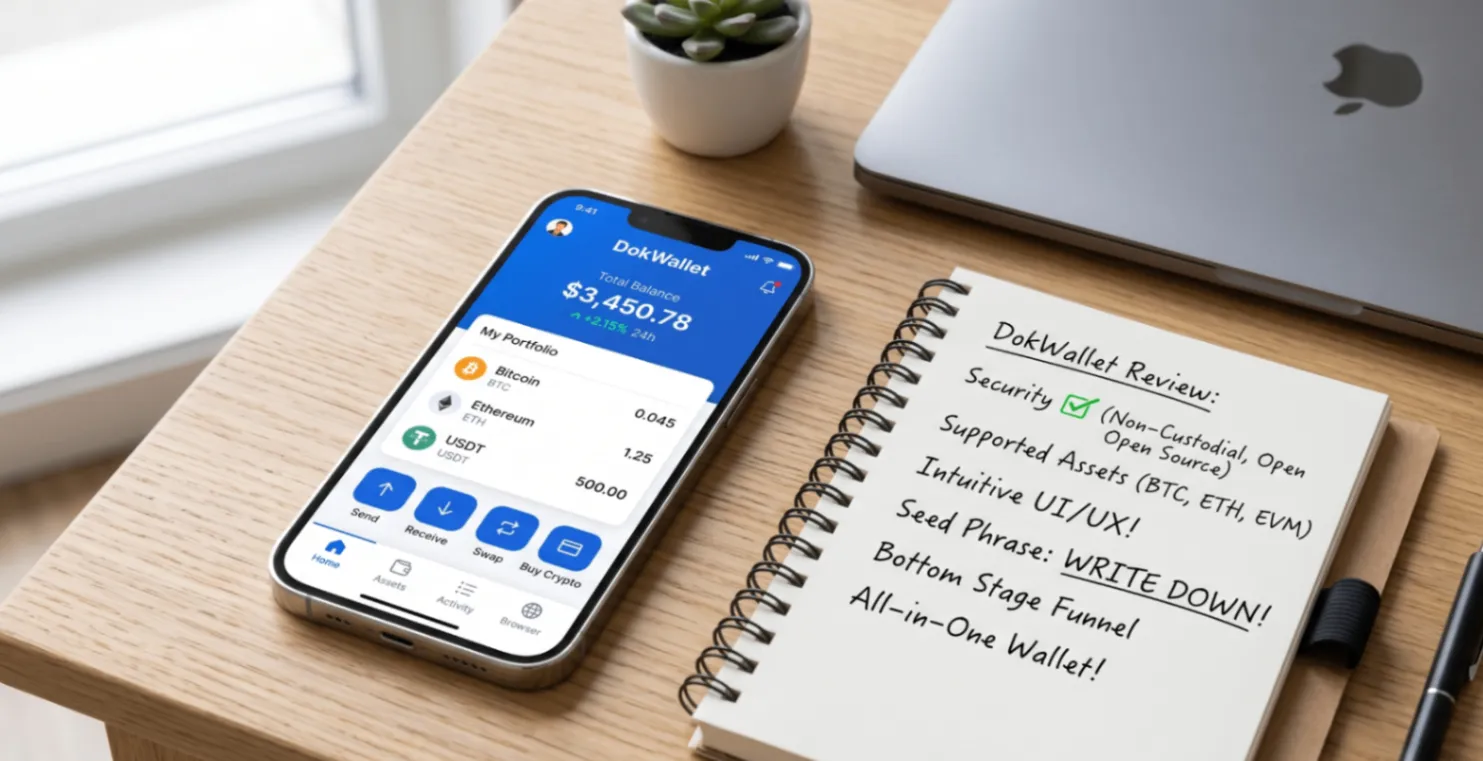
There is no shortage of crypto wallets on the market. What is rare is a wallet that genuinely balances security, usability, and breadth of features without making trade-offs that hurt real users. DokWallet is a non-custodial, open-source crypto wallet available on iOS, Android, and the web — and this review covers every dimension that matters: how it handles security, which chains and assets it supports, what the user experience is actually like, and who it is best suited for.
This is not a promotional summary. It is a structured look at what DokWallet does well, what it is designed to do, and whether it lives up to the standard that serious crypto users should expect from a self-custody wallet in 2026.
Security — The Foundation
Any meaningful review of a crypto wallet has to start with security, because everything else is secondary if your funds can be compromised. DokWallet is non-custodial by design, which means private keys are generated directly on the user's device and are never transmitted to any server. The wallet software facilitates signing transactions locally — the private key itself never leaves the device at any point during normal operation.
The open-source nature of DokWallet's codebase is a significant security advantage. The full source code is publicly available on GitHub, which means security researchers, developers, and informed users can audit exactly how the wallet handles private keys, signs transactions, and manages user data. This is not a claim that has to be taken on faith — it can be independently verified. That level of transparency is the standard that all wallets handling user funds should meet, but many do not.
Seed phrase handling reflects the same security-first approach. When you create a new wallet, the seed phrase is generated entirely on your device. During the display step, screenshots are disabled to prevent accidental capture by screen-recording software or cloud backup services. The phrase is never transmitted to DokWallet's servers — there is no server-side backup of your recovery phrase, which is precisely how it should be for genuine self-custody. The responsibility for storing the seed phrase safely falls entirely on the user, which is the correct design for a non-custodial wallet.
Supported Chains and Assets
DokWallet supports a broad range of blockchain networks, covering the chains that most users actually need. Bitcoin and Ethereum are fully supported, as are BNB Chain, Polygon, Avalanche, and Tron. EVM-compatible chains are handled through a unified framework, which means adding support for newer EVM networks is straightforward for the development team and transparent to users.
For token support, ERC-20 tokens are auto-detected on Ethereum and other supported EVM chains — when you receive a token, it appears in your wallet without requiring manual configuration. For newer or less common assets, DokWallet provides custom token support, allowing users to add any token by contract address. This combination of automatic detection and manual addition covers the vast majority of use cases without requiring users to search for tokens in a registry or wait for the wallet developer to add explicit support.
The multi-chain architecture means users managing assets across different networks do not need multiple wallets. Bitcoin holdings, Ethereum DeFi positions, BNB Chain tokens, and Polygon assets can all be accessed from a single DokWallet installation, each secured by the same seed phrase.
User Experience
DokWallet presents a unified dashboard that shows all assets across all supported chains in one view. Rather than forcing users to switch between network tabs to see their total portfolio, the dashboard aggregates holdings so you can see your complete crypto position at a glance. Individual chain views are available for users who want to drill down, but the default experience is designed around the complete picture.
Setup is fast. The full process — downloading the app, creating a wallet, securing the seed phrase, and making the wallet ready to use — takes under five minutes. The onboarding flow is clearly structured, with explicit guidance at the seed phrase step to ensure users understand what they are being asked to do before proceeding. There is no account registration, no email address required, and no KYC process. The wallet is functional from the moment the seed phrase is secured.
The interface is mobile-first and avoids unnecessary complexity. Technical terminology is used where necessary but is not used to make the product feel more sophisticated than it needs to. Actions like sending, receiving, and swapping are accessible from the main screen without multiple layers of navigation. For users coming from exchange apps, the learning curve is minimal.
One underused feature worth highlighting is support for multiple wallets within a single app installation. Users can create separate wallets for different purposes — a primary wallet for long-term holdings, a secondary wallet for DeFi activity, a third for smaller transactions — without installing multiple apps or managing multiple devices. Each wallet has its own seed phrase and is completely independent.
Key Features
WalletConnect integration is one of DokWallet's most important features for active crypto users. By scanning a QR code or pasting a WalletConnect URI, you can connect DokWallet to any DeFi protocol, NFT marketplace, or Web3 application that supports the standard. This covers the overwhelming majority of the DeFi ecosystem, including Uniswap, Aave, Compound, and hundreds of other protocols. The connection is handled securely through the WalletConnect protocol — your private key never leaves the wallet.
The built-in swap functionality allows users to exchange tokens directly within the wallet, without navigating to an external exchange or DApp. This is useful for routine token swaps where the convenience of staying within a single interface outweighs the marginal rate differences you might find by comparing multiple DEXs manually.
For users who want to move fiat currency into crypto, DokWallet includes an integrated buy crypto feature connected to vetted fiat-to-crypto providers. This removes the friction of separately purchasing crypto on an exchange and transferring it to a self-custody wallet — a workflow that is a significant barrier for many beginners.
Standard send and receive functionality is supported with QR code generation and scanning, making in-person transfers straightforward. An address book allows users to save frequently used addresses, reducing the risk of copy-paste errors on large transactions. For EVM chains, DokWallet also provides the ability to speed up or cancel pending transactions by replacing them with a higher-fee version — a useful tool when network congestion causes transactions to stall.
Who DokWallet Is For
DokWallet is a strong choice for beginners who want a secure and simple starting point for self-custody. The setup process is straightforward, the interface is clean, and the wallet handles the technical complexity of key management transparently. A beginner who has only used exchange apps will find the transition manageable, and the non-custodial architecture means they are building on the right security foundation from the start.
Intermediate users who hold assets across multiple chains will find DokWallet's multi-chain support particularly valuable. Managing Bitcoin, Ethereum, and BNB Chain assets from a single wallet eliminates the overhead of running separate apps and reduces the number of seed phrases to secure. The unified dashboard provides a clear picture of total holdings without requiring manual aggregation.
DeFi users who need reliable WalletConnect support will find DokWallet functions as a capable primary wallet for protocol interactions. The WalletConnect integration is stable, and the mobile-first design means users can interact with DeFi protocols from their phone without switching to a browser extension wallet.
Privacy-conscious users who want genuine self-custody without KYC are also well served. DokWallet requires no personal information at any stage. There is no account to create, no identity to verify, and no data submitted to the wallet provider. The open-source codebase allows users to verify that no data collection occurs at the code level, not just on the basis of a privacy policy.
The Bottom Line
DokWallet meets every serious criterion for a modern self-custody crypto wallet. It is non-custodial — your private keys are generated and stored on your device, never transmitted. It is open source — the codebase is publicly available for independent audit. It supports multiple major chains and a wide range of assets. The user experience is clean and accessible without sacrificing depth for experienced users. And it includes the features that active crypto users actually need: WalletConnect, in-wallet swaps, fiat on-ramp, and EVM transaction management.
DokWallet is available free on iOS and Android, with a web wallet also available for desktop use. For users who want a single wallet that handles the full scope of their crypto activity — from long-term holding to DeFi participation to day-to-day transactions — DokWallet is a well-built, trustworthy choice.