
Open Source Crypto Wallets: Why Transparency Is a Security Feature
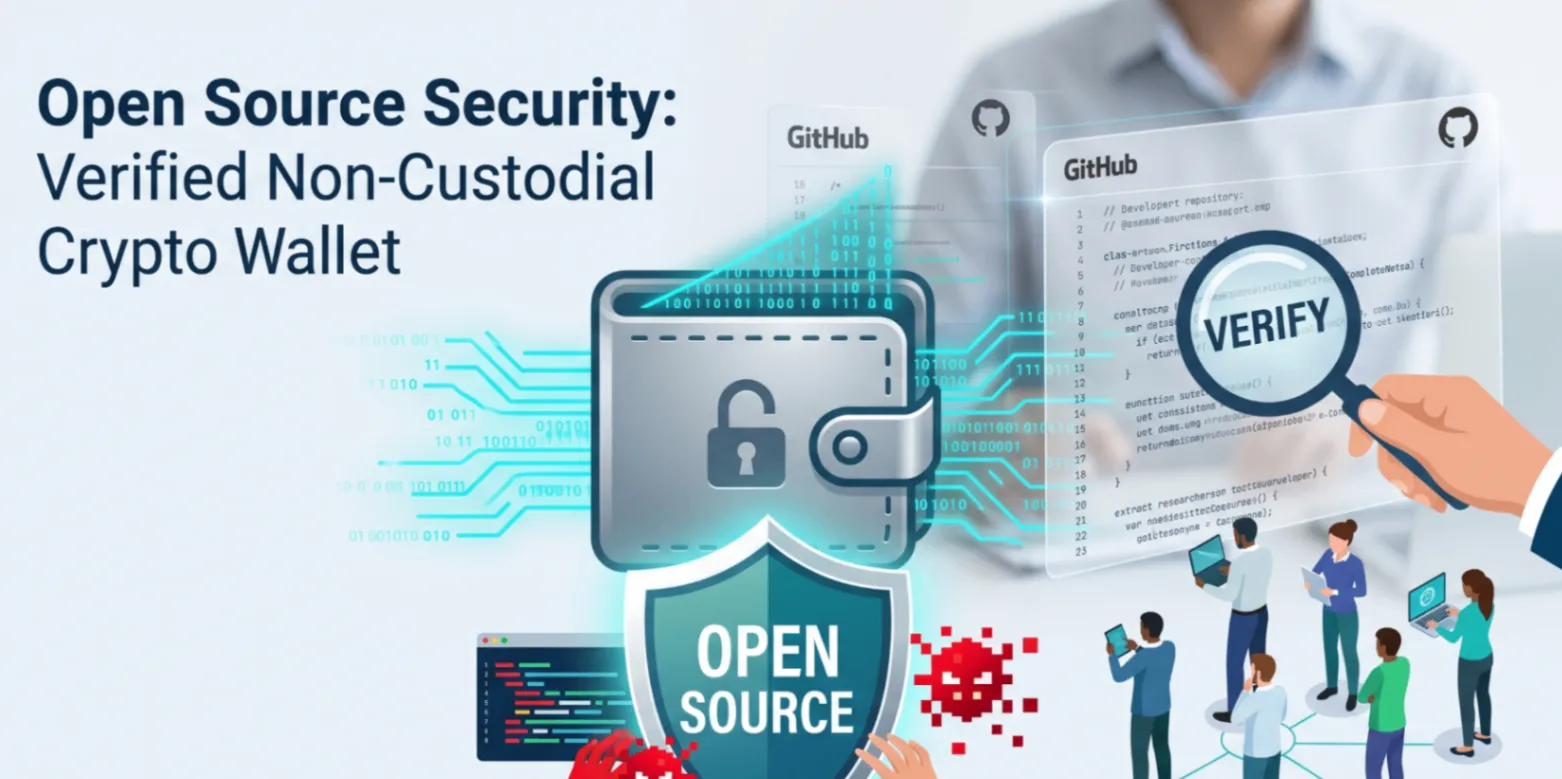
In crypto, security claims are only as valuable as the evidence behind them. Any wallet developer can publish a privacy policy stating that your private keys never leave your device. Any company can describe their security architecture in marketing material. But without the ability to independently verify those claims, users are making a trust-based decision with real financial consequences.
Open source is not a bonus feature for crypto wallets — it is a baseline requirement for any wallet that takes its security posture seriously. This article explains what open source actually means in the context of crypto wallets, why closed-source wallets represent a structural risk, what open source genuinely proves (and what it does not), and how DokWallet implements transparency as a core part of its security architecture.
What Open Source Means in the Context of Crypto Wallets
Open source software means the source code is publicly available. Anyone can read it, review it, copy it, and build upon it. In most software contexts, open source is primarily a licensing and collaboration model. In the context of crypto wallets, it has a specific and critical security implication: it means users and independent researchers can verify exactly how the wallet handles private keys, constructs transactions, and processes user data.
For a crypto wallet, the questions that matter most are: Does the wallet generate keys locally or on a server? Does it transmit the private key or seed phrase anywhere? What data does it send to the developer's servers, if any? Does it sign transactions locally or does signing involve a remote service? Open source code allows these questions to be answered with certainty rather than inference. A security researcher can read the key generation routine, trace the transaction signing flow, and examine every network call the application makes.
The contrast with closed-source wallets is stark. A closed-source wallet asks you to trust the developer's word without any means of verification. You cannot inspect how keys are handled. You cannot confirm that a "non-custodial" claim is technically accurate. You cannot know what the app transmits to remote servers. For a piece of software that controls access to your financial assets, that is an unreasonable position to put users in.
Why Closed-Source Wallets Are a Risk
The risks of closed-source crypto wallets are not theoretical. A closed-source wallet claiming to be non-custodial cannot be verified as such. The private key handling routine is hidden. There is no way to confirm that keys are generated on-device rather than on a server that the developer controls. There is no way to confirm that the seed phrase is not transmitted during backup, onboarding, or any other routine operation.
Beyond key handling, closed-source wallets cannot be independently audited for data transmission. Modern mobile applications routinely send analytics, crash reports, and behavioural data to remote servers. In most contexts this is a minor privacy concern. In a crypto wallet context, if that data collection includes any component of key material, address data correlated with transaction history, or device identifiers linked to wallet state, the security and privacy consequences are significant. Without source code access, no independent security audit is possible — only the developer can assess their own security, which is not a meaningful check.
The history of crypto wallet security incidents reinforces this concern. Several wallet applications have been found to exfiltrate seed phrases or private keys to remote servers. In many cases, these vulnerabilities were discovered not through official disclosure but through reverse engineering by independent researchers — a much harder and less reliable process than reviewing source code directly. Had those wallets been open source, the vulnerabilities would have been identifiable through straightforward code review, rather than requiring forensic analysis after users had already been harmed.
Closed-source wallets also have no mechanism for responsible disclosure from the security research community. Researchers who identify vulnerabilities in closed-source software have limited options: they can contact the developer privately and hope for a response, or they can publish publicly. The closed-source model eliminates the community-driven security review that is one of the most effective mechanisms for identifying and fixing vulnerabilities before they are exploited.
What Open Source Actually Proves
Open source code enables security review by researchers worldwide. When a wallet's source code is published on GitHub, anyone with the relevant skills can examine it. Security firms, independent researchers, academic cryptographers, and experienced developers all have the ability to review the code and identify issues. Vulnerabilities found through this process can be reported to the development team through structured disclosure, fixed in the codebase, and verified as resolved — all transparently and on the record.
Open source also means that security improvements happen in public. When a vulnerability is patched, the fix is visible in the commit history. The nature of the vulnerability and the adequacy of the fix can be assessed independently. This is a fundamentally different security model from closed-source software, where fixes are invisible and users must trust that patches actually address the reported issue.
It is important to be precise about what open source does and does not prove on its own. Open source code proves the logic of the application as written. It does not automatically prove that the binary distributed through app stores was compiled from that source code without modification. This is where reproducible builds and binary attestation become relevant. Reproducible builds allow anyone to compile the source code and verify that the resulting binary matches the distributed version. Not all open-source wallets have achieved reproducible builds, which is a meaningful limitation. Users who want the highest level of verification should look for wallets that combine open source code with reproducible build processes or third-party binary attestation.
Community-driven responsible disclosure is another genuine benefit of open source wallets. Researchers who identify potential issues can submit them through issue trackers or direct contact with the development team. The open development model creates accountability: if a reported issue is ignored or inadequately addressed, that failure is visible to the community. This creates strong incentives for development teams to take security reports seriously and respond promptly.
How to Verify a Wallet's Open Source Claims
When evaluating a wallet's open source claims, the first step is confirming that the GitHub repository actually exists, is publicly accessible, and contains the application source code — not just a subset of it or a sample project. Some wallets claim to be open source while only publishing peripheral code rather than the full wallet application.
An active repository is a meaningful signal. Look for recent commits, a history of regular updates, open and closed issues that reflect real user and developer engagement, and evidence that the repository corresponds to the current version of the released application. A repository that was last updated two years ago and contains code that does not match the current app version provides much weaker assurance than an actively maintained one.
Security audits by named third-party firms add another layer of verification. A formal audit means that qualified security professionals have systematically reviewed the codebase and published their findings. Look for audit reports that are publicly available, name the firm that conducted the review, specify the scope and version audited, and document the findings and remediation status. An audit report that cannot be verified independently, or that does not disclose the scope and findings, provides limited assurance.
For users who want the highest level of confidence, reproducible builds are the gold standard. If the wallet supports reproducible builds, you can compile the source code yourself and compare the resulting binary to the version distributed through the App Store or Google Play. This closes the gap between "the source code is clean" and "the binary I downloaded matches the source code." This level of verification requires technical knowledge, but its availability is itself an indicator of the development team's commitment to transparency.
DokWallet's Open Source Architecture
DokWallet's code is publicly available on GitHub, covering both the mobile application and the web wallet. The repository is actively maintained, with a commit history that reflects ongoing development, security updates, and feature additions. Anyone can read, audit, and build from the source code. This is not a partial release — the core application logic, including key generation, transaction signing, and network communication, is all publicly accessible.
The private key handling architecture in DokWallet's code reflects the non-custodial design: keys are generated locally using the device's cryptographic capabilities, stored in the device's secure storage, and used for transaction signing on-device. The signing process does not require any network call to a DokWallet server — the signed transaction is broadcast directly to the blockchain network. This flow is verifiable in the source code, not just claimed in documentation.
The open repository also enables community contributions and issue tracking. Developers can submit pull requests, report bugs, and propose improvements through standard GitHub workflows. Security researchers who identify potential issues have a clear and accessible channel for responsible disclosure. This community engagement is not just a development benefit — it is a continuous security review process that closed-source wallets structurally cannot replicate.
Open Source + Non-Custodial = Maximum Verifiability
Open source and non-custodial are often discussed as separate properties, but their combination produces something greater than either alone. A non-custodial wallet means that private keys are controlled by the user rather than the developer. An open-source wallet means that the non-custodial claim can be independently verified. Together, they provide the highest level of verifiable security for self-custody: confirmed key management architecture combined with no third-party custody of assets.
A wallet that is non-custodial but closed-source provides the right architecture in principle but requires trust in the developer's implementation. A wallet that is open-source but custodial provides transparency about an architecture that still puts user assets in third-party hands. Only the combination of open source and non-custodial gives users both the correct architecture and the ability to verify it independently.
For serious crypto self-custody, this combination should be considered the baseline requirement rather than a premium feature. The financial stakes involved in crypto asset management make the alternative — trusting claims without evidence — a risk that users should not have to accept.
Conclusion — Trust, but Verify
The phrase "trust, but verify" is particularly apt for crypto wallet security. In self-custody, the entire premise is that users control their own assets — but that control is only meaningful if users can verify that the wallet software actually behaves as claimed. Open source makes verification possible. It transforms security claims from marketing assertions into auditable facts.
The standard is not difficult to articulate: a crypto wallet should be open source, non-custodial, and actively maintained. It should welcome security review rather than obscuring its implementation. It should have a mechanism for responsible disclosure and a track record of responding to security reports. And ideally, it should support reproducible builds so that the binary can be verified against the source.
DokWallet meets this standard. Its open-source codebase on GitHub, combined with its non-custodial architecture, allows users to verify every substantive security claim the wallet makes. In a space where trust is often asked for without evidence, that level of transparency is not just admirable — it is the correct baseline for any wallet that takes user security seriously.