Easy-to-Use Multicurrency, Non-Custodial Wallet: A Smarter Way to Manage Your Crypto
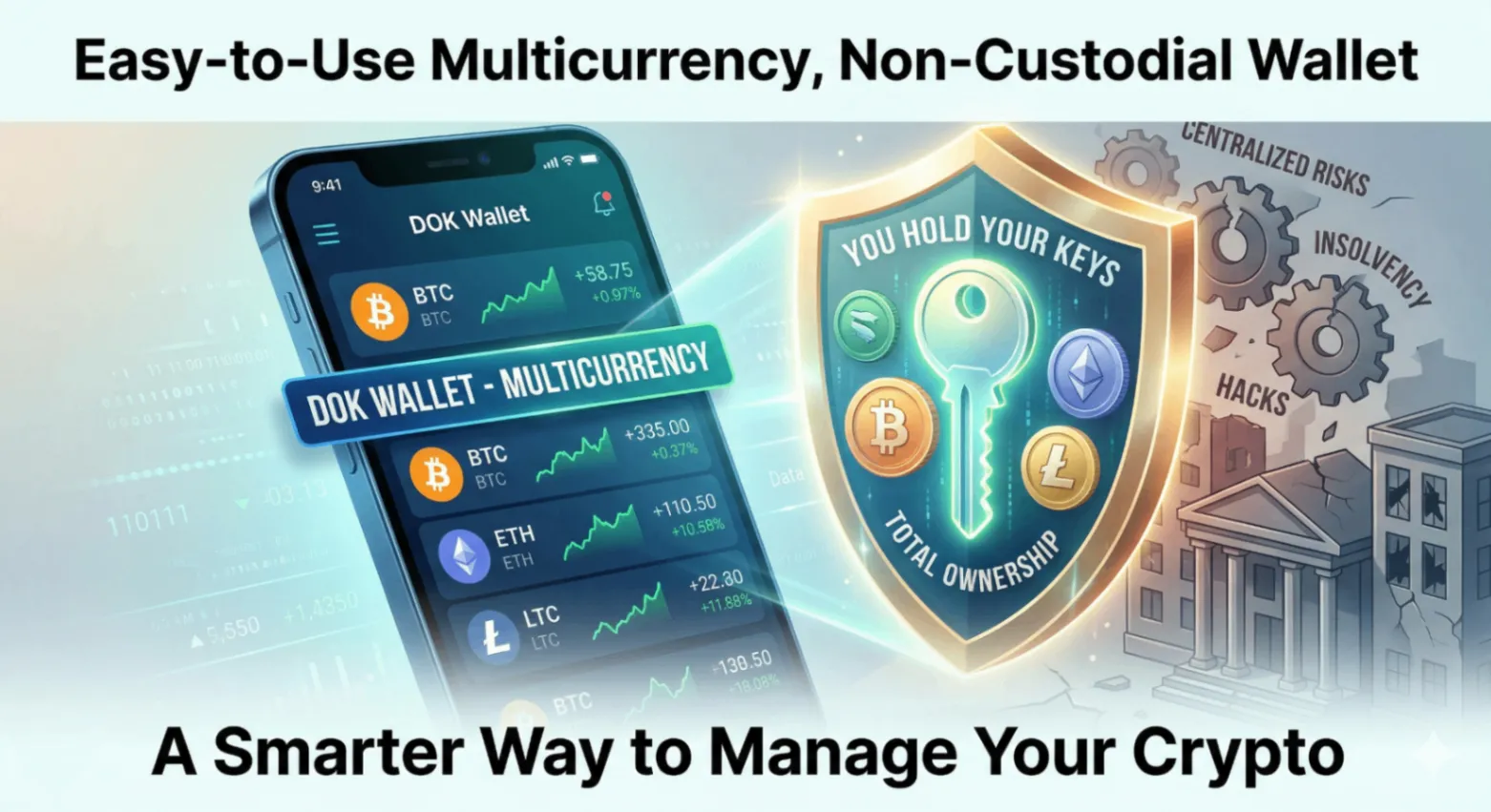
When you store crypto on an exchange or a custodial app, you are not technically the owner of those funds. The platform is. They hold the private keys, they decide the rules, and if something goes wrong — a hack, an insolvency, a regulatory freeze — your access to your own money can disappear overnight.
This is not hypothetical. Major exchange collapses in recent years have wiped out billions of dollars in user funds. Each incident was a reminder of a core crypto principle: if you do not hold your private keys, you do not own your coins.
A non-custodial wallet solves this problem at its root. And DOK Wallet — a free, open-source, multicurrency wallet available on iOS and Android — is built on exactly this premise. In this post, we will break down what non-custodial actually means, why it matters, and how DOK Wallet makes self-custody practical for everyday users.
Custodial vs. Non-Custodial: What Is the Difference?
Understanding this distinction is the single most important concept in crypto security.
Custodial Wallets
A custodial wallet is one where a third party — typically a centralised exchange or fintech platform — holds your private keys on your behalf. When you log into your exchange account and see a Bitcoin balance, that number represents a promise from the platform. The actual Bitcoin is held in the platform’s own wallets.
The risks of this model are significant:
- If the platform is hacked, your funds may be stolen
- If the platform becomes insolvent or freezes withdrawals, you may lose access to your assets
- The platform can restrict, delay, or block your transactions
- You are subject to the platform’s KYC, AML, and regulatory policies
In short, with a custodial wallet, you are trusting a company with your money, much like a bank but without deposit insurance.
Non-Custodial Wallets
A non-custodial wallet is one where you alone hold the private keys to your funds. The wallet application — whether it is on your phone, browser, or hardware device — is simply an interface for interacting with your keys and the blockchain.
The key benefits are:
- Full ownership: your funds are accessible only with your private key or seed phrase
- No counterparty risk: there is no company that can freeze, block, or lose access to your assets
- No KYC required: non-custodial wallets typically do not require identity verification
- Censorship resistance: no one can prevent you from sending or receiving transactions
The trade-off is responsibility. With no company to call if you forget your password, keeping your seed phrase safe is entirely up to you. This is a reasonable trade for most users who understand it.
Why Open Source Transparency Matters
DOK Wallet is open source. This means the code that powers the application is publicly available for anyone to inspect, audit, and verify.
For a wallet application, this is a significant security advantage. With closed-source software, users must trust the developer’s claims about how their private keys are handled. With open-source software, those claims can be independently verified. Security researchers, developers, and technically inclined users can confirm exactly what the app does with your data — and what it does not do.
Open-source software also benefits from community oversight. Bugs and vulnerabilities can be spotted and reported by a wider pool of people, and improvements can be contributed by anyone. This is how some of the most trusted software in the world is built.
Multicurrency Support: Managing More Than One Asset
Most serious crypto users hold more than one type of asset. Bitcoin is the most widely held, but Ethereum and ERC-20 tokens have become equally central to many portfolios. Managing these across different apps is inefficient and introduces unnecessary complexity.
DOK Wallet supports Bitcoin (BTC), Ethereum (ETH), and Ethereum-based tokens within a single application. A single seed phrase generates wallets for all supported assets, so you never have to juggle multiple recovery phrases. Your full portfolio is visible and accessible in one place.
This multicurrency approach extends to the wallet’s buy and swap functionality as well. You can purchase Bitcoin or Ethereum directly through the app, and you can swap one asset for another — for example, converting a token into ETH — without leaving the wallet interface. External exchanges are optional, not required.
Cross-Device Access
DOK Wallet is available on both iOS and Android. Because your wallet is derived from your seed phrase rather than stored in an app account, you can access the same wallet from any compatible device simply by importing your phrase.
This means your funds are not locked to a single phone. If you upgrade your device, lose it, or simply want to access your wallet from a different phone, the process is straightforward: install the app, choose “Import Wallet,” and enter your seed phrase. Your full wallet — all assets, all addresses — is immediately available.
A Note on Web Access
DOK Wallet also offers a web access option for advanced users. However, it is important to understand the context in which this is appropriate. Web access is best suited for offline or highly secure environments and is recommended primarily for experienced users who understand the additional risks associated with browser-based wallet access. For everyday use, the mobile app remains the safer and more convenient choice.
What Makes DOK Wallet Easy to Use?
The concept of self-custody has historically been associated with complexity — unfamiliar interfaces, confusing terminology, and steep learning curves. DOK Wallet is designed to change that perception without compromising on the security fundamentals.
The app presents your portfolio clearly, with balances and asset values accessible at a glance. Sending, receiving, buying, and swapping are all accessible through a clean, intuitive interface that does not require prior technical knowledge. First-time crypto users can get set up, secure their seed phrase, and start managing assets within minutes.
This matters because the biggest obstacle to self-custody is often not security risk — it is perceived difficulty. DOK Wallet lowers that barrier while keeping the security model intact.
Frequently Asked Questions
What does non-custodial mean in simple terms?
It means you hold your own private keys. No company has access to your funds, and you do not need anyone’s permission to send or receive crypto. You are the sole custodian of your assets.
Is DOK Wallet free to use?
Yes. DOK Wallet is free to download and use. Some in-app features — such as buying or swapping crypto through third-party providers — may incur fees set by those providers, not by DOK Wallet itself.
What happens if I lose my seed phrase?
Your seed phrase is the only way to recover your wallet if you lose access to your device. If your seed phrase is lost, your funds cannot be recovered by DOK Wallet or anyone else. This is why keeping it written down in a secure, offline location is so important.
Can I import an existing wallet into DOK Wallet?
Yes. If you have an existing wallet with a compatible seed phrase, you can import it into DOK Wallet by selecting the import option during setup and entering your phrase. Your funds will then be accessible through the DOK Wallet interface.
Does DOK Wallet require identity verification (KYC)?
The wallet itself does not require identity verification. Some third-party providers used for buying crypto within the app may have their own KYC requirements, but these are determined by the provider, not by DOK Wallet.
Take Control of Your Crypto
Self-custody is not just a technical preference — it is the foundation of what crypto was built for. With DOK Wallet, you get a non-custodial, open-source, multicurrency wallet that makes self-custody accessible to everyone. Download it free on iOS or Android and start managing your assets the right way.