Get the Best Wallet for All Your Crypto Assets: Secure, Simple & Powerful
With hundreds of crypto wallet options on the market, picking the right one is genuinely hard. The wrong choice can mean losing funds to a hack, discovering your assets are locked on a failing platform, or simply dealing with an app so confusing that you make costly mistakes.
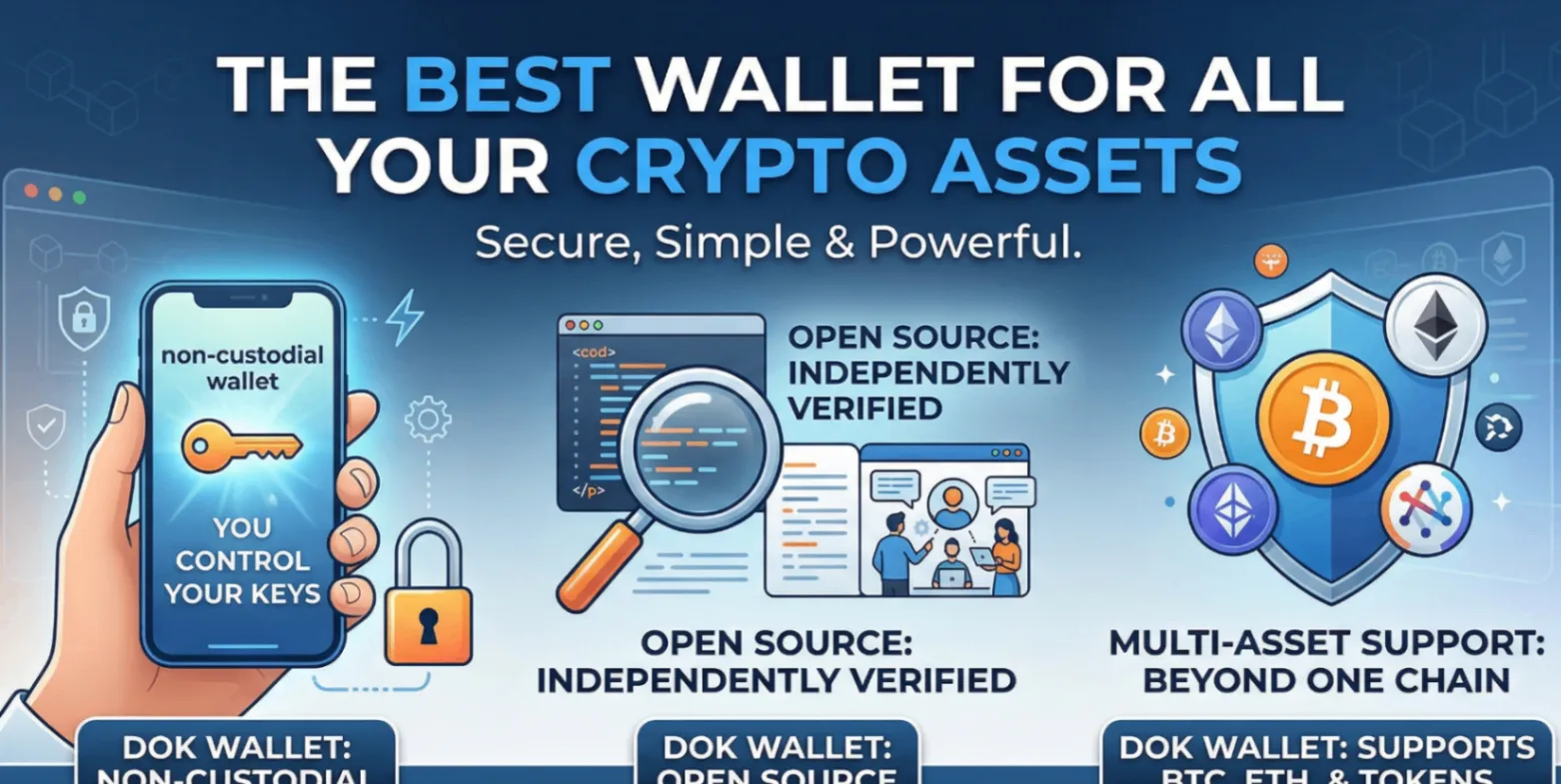
The best crypto wallet is not necessarily the most popular or the most feature-rich. It is the one that keeps your assets secure, gives you real ownership, supports the currencies you actually hold, and is easy enough to use every day. In this guide, we will walk through what to look for in a crypto wallet and explain how DOK Wallet measures up against each criterion.
What to Look for in a Crypto Wallet
1. Custody Model: Who Actually Controls Your Funds?
This is the single most important question to ask about any wallet. There are two models:
- Custodial wallets: The wallet provider holds your private keys. You access your funds through their platform. Examples include exchange wallets on Coinbase, Binance, or similar platforms.
- Non-custodial wallets: You hold your own private keys. The app is just an interface. No third party can access or freeze your funds.
For long-term storage and genuine ownership of your assets, non-custodial is the right choice. A custodial wallet is convenient, but you are always one platform failure away from a problem. DOK Wallet is non-custodial: your keys, your coins, full stop.
2. Open Source vs. Closed Source
An open-source wallet allows anyone to inspect the code and verify how it handles your private keys. This is a major trust signal. Closed-source wallets ask you to take their security claims on faith alone. Open-source wallets allow those claims to be independently verified by security researchers and the wider developer community.
DOK Wallet is fully open source. Its codebase is publicly available for inspection, which means there is no black box between you and your funds.
3. Multi-Asset Support
Most serious crypto users hold more than one asset. A wallet that only supports Bitcoin is limiting, as is one that only supports Ethereum. The best wallets support multiple chains natively, allowing you to manage your entire portfolio in one place.
DOK Wallet supports Bitcoin (BTC), Ethereum (ETH), and ERC-20 tokens, covering the vast majority of assets that typical crypto users hold. One app, one seed phrase, all your assets.
4. Security Architecture
Beyond the custody model, a well-designed crypto wallet should:
- Generate private keys locally on your device, never on a remote server
- Encrypt stored data so that even if your device is compromised, your keys are not immediately accessible
- Allow for full wallet recovery via seed phrase on any new device
- Offer app lock features such as PIN or biometric authentication
DOK Wallet follows these security principles. Your keys are generated and stored on your device, and your seed phrase is the master recovery mechanism — kept entirely in your control.
5. Ease of Use
Security should not come at the cost of usability. A wallet that is too complex to use reliably is itself a risk, as users may make mistakes or abandon best practices out of frustration.
DOK Wallet is designed with everyday usability in mind. The interface is clean and intuitive, transactions are straightforward, and the setup process — including generating and securing your seed phrase — is guided clearly without unnecessary complexity.
6. Built-In Functionality
A complete wallet does more than just store assets. The best options include:
- Buy crypto: purchase assets directly within the app without visiting an exchange
- Swap crypto: exchange one asset for another within the wallet interface
- Portfolio overview: see all your holdings and their values at a glance
DOK Wallet includes all of these capabilities. You can buy and swap crypto without ever leaving the app, making it a self-contained hub for your entire crypto activity.
7. Platform Availability
The best wallet is the one you actually have with you. DOK Wallet is available on both iOS and Android, so it works across the major mobile platforms. And because your wallet is tied to your seed phrase rather than an account, switching devices is seamless.
Common Wallet Mistakes to Avoid
Even experienced crypto users make avoidable errors. Here are the most common pitfalls:
Storing your seed phrase digitally
Writing your seed phrase in a notes app, emailing it to yourself, or taking a screenshot is a serious security risk. Digital storage can be hacked, synced to cloud services, or accessed by malware. Always write your seed phrase on paper and store it physically in a secure location.
Using the same wallet for everything
If you are actively trading, experimenting with DeFi, or interacting with unfamiliar smart contracts, consider using a separate wallet for those activities. Keep your main holdings in a wallet you use only for trusted transactions.
Trusting custodial wallets for long-term storage
Exchanges are useful for trading, but they are not designed to be long-term storage for significant crypto holdings. The history of crypto is full of exchange collapses, hacks, and withdrawal freezes. If you plan to hold assets for the medium or long term, a non-custodial wallet is the appropriate choice.
Ignoring wallet updates
Wallet applications are updated regularly to patch security vulnerabilities and add features. Keeping your wallet app updated is a basic but important security practice.
How DOK Wallet Compares
There is no shortage of non-custodial wallet options. Trust Wallet, MetaMask, and Exodus are among the most well-known. DOK Wallet distinguishes itself through a combination of factors:
- Non-custodial and open-source: both of the foundational trust requirements are met
- Native Bitcoin and Ethereum support in a single mobile app: no separate extensions or workarounds
- Built-in buy and swap: a complete crypto management experience without third-party apps
- Available free on iOS and Android: no cost to access the full feature set
- Straightforward setup: designed to be accessible to users who are new to self-custody
For users who want a clean, trustworthy, and fully featured non-custodial wallet on mobile, DOK Wallet is a strong choice worth serious consideration.
Frequently Asked Questions
What is the safest type of crypto wallet?
For most users, a non-custodial hardware wallet offers the highest level of security for large holdings. For everyday mobile use, a non-custodial, open-source software wallet — like DOK Wallet — provides an excellent balance of security and convenience.
Can I recover my wallet if I lose my phone?
Yes. As long as you have your seed phrase, you can recover your full wallet on any new device. Install DOK Wallet, choose the import option, and enter your seed phrase. All your assets and addresses will be immediately accessible.
Is DOK Wallet good for beginners?
Yes. DOK Wallet is designed to be straightforward for users who are new to self-custody wallets. The setup process is clearly guided, and the interface is intuitive enough to use without prior technical knowledge.
Does DOK Wallet charge fees?
DOK Wallet is free to download and use. Transaction fees (gas fees for Ethereum, network fees for Bitcoin) are paid to the blockchain network, not to DOK Wallet. Third-party providers used for buying crypto may charge their own fees.
How does DOK Wallet protect my private keys?
Your private keys are generated locally on your device and are never transmitted to DOK Wallet’s servers or any third party. The seed phrase you generate during setup is the only way to recover your wallet, and it remains entirely in your control.
Ready to Take Control of Your Crypto?
The best wallet is the one that keeps your assets safe, gives you genuine ownership, and stays out of your way when you need to use it. DOK Wallet delivers on all three. Download it free on iOS or Android and start managing all your crypto assets with the security and simplicity you deserve.