
Ethereum and EVM Wallets: What You Need to Know About Gas, Tokens, and DeFi
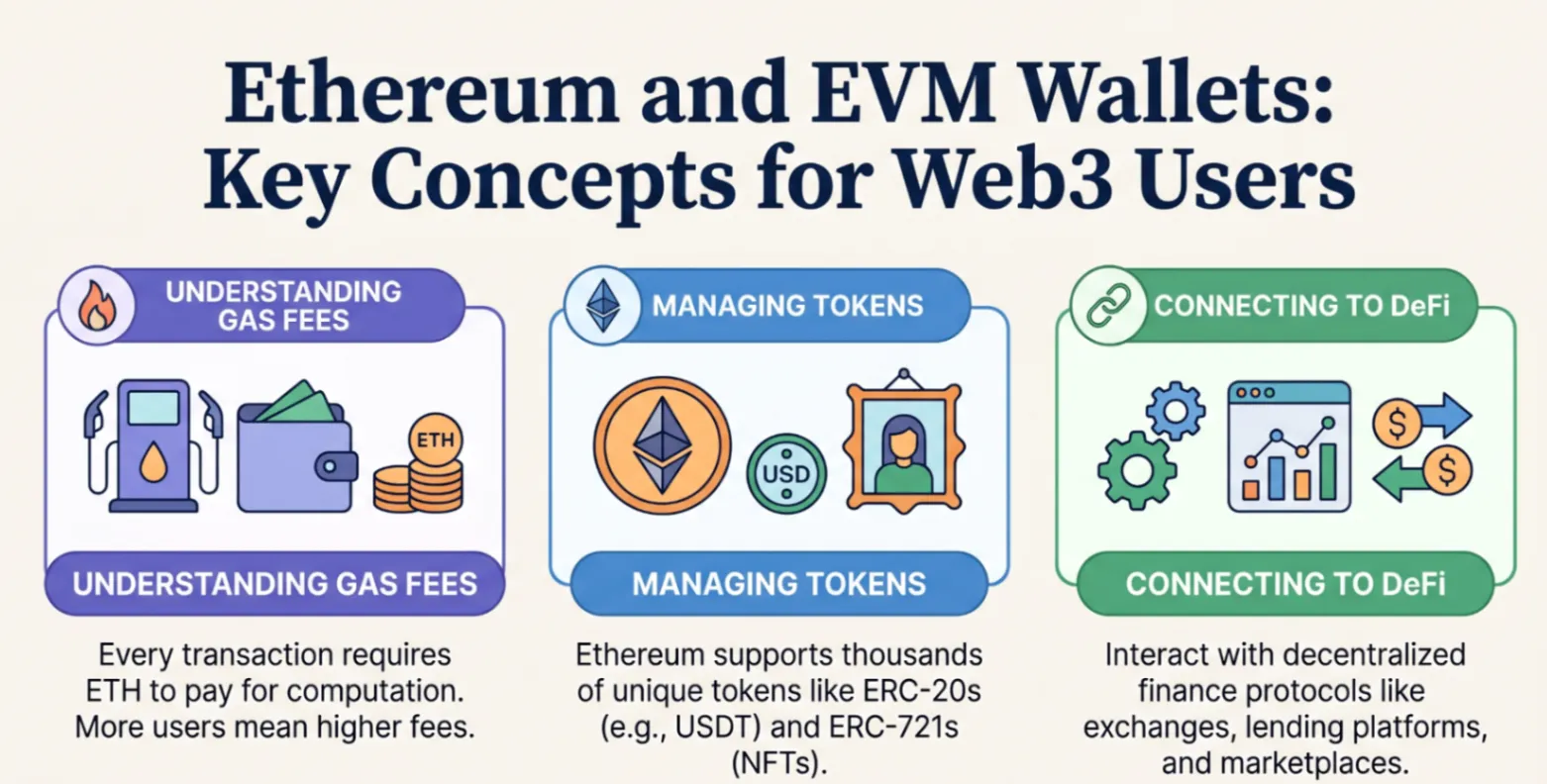
Ethereum is the backbone of decentralised finance, NFTs, stablecoins, and thousands of tokens that collectively represent hundreds of billions of dollars in value. If you are active in crypto beyond simply holding Bitcoin, you are almost certainly interacting with Ethereum or one of the many EVM-compatible chains that share its architecture. Understanding how EVM wallets work — how gas fees are calculated, how tokens are managed, and how DeFi protocols are accessed safely — is essential knowledge for anyone operating in this ecosystem.
This guide covers the full picture: what Ethereum and the EVM actually are, how gas fees work in practice, what ERC-20 tokens mean for your wallet, and how to connect to DeFi protocols without compromising your private keys.
What Is Ethereum and the EVM?
Ethereum is a programmable blockchain — unlike Bitcoin, which is primarily designed to record value transfers, Ethereum was built to execute arbitrary code. That code runs in the form of smart contracts: self-executing programs stored on the blockchain that activate automatically when their conditions are met. Smart contracts are the building blocks of every DeFi protocol, every token, every NFT collection, and every decentralised application built on Ethereum.
The Ethereum Virtual Machine (EVM) is the runtime environment that executes smart contract code. Every node in the Ethereum network runs the EVM, and they all execute the same instructions and arrive at identical results — this consensus is what makes the system trustless. The EVM processes transactions, updates account balances, and runs contract logic in a deterministic, verifiable way.
A significant portion of the blockchain ecosystem has adopted EVM-compatible architectures. BNB Chain, Polygon, Avalanche, Arbitrum, Optimism, and Base all implement the EVM, which means they use the same address format (0x...), the same wallet tooling, and the same smart contract language (Solidity). One Ethereum address works on all of these networks. However, it is critical to understand that these are separate networks — assets on Ethereum mainnet are distinct from assets on Polygon, even if the address is identical. Sending to the wrong network is a common and often irreversible mistake.
Understanding Gas Fees
Every operation on Ethereum consumes computational resources, and those resources are paid for through gas. Gas is not a separate token — it is a unit of measurement for computational work, and it is always paid in ETH (or the native token of the EVM chain you are using). Gas fees serve two purposes: they compensate validators for processing transactions, and they prevent spam by making it costly to flood the network with computation.
How Gas Costs Are Calculated
The total ETH cost of a transaction is determined by two variables: the gas units consumed by the operation, and the gas price — measured in Gwei, which is one billionth of an ETH. Gas units are fixed by the type of operation: a simple ETH transfer uses 21,000 gas units, while a complex DeFi interaction might consume 200,000 or more. Gas price is variable and set by market conditions — when the network is congested, users bid higher prices to have their transactions included faster, and the base fee adjusts dynamically.
The gas limit is the maximum number of gas units you are willing to allow a transaction to consume. Setting it too low causes the transaction to fail (though the gas spent up to the failure point is still consumed). Wallets like DokWallet estimate appropriate gas limits automatically based on the transaction type, protecting users from this failure mode.
Gas on EVM-Compatible Chains
On EVM-compatible networks, the gas mechanism is identical in concept but uses each chain's native token. Polygon requires MATIC for gas, BNB Chain requires BNB, Avalanche requires AVAX. This is an important practical point: even if you are only sending an ERC-20 token (or its equivalent on another chain), you must hold the native gas token to pay for the transaction. Running out of the native token is a common reason transactions fail for new users.
ERC-20 Tokens Explained
ERC-20 is the technical standard that defines how fungible tokens are implemented on Ethereum. Any token that follows this standard behaves in a predictable, interoperable way — wallets, exchanges, and protocols can all interact with it using the same interface. The standard covers basic functions: checking a balance, transferring tokens between addresses, and approving a smart contract to spend tokens on your behalf.
Thousands of tokens are ERC-20 tokens: stablecoins like USDT and USDC, DeFi governance tokens like UNI and AAVE, wrapped assets, project tokens, and many others. All of them live at your Ethereum address. You do not hold ERC-20 tokens in the way you hold cash in a physical wallet — instead, each token is a smart contract that maintains a ledger of balances, and your address appears in that ledger with whatever quantity you hold. Your wallet displays your balance by querying these contracts.
Each ERC-20 token has a unique contract address — a hexadecimal string that identifies it on the blockchain. This is how wallets distinguish between USDT and USDC even though both are stablecoins at the same face value: they are different contracts at different addresses. DokWallet auto-detects ERC-20 tokens when they arrive at your address, so for commonly listed tokens you will see your balance update automatically without any manual steps.
Managing Tokens in Your EVM Wallet
Most wallets handle well-known tokens automatically through token lists maintained by the community. For tokens that are not auto-detected — such as newly launched projects or obscure assets — you can add them manually by entering the token's contract address. The wallet will then query the contract and display your balance. When adding tokens manually, always verify the contract address from an authoritative source (the project's official site or a reputable block explorer) to avoid adding fake tokens that impersonate legitimate ones.
Sending ERC-20 tokens uses the same address format as sending ETH, but the transaction type is different. A token transfer calls the token contract's transfer function rather than simply moving ETH between accounts. This means it consumes more gas than a plain ETH transfer, and — critically — you still need ETH in your wallet to pay that gas even though you are not sending any ETH.
Layer 2 networks add another layer of complexity: tokens on Polygon or Arbitrum occupy the same address as your Ethereum mainnet tokens but exist on entirely separate networks. USDC on Polygon and USDC on Ethereum are different assets until bridged. Always confirm which network you are on and which network the recipient expects before sending.
DeFi — What You Can Do With an EVM Wallet
Decentralised finance (DeFi) refers to financial services built as smart contracts on blockchains, operating without centralised intermediaries. An EVM wallet is your interface to this ecosystem. The range of what is available has grown substantially since Ethereum launched — today it encompasses trading, lending, yield generation, derivatives, insurance, and more, all accessible directly from your wallet.
Decentralised Exchanges (DEX)
DEXes like Uniswap and Curve allow you to swap one token for another directly on-chain, without depositing funds on a centralised exchange. Trades execute against liquidity pools — smart contracts holding reserves of token pairs — and settlement is immediate and non-custodial. You remain in control of your tokens until the moment the swap transaction executes.
Lending and Borrowing
Protocols like Aave and Compound allow you to deposit crypto assets and earn interest, or borrow against your holdings using crypto collateral. Interest rates are set algorithmically based on supply and demand. These protocols are permissionless — no credit check, no identity verification, no application process. The collateral requirement and liquidation risk are the primary risk factors to understand before participating.
Yield Farming, Liquidity Provision, and NFTs
Providing liquidity to DEX pools earns a share of trading fees. Yield farming strategies layer multiple protocols to maximise returns, though they involve compounding smart contract risk. NFT marketplaces like OpenSea allow buying and selling non-fungible tokens directly from your EVM wallet. In every case, the interaction model is the same: connect your wallet, review the transaction the DApp presents, and approve or reject it. Your private key never leaves your wallet.
WalletConnect — How to Connect to DApps Safely
WalletConnect is the open protocol that enables mobile wallets to interact with desktop-based DApps. The connection is established via QR code: the DApp displays a code, you scan it with your wallet app, and a secure encrypted session is established. Transaction requests from the DApp are relayed to your wallet for approval, and signatures are returned. At no point does the DApp receive or see your private key — it only receives signed transaction data that authorises a specific action.
DokWallet supports WalletConnect, enabling you to connect to any compatible DeFi protocol, NFT marketplace, or Web3 application directly from your mobile wallet. The workflow is: navigate to the DApp in a desktop browser, select "Connect Wallet" and choose WalletConnect, scan the QR code with DokWallet, and confirm the connection. From that point, the DApp can propose transactions that you review and sign within the DokWallet interface.
Security vigilance is essential when connecting wallets to DApps. Always verify the URL of the DApp before connecting — phishing sites frequently mimic the design of legitimate platforms with slight URL variations. Bookmark trusted DApps and navigate directly to bookmarks rather than following links from social media or messages. Before approving any transaction, read the details in your wallet's confirmation screen carefully. A legitimate DApp swap or deposit will show specific, understandable actions — if a transaction asks for unlimited token approvals or involves unfamiliar contract addresses, reject it and investigate before proceeding.
DokWallet for Ethereum and EVM Chains
DokWallet supports Ethereum mainnet alongside a broad range of EVM-compatible chains including BNB Chain, Polygon, Avalanche, and more. All chains share a single interface — your portfolio view aggregates balances across every supported network, and switching between chains requires only selecting the relevant network from the chain selector.
Token detection is automatic for both ERC-20 tokens on Ethereum and BEP-20 tokens on BNB Chain, as well as their equivalents on other supported networks. When tokens arrive at your address, DokWallet identifies them against its token registry and displays them without requiring manual contract entry for common assets. For unlisted tokens, manual addition by contract address is available.
Gas fee management in DokWallet includes automatic estimation with selectable speed tiers — allowing you to choose between a lower-cost slower confirmation or a higher-fee faster inclusion based on your needs. For transactions that become stuck due to underpriced gas, DokWallet provides speed-up and cancellation options that resubmit the transaction with an updated fee, resolving the issue without requiring external tools.
Conclusion
Ethereum and the EVM-compatible ecosystem represent the most actively developed and feature-rich environment in crypto today. The mechanics — gas fees, ERC-20 tokens, smart contract interactions — may seem complex at first, but they follow consistent patterns that become intuitive with experience. Understanding how gas is calculated, why ETH is always required on EVM chains, how token contracts work, and how WalletConnect enables safe DeFi access provides the foundation for participating confidently.
DokWallet is built to make this ecosystem accessible without sacrificing the self-custody and transparency that non-custodial wallets provide. Whether you are sending USDC on Polygon, connecting to a DEX on Ethereum mainnet, or monitoring BEP-20 token balances on BNB Chain, the interface handles the complexity while you retain full control of your keys and funds.