
HD Wallets and Seed Phrases: How Your Crypto Keys Are Generated and Protected
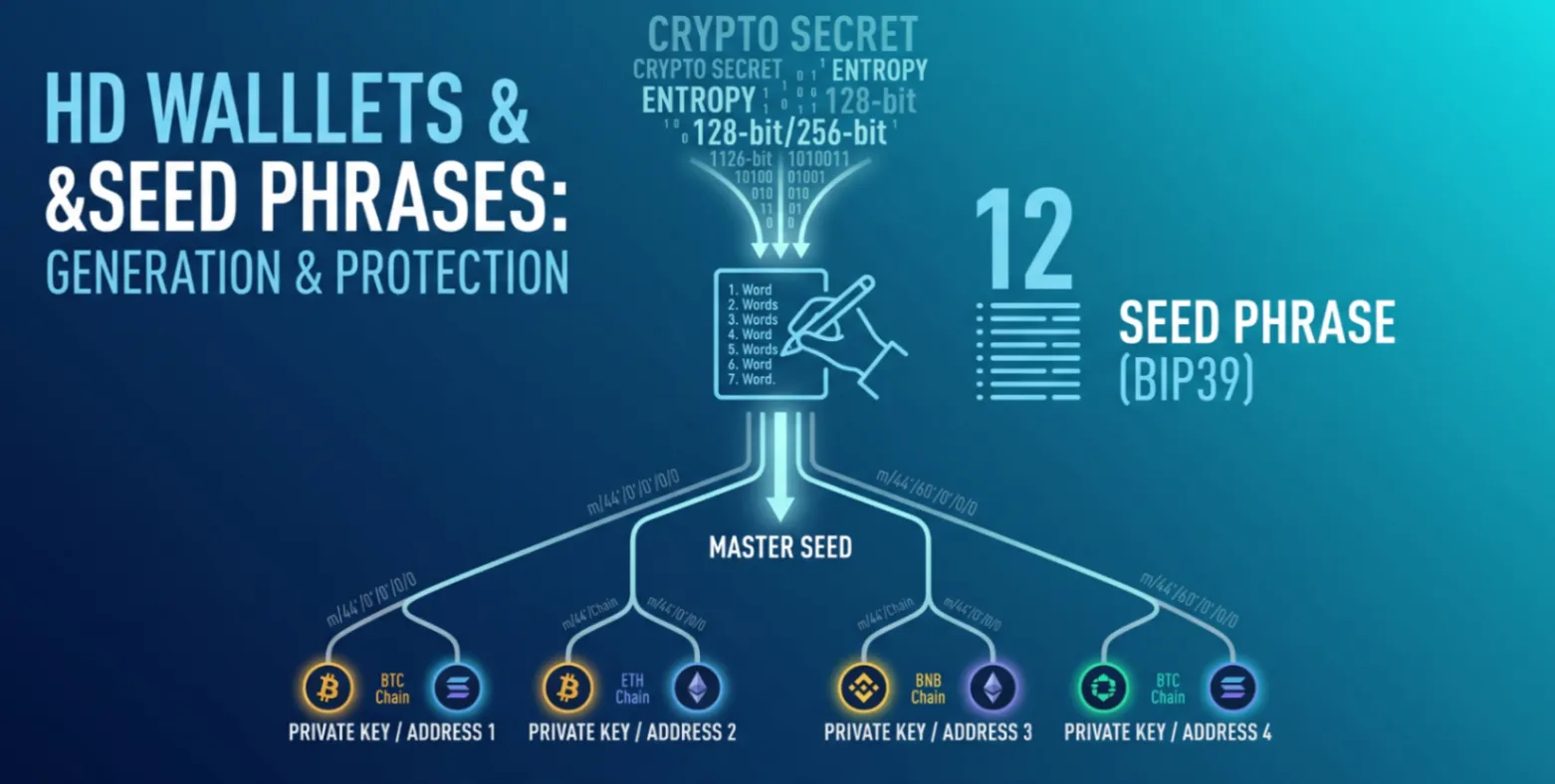
Every modern non-custodial wallet is built on two interconnected standards: hierarchical deterministic (HD) wallet architecture and BIP-39 seed phrases. Together, these specifications define how your private keys are generated, how your wallet addresses are derived, and how a single human-readable backup can recover an entire multi-chain portfolio. Understanding them demystifies how wallets actually work and reveals exactly why that sequence of words carries so much responsibility.
Whether you are setting up your first wallet or looking to understand the mechanics behind a tool you already use daily, this guide walks through the full picture — from entropy to addresses, from derivation paths to real-world protection practices.
What Is a Hierarchical Deterministic (HD) Wallet?
Before HD wallets existed, managing multiple cryptocurrency addresses was genuinely burdensome. Every new address required generating a fresh, independent private key. If you used ten addresses, you needed to back up ten separate keys. If you generated addresses regularly — as good privacy practice recommends — the backup problem grew continuously. Lose any single key, and the funds associated with that address were gone.
HD wallets, standardised in Bitcoin Improvement Proposal 32 (BIP-32), solved this problem completely. An HD wallet derives an entire tree of key pairs from a single master seed using a deterministic mathematical process. Every address your wallet has ever generated, and every address it will ever generate in the future, flows from that one root. The structure is hierarchical — a master key at the root, account-level keys as branches, and individual address keys as leaves — and it is deterministic, meaning the same seed always produces exactly the same keys in exactly the same order.
The practical consequence is powerful: one backup covers everything. There is no longer a growing list of individual keys to protect. Secure the root seed, and you secure every key that has ever been or will ever be derived from it. This design is now universal — every serious non-custodial wallet you encounter is an HD wallet.
How Seed Phrases Work — BIP-39 Explained
The HD wallet master seed is, at its core, a very large random number — typically 128 or 256 bits of entropy. A raw number of that size is impractical for humans to record and verify accurately. A single digit error is undetectable and catastrophic. Bitcoin Improvement Proposal 39 (BIP-39) solved the human-legibility problem by converting this entropy into a sequence of ordinary words.
The BIP-39 wordlist contains exactly 2,048 words, each carefully chosen to be distinct and recognisable across different languages and handwriting styles. Each word encodes 11 bits of data. A 12-word phrase encodes 128 bits of entropy plus a 4-bit checksum; a 24-word phrase encodes 256 bits of entropy plus an 8-bit checksum. The checksum — derived from the entropy itself — is critical: it means that a randomly chosen set of words will almost certainly fail validation, so transcription errors are caught immediately rather than discovered when you need to recover your funds.
From the mnemonic words, a deterministic algorithm (PBKDF2 with HMAC-SHA512) derives the binary seed, which is then used as the input to the HD wallet derivation process. The words themselves are the backup. Anyone who possesses them can regenerate the complete key tree — which is why their protection is of paramount importance.
Derivation Paths — How One Seed Serves Multiple Chains
A single HD wallet seed can derive addresses for every major blockchain, and BIP-44 defines the standard path structure that makes this possible across wallets in an interoperable way. The path format is: m / purpose' / coin_type' / account' / change / index. Each level of the hierarchy serves a specific function: purpose identifies the BIP standard being followed, coin_type identifies the blockchain, account allows logical separation of funds, change distinguishes external from internal addresses, and index generates sequential addresses within an account.
Different blockchains are assigned different coin_type numbers in the BIP-44 registry. Bitcoin uses coin_type 0, Ethereum uses 60, BNB Chain uses 714, and so on. This means your Bitcoin addresses are derived at a completely different path from your Ethereum addresses, even though both originate from the same master seed. The keys are cryptographically independent — one set cannot be derived from the other — but they share a common root backup.
DokWallet follows these standard derivation paths for every supported chain. When you enter your seed phrase into DokWallet, it automatically derives your Bitcoin addresses, your Ethereum and EVM chain addresses, and all other supported chain addresses using the correct BIP-44 paths. This is why one seed phrase in DokWallet restores your BTC, ETH, BNB, and every other supported chain wallet simultaneously, with no manual configuration required.
The Security Properties of HD Wallets
The security model of an HD wallet is straightforward but important to understand fully. The seed phrase is the root of all security. Anyone who obtains your seed phrase can derive every private key in your wallet and take complete control of all associated funds across all chains. Conversely, protecting your seed phrase — keeping it physical, private, and inaccessible — protects everything.
A key property of BIP-32 derivation is that it is a one-way process downward: child keys can be derived from the parent, but the parent seed cannot be reconstructed from a child key. Exposing a single address private key does not compromise your seed or any other addresses. This is an important layer of resilience.
Extended public keys (xpub) are a more advanced feature of HD wallets worth understanding. An xpub allows generating all the public keys (and therefore addresses) in an account without access to any private key. This enables read-only wallet monitoring — you can watch incoming transactions and check balances without the ability to spend. Hardware wallet integrations and accounting tools often use xpub keys for this purpose. However, xpub keys do reveal all addresses in the account, so they should be shared only with trusted monitoring applications.
How DokWallet Handles Seed Phrase Generation
When you create a new wallet in DokWallet, the seed phrase generation process is designed to be as secure as possible from the first moment. Entropy is generated on-device using the operating system's cryptographically secure random number generator — the same source used for security-critical applications. This is not pseudo-random number generation; it draws from hardware entropy sources to ensure true unpredictability.
The generated seed phrase is never transmitted to any server. It exists only on the device during the setup process, and only you see it. On mobile platforms, DokWallet disables screenshots during the seed phrase display screen, preventing accidental or malicious capture of the phrase by screen-recording software or screenshot tools.
DokWallet also requires an explicit confirmation step before proceeding past seed phrase display. You must acknowledge that you have written down your phrase, and in the mobile app, a verification step requires correctly identifying specific words from the phrase in sequence. This design ensures that users who skip the backup step cannot claim they were not warned — the interface enforces it.
Best Practices for Protecting Your Seed Phrase
The single most important rule is this: your seed phrase must exist only in physical form, never in any digital format. Do not photograph it, do not type it into a notes application, do not save it to cloud storage, do not email it to yourself, and do not store it in a password manager. Any digital copy creates a vector for theft — through cloud account compromise, malware, or data breaches — that your physical security cannot protect against.
- Write the phrase on paper using a pen that will not fade — and verify your copy word by word immediately after writing it
- Store it in a secure physical location: a personal safe, a fireproof box, or a bank safety deposit box for high-value wallets
- Consider splitting storage across two secure locations for additional resilience against single-location loss (fire, flood, theft)
- For significant holdings, consider engraving or stamping the phrase onto a steel or titanium plate — metal is fire-resistant and waterproof in ways paper is not
- Never enter your seed phrase into any application or website other than your own wallet's recovery screen — no legitimate service will ever ask for it
- No wallet support team, including DokWallet's, will ever ask for your seed phrase — any such request is fraud
Threat modelling is useful here. The most common cause of seed phrase loss is not sophisticated theft — it is the wallet owner losing or destroying their own backup, or forgetting where they stored it. The second most common cause is giving it away, either through phishing or social engineering. Physical redundancy and a strict "never share" rule address both threat categories effectively.
Recovering Your Wallet from a Seed Phrase
One of the most important properties of the BIP-39 and BIP-44 standards is interoperability. Because these are open, published standards followed by the entire industry, your seed phrase is not locked to any single wallet application. Any wallet that correctly implements BIP-39 and BIP-44 will derive the same keys from your phrase and recover your full balance. If DokWallet were ever unavailable, your funds would remain accessible through any other compliant wallet.
Recovery in DokWallet is straightforward: select the recovery option on the wallet setup screen, enter your 12 or 24 words in the correct order, and set a new wallet password. The app derives all keys from the phrase, scans the blockchain for your transaction history, and restores your complete wallet including all chains and token balances. The recovery process requires only your words — nothing else is needed, and nothing can substitute for them.
Conclusion
HD wallets and BIP-39 seed phrases are not just technical implementation details — they are the foundation of self-custody in crypto. The HD architecture solves the key management problem by deriving an unlimited, organised tree of keys from a single root. BIP-39 makes that root human-legible and verifiable. BIP-44 extends the design across every major blockchain, enabling a single phrase to manage an entire multi-chain portfolio.
Understanding these mechanisms clarifies what is actually at stake when protecting a seed phrase. It is not just a "password" in the conventional sense — it is the complete mathematical specification of your entire crypto identity. DokWallet is built to generate it securely, help you back it up correctly, and recover from it reliably. The rest is in your hands.