
What Is a Non-Custodial Crypto Wallet — And Why It Should Matter to You
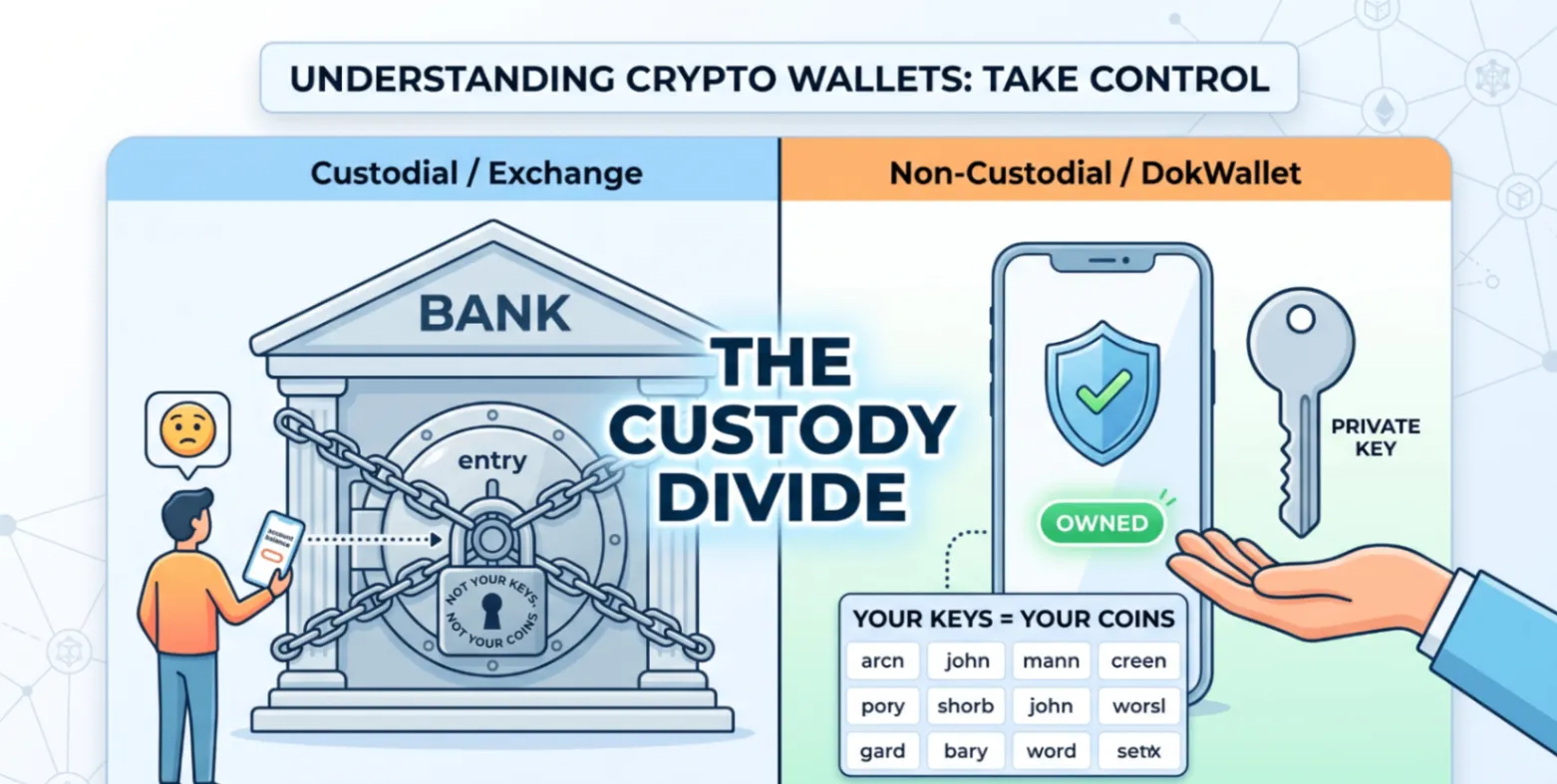
When you buy cryptocurrency through an exchange, you might assume the coins are yours the moment the transaction confirms. In reality, they often are not — not in the most important sense. What you own is an entry in a company's internal ledger, and access to it depends entirely on that company continuing to exist and honour your balance.
A non-custodial crypto wallet changes that equation completely. With a non-custodial wallet, you hold your own private keys, which means you own your crypto in the truest sense possible. No company, no platform, and no third party can freeze, block, or confiscate it. This article explains what a non-custodial crypto wallet is, how it works, and why the distinction matters far more than most beginners realise.
The Core Concept: Custody in Crypto
In traditional finance, "custody" refers to the holding and safekeeping of assets on behalf of clients. When you deposit money at a bank, the bank is your custodian. If the bank fails, your deposit up to a certain threshold may be insured, but you are fundamentally relying on the institution.
Cryptocurrency inherited a similar model through exchanges. When you hold Bitcoin on Coinbase, Binance, or any centralised exchange, the exchange is your custodian. They control the private keys. You have an account balance, not actual coins. This is sometimes summarised as "not your keys, not your coins."
A non-custodial crypto wallet inverts this model. You generate your own private keys, you store them yourself, and no third party is ever in control of your assets. The wallet software facilitates transactions but holds no authority over your funds.
How Non-Custodial Wallets Work
Private Keys and Seed Phrases
Every cryptocurrency wallet is built around a pair of cryptographic keys: a public key (your address, which anyone can send funds to) and a private key (your secret, which authorises transactions). In a non-custodial wallet, these keys are generated on your device and never transmitted to any server.
Most modern non-custodial wallets, including DokWallet, use a seed phrase — a human-readable sequence of 12 or 24 words — as a master backup for all keys in the wallet. This phrase is generated once during setup and must be written down and stored securely offline. It is the only way to recover your wallet if you lose your device.
Critical Rule: Never share your seed phrase with anyone. Never store it digitally. Anyone who has your seed phrase has full access to your funds.
How Transactions Are Signed
When you send cryptocurrency, the transaction must be "signed" by your private key to prove you authorised it. In a non-custodial wallet, this signing happens locally on your device. The private key never leaves your phone or computer, which means it can never be intercepted during transmission. The blockchain network receives only the signed transaction, which it can verify without ever seeing the private key.
Non-Custodial vs. Custodial: A Direct Comparison
Control
With a custodial wallet, the platform controls your private keys and can restrict access, freeze accounts, or lose your funds if they are hacked or go bankrupt. With a non-custodial wallet, you are the only person who can authorise transactions.
Recovery
Custodial platforms can reset your password because they control your account. With a non-custodial wallet, there is no central authority to reset anything. Your seed phrase is the only recovery mechanism — which is why protecting it is absolutely essential.
Privacy
Custodial platforms typically require identity verification (KYC). Non-custodial wallets like DokWallet require no KYC — you create a wallet entirely without providing personal information.
Risk Profile
Custodial wallets carry platform risk: if the exchange is hacked or insolvent, your funds may be lost or inaccessible for extended periods. Non-custodial wallets transfer that risk to the user — you are responsible for your seed phrase security.
Who Should Use a Non-Custodial Crypto Wallet?
Non-custodial wallets are appropriate for anyone who:
- Wants true ownership and control of their digital assets
- Values financial privacy and does not want to submit KYC documentation
- Holds crypto for the medium to long term and does not need to trade constantly
- Wants to interact with decentralised applications (DApps) and DeFi protocols
- Has reason to be concerned about exchange failure, censorship, or account freezing
They are less suitable for pure day-traders who need instant access to exchange order books, or for beginners who are not yet confident managing their own security.
DokWallet as a Non-Custodial Solution
DokWallet is a non-custodial, open-source crypto wallet available on iOS and Android. It is built on the principle that your keys belong to you. The wallet never transmits your private keys or seed phrase to any server. The open-source codebase, publicly available on GitHub, allows anyone to independently verify this claim — which is a standard that most custodial platforms cannot meet.
Setup takes minutes. During onboarding, you create a password to protect local access, generate your seed phrase, and write it down. From that point, your wallet is fully operational across Bitcoin, Ethereum, and a wide range of tokens — with complete self-custody throughout.
The Bottom Line on Non-Custodial Ownership
The case for non-custodial crypto wallets is not ideological — it is practical. Exchanges get hacked. Platforms freeze accounts. Companies go bankrupt. In every one of these scenarios, users of custodial platforms face potential loss of access to or permanent loss of their funds. Users of non-custodial wallets face none of these risks, because their funds are never in anyone else's control.
The trade-off is personal responsibility for your seed phrase. That responsibility is significant, but it is also manageable. For anyone serious about crypto ownership, a non-custodial wallet is not optional — it is foundational.