Why a Multi-Chain Wallet Is Essential in 2026 — And How DokWallet Makes It Simple
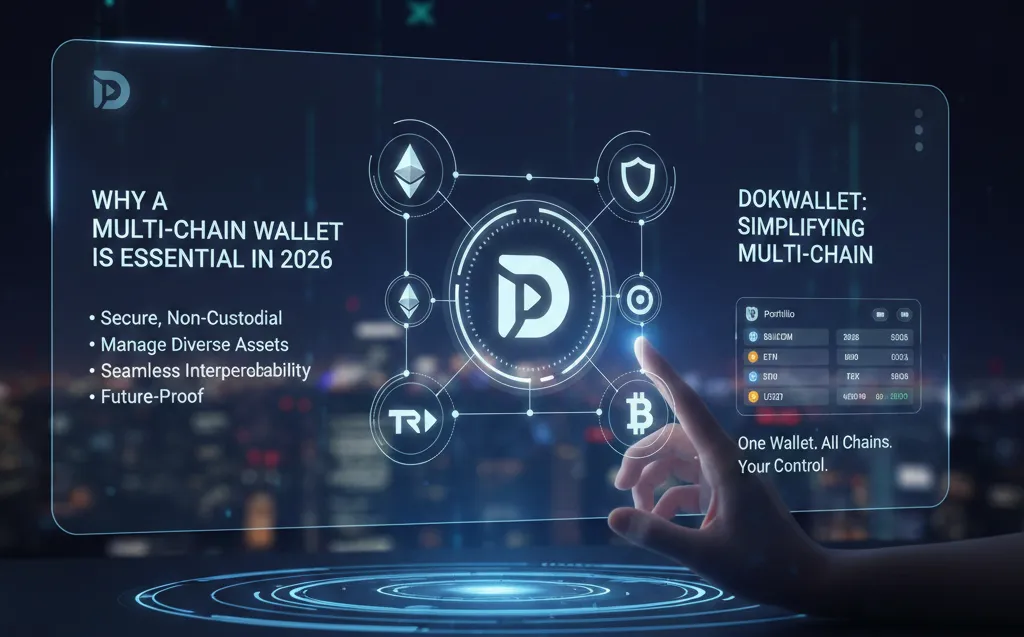
Cryptocurrency is no longer limited to one blockchain, one token standard, or one ecosystem. What started with Bitcoin as a peer-to-peer digital currency has expanded into a vast, multi-chain environment powered by networks like Ethereum, BNB Smart Chain, and TRON.
For users, this evolution has created opportunity — but also complexity.
Today's crypto holders often manage assets across multiple networks. They interact with decentralized platforms, hold different token standards, and need flexibility without sacrificing security. This is where a multi-chain wallet becomes essential.
DokWallet is built around this exact need: providing a secure, non-custodial, multi-chain environment where users can manage digital assets efficiently and independently.
Let's explore why multi-chain management matters more than ever — and how DokWallet addresses that challenge.
The Problem: Crypto Fragmentation
In the early days of cryptocurrency, managing digital assets was relatively straightforward. If you owned Bitcoin, you used a Bitcoin wallet. That was it.
But today, assets are distributed across various blockchains:
- BTC operates on the Bitcoin network
- ETH and ERC-20 tokens operate on Ethereum
- BEP-20 tokens operate on BNB Smart Chain
- TRC-20 tokens operate on Tron
Each blockchain has:
- Different address formats
- Different transaction fee structures
- Different confirmation speeds
Managing separate wallets for each chain can quickly become inefficient and confusing.
Fragmentation increases:
- Operational complexity
- Risk of sending funds to the wrong network
- Difficulty tracking portfolio activity
A modern crypto user needs consolidation — not more apps.
The Multi-Chain Advantage of DokWallet
DokWallet provides a unified environment where users can manage assets across supported blockchains within a single mobile interface.
Instead of switching between applications, users can:
- Store assets from multiple networks
- Generate addresses specific to each chain
- Send tokens securely
- View transaction history per network
- Monitor balances in one place
This consolidation dramatically reduces the friction that often discourages new users from fully engaging with crypto.
It also reduces the likelihood of costly mistakes, such as transferring tokens to incompatible networks.
Self-Custody: Control Without Intermediaries
A defining feature of DokWallet is its non-custodial structure.
Unlike custodial platforms where a third party controls private keys, DokWallet ensures that users maintain complete ownership of their keys and assets.
During setup, users receive a recovery phrase. This phrase:
- Grants full access to the wallet
- Allows restoration on a new device
- Is not stored by DokWallet
This model follows the decentralization principles introduced by Satoshi Nakamoto when launching Bitcoin.
Why Self-Custody Matters
Self-custody ensures:
- No third-party freezing of assets
- No dependency on centralized account access
- Full control over transaction approvals
However, it also places responsibility on the user to safeguard their recovery phrase securely.
DokWallet provides the infrastructure. The ownership — and accountability — remains with you.
Sending and Receiving Across Networks
At the heart of any crypto wallet lies the ability to send and receive funds safely.
DokWallet simplifies this process across its supported chains.
Receiving Crypto
To receive funds, users:
- Select the appropriate blockchain
- Generate the corresponding wallet address
- Share the address or QR code
Because address formats vary between networks, DokWallet clearly distinguishes them to reduce confusion.
This is particularly important when dealing with token standards like ERC-20, BEP-20, and TRC-20.
Sending Crypto
Sending funds involves:
- Entering or scanning a wallet address
- Selecting the correct network
- Reviewing transaction details
- Confirming the transaction
The wallet signs the transaction using the private key stored locally and broadcasts it to the blockchain.
DokWallet does not hold user funds — it simply provides secure access and transaction authorization tools.
Buying Crypto Within the Wallet
For many users, entering the crypto ecosystem begins with purchasing digital assets.
DokWallet integrates crypto purchasing functionality directly into the wallet experience. This means users can:
- Buy supported cryptocurrencies
- Use available payment methods
- Store purchased assets immediately in their wallet
This reduces reliance on external platforms and simplifies onboarding for newcomers.
After purchase, funds remain under user control within the non-custodial wallet structure.
Secure dApp Connectivity Through WalletConnect
Crypto is no longer just about holding assets. Many users interact with decentralized platforms and blockchain-based applications.
To connect safely to such platforms, DokWallet integrates with WalletConnect.
WalletConnect allows users to:
- Scan a QR code from a supported decentralized application
- Establish a secure connection
- Approve transactions directly within DokWallet
At no point are private keys exposed externally.
Each transaction must be manually authorized by the user inside the wallet.
This ensures both flexibility and security when interacting with supported blockchain platforms.
Mobile Accessibility in a Real-Time Economy
Modern crypto usage demands mobility.
Markets operate 24/7. Blockchain transactions do not pause. Opportunities and obligations arise at any time.
DokWallet's mobile-first approach allows users to:
- Monitor balances
- Check transaction confirmations
- Send crypto instantly
- Approve dApp interactions
All without needing a desktop environment.
Mobile accessibility supports real-time decision-making while preserving self-custody principles.
Reducing Errors Through Clear Network Separation
One of the most common mistakes in crypto is sending assets to the wrong blockchain network.
For example:
- Sending ERC-20 tokens to a non-compatible address
- Selecting the incorrect blockchain during a transfer
DokWallet reduces this risk by:
- Clearly labeling networks
- Separating addresses per blockchain
- Requiring transaction confirmation
This structure helps users make informed decisions before finalizing transfers.
Who Benefits Most from DokWallet?
DokWallet serves a wide range of crypto users, but is particularly valuable for:
Multi-Chain Holders
Investors holding BTC, ETH, BEP-20, and TRC-20 tokens can manage them within one wallet.
This eliminates the need to juggle multiple applications and reduces operational complexity.
Self-Custody Advocates
Users who prioritize control over private keys can maintain independence from centralized platforms.
DokWallet's non-custodial architecture aligns with this philosophy.
Active Blockchain Participants
Those connecting to supported decentralized applications can securely authorize transactions using WalletConnect.
This provides seamless integration while maintaining security.
Beginners Entering Crypto
Integrated purchasing functionality and a mobile interface simplify the onboarding process.
Clear network separation and guided workflows reduce the learning curve.
The Broader Trend: Simplicity in a Complex Ecosystem
Blockchain networks will likely continue expanding. Token standards will evolve. New decentralized applications will emerge.
As complexity increases, user tools must simplify — not complicate — the experience.
DokWallet achieves this balance by combining:
- Multi-chain compatibility
- Non-custodial ownership
- Integrated crypto purchasing
- Secure WalletConnect support
- Mobile-first accessibility
It does not attempt to replace blockchain networks. It does not custody user funds. It does not act as a centralized exchange.
Instead, it functions as a user-controlled gateway to blockchain ecosystems.
Final Thoughts
As blockchain adoption expands beyond early adopters into mainstream users, multi-chain wallets that prioritize simplicity and self-custody will become increasingly important.
DokWallet represents the direction that combines:
- Essential multi-chain functionality
- Non-custodial ownership
- Mobile accessibility
- Secure dApp integration
In a world where crypto is becoming part of daily digital life, tools that reduce friction while maintaining user control will drive adoption.
DokWallet delivers on this promise: A practical, user-controlled gateway to today's multi-chain crypto ecosystem.