
Best Mobile Crypto Wallet in 2026: How to Choose the Right One
Search for “best mobile crypto wallet” and you'll find dozens of lists, most ranking apps by download counts or affiliate payouts rather than what actually matters: security architecture, chain support, and whether the app does what you need without exposing you to unnecessary risk. This guide skips the popularity contest and walks through the criteria that genuinely separate a strong mobile wallet from a mediocre one.
Start With the Question a “Best” List Can't Answer
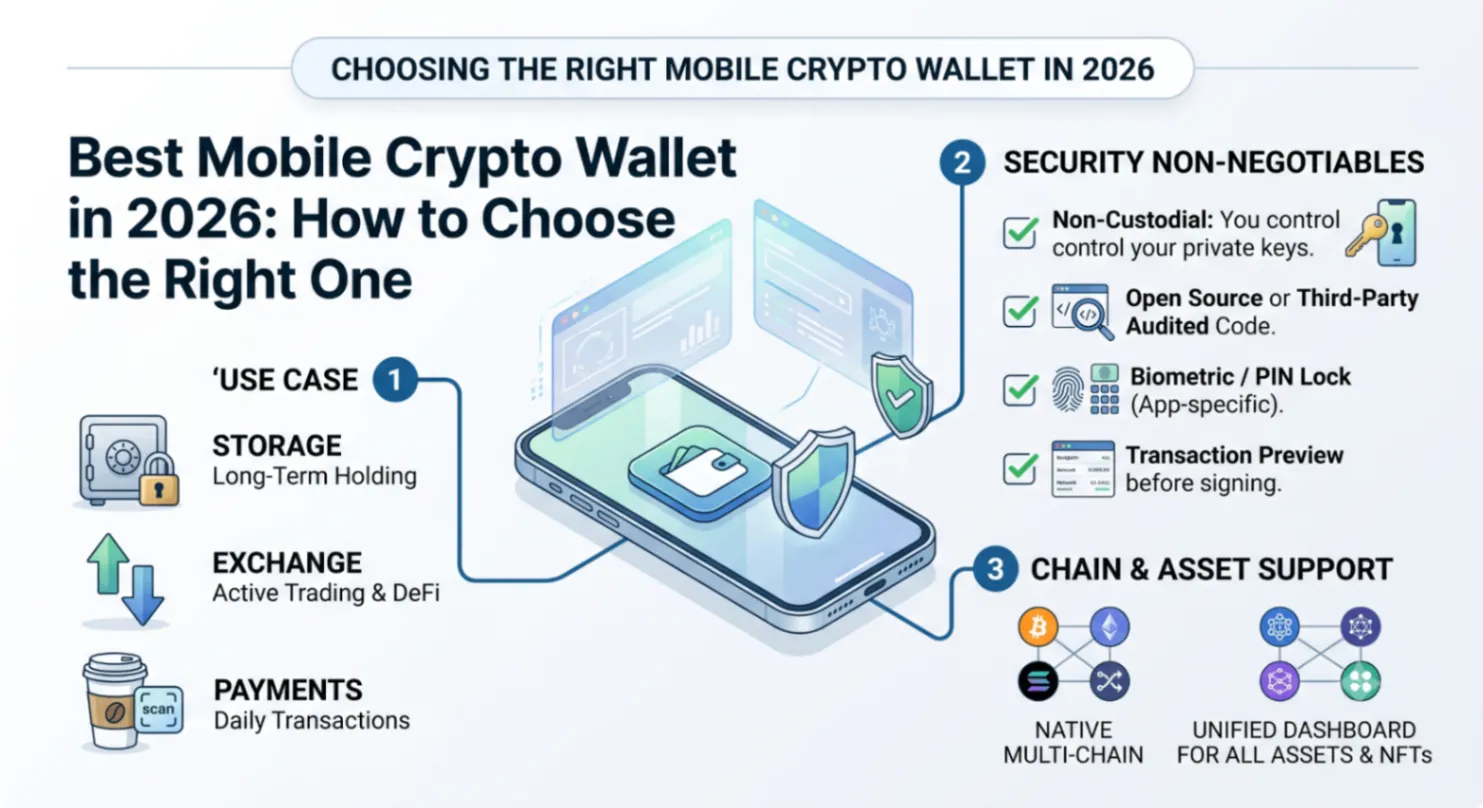
There is no single best mobile crypto wallet for everyone — the right choice depends on what you're actually doing with it. Someone holding a long-term Bitcoin position has very different needs than someone actively trading tokens across five chains or making everyday crypto payments. Before comparing apps, it helps to define your own use case:
- Long-term storage of a small number of assets
- Active multi-chain trading and DeFi participation
- Everyday spending and payments
- NFT collecting and marketplace interaction
Once you know the use case, the feature list narrows quickly.
Non-Negotiable Security Criteria
Regardless of use case, certain security features should be considered mandatory rather than “nice to have”:
- Non-custodial key storage. The app should never transmit your private key or seed phrase off your device. See our non-custodial wallet guide for the full breakdown.
- Open, verifiable code or third-party audits. Reputable wallets publish audit results or maintain open-source repositories.
- Biometric/PIN lock separate from device lock. An extra authentication layer specifically for the wallet app.
- Clear seed phrase backup flow. Onboarding should walk you through backup deliberately, not bury it in settings.
- Transaction preview before signing. You should be able to see exactly what a transaction will do — recipient, amount, network, and any permissions being granted — before approving it.
Any wallet missing these basics should be treated as a red flag, regardless of how polished its interface looks.
Chain and Asset Support
Mobile wallets vary widely in which blockchains they support natively versus through third-party bridges. If you hold assets across multiple networks, look for:
- Native multi-chain support built into the wallet's core architecture, not bolted on as an afterthought
- Automatic network detection when receiving assets, reducing the risk of sending funds to the wrong chain
- Token and NFT visibility across all supported chains in a single dashboard
A wallet that only supports one or two chains might be fine for a Bitcoin-only holder, but it becomes a limitation quickly for anyone diversifying across ecosystems.
Usability Factors That Actually Matter
Security is the foundation, but usability determines whether you'll actually use the wallet correctly day to day:
- Clear, uncluttered interface for checking balances and sending/receiving funds
- Built-in swap or exchange functionality, so you don't need to move funds to a separate platform for basic trades
- Address book and labeling, reducing the risk of sending to the wrong address
- QR code scanning for fast, error-free address entry
- Fee estimation and customization, especially useful during network congestion
Comparing Wallet Types for Mobile Use
| Wallet Type | Best For | Trade-off |
|---|---|---|
| Hot mobile wallet (software-only) | Daily transactions, DeFi, active use | Private key lives on an internet-connected device |
| Mobile wallet + hardware pairing | Larger balances needing extra security | Slightly more setup friction |
| Exchange mobile app (custodial) | Trading, fiat on/off-ramp | No true ownership of keys |
Many experienced users run a hybrid approach: a mobile non-custodial wallet for spending money and active use, paired with a hardware wallet or cold storage for the bulk of their holdings.
Red Flags to Watch For
- Wallets that request your seed phrase through a “support” chat or customer service form
- Apps with no public information about the development team or company
- Excessive permission requests unrelated to core wallet functionality
- Wallets distributed only through unofficial third-party links rather than the developer's official website, or listed under a name that doesn't match the developer's official branding
- Reviews mentioning sudden balance discrepancies or withdrawal issues
A Practical Evaluation Checklist
Before committing to a mobile wallet, verify:
- Is it non-custodial, with keys generated and stored only on-device?
- Does it support the specific chains and tokens you hold?
- Is the seed phrase backup process clear and mandatory during setup?
- Can you preview transaction details before signing?
- Does it have a track record — reviews, audit history, or an identifiable development team?
- Does it fit your actual use case (storage, trading, spending, or NFTs)?
Frequently Asked Questions
Is a mobile wallet safe enough for large amounts of crypto?
Mobile wallets are reasonably secure for everyday amounts, especially with biometric locks and non-custodial architecture. For significant holdings, pairing the mobile app with a hardware wallet adds a meaningful layer of protection against device-level compromise.
Can I use more than one mobile wallet at once?
Yes. Many users separate funds by purpose — one wallet for daily spending, another for long-term holding — which also limits exposure if one wallet is ever compromised.
Do mobile wallets charge fees?
The wallet app itself is typically free to download and use. You'll still pay standard blockchain network fees for transactions, and possibly a small spread if you use an in-app swap feature.
How to Test-Drive a Wallet Before Committing
Reading feature lists only gets you so far — the best way to evaluate a mobile wallet is to actually use it with a small amount of funds before deciding to rely on it for anything larger. During this trial period, pay attention to:
- How clearly the app explains what's happening at each step, from setup through your first transaction
- Whether error messages are helpful or cryptic when something goes wrong (like entering an invalid address)
- How responsive the app feels when checking balances or loading transaction history, especially on a slower connection
- Whether customer support (if offered) is limited to general troubleshooting, or ever asks for sensitive information it shouldn't need
A wallet that feels confusing or evasive during this trial period with a small amount is unlikely to feel better once real money is involved.
Reading Community Feedback Critically
Public ratings and review counts, wherever they appear, are easy to manipulate, and crypto wallets are a frequent target for fake positive reviews designed to boost a counterfeit or poorly-built app's visibility. When evaluating any feedback you find:
- Look for detailed, specific accounts rather than generic praise with no substance
- Pay close attention to any recurring complaints about withdrawal issues, balance discrepancies, or unresponsive support
- Cross-reference the wallet's reputation across independent crypto community forums and social media rather than relying on a single source
- Be skeptical of reviews that read like advertising copy, especially clusters of similar-sounding positive posts appearing around the same time
Why “Best” Changes Over Time
The mobile wallet landscape moves quickly — new chains launch, security standards evolve, and previously reputable apps occasionally get acquired or change their approach to user data. A wallet that was the clear best choice two years ago may not hold that position today. It's worth periodically revisiting your choice of wallet, particularly checking whether it has kept pace with security audits, new chain support, and active development, rather than assuming an initial good choice remains optimal indefinitely.
Matching Wallet Choice to Life Stage in Crypto
The right mobile wallet often changes as someone's involvement with crypto matures. A newcomer buying their first small amount of Bitcoin has very different needs than the same person two years later, actively participating in DeFi across multiple chains. It's reasonable, and common, to switch wallets — or add a second one — as usage patterns evolve, rather than assuming the first wallet chosen has to remain the only one used indefinitely. Revisiting the evaluation criteria in this guide periodically, especially after a meaningful change in how you use crypto, helps ensure your wallet choice still matches your actual needs rather than reflecting decisions made when your usage looked very different.
Weighing Convenience Against Long-Term Fit
It's tempting to choose whichever wallet a friend recommends or whichever one appears first in a search, but a few extra minutes spent matching a wallet's actual feature set against your specific use case pays off considerably over time. A wallet that's slightly less convenient to set up but genuinely fits how you plan to use crypto — storage, active trading, spending, or a mix — will almost always serve you better over months and years than one chosen purely for its initial ease of setup.
The Bottom Line
The “best” mobile crypto wallet isn't the one topping a generic list — it's the one that matches your specific use case while meeting non-negotiable security standards: non-custodial key storage, transparent code, and clear transaction visibility. Define what you need the wallet to do first, then evaluate candidates against that checklist rather than marketing claims.
Download DOK Wallet and see how it fits your use case at dokwallet.com.