
Non-Custodial Crypto Wallet Explained: Why Owning Your Keys Matters
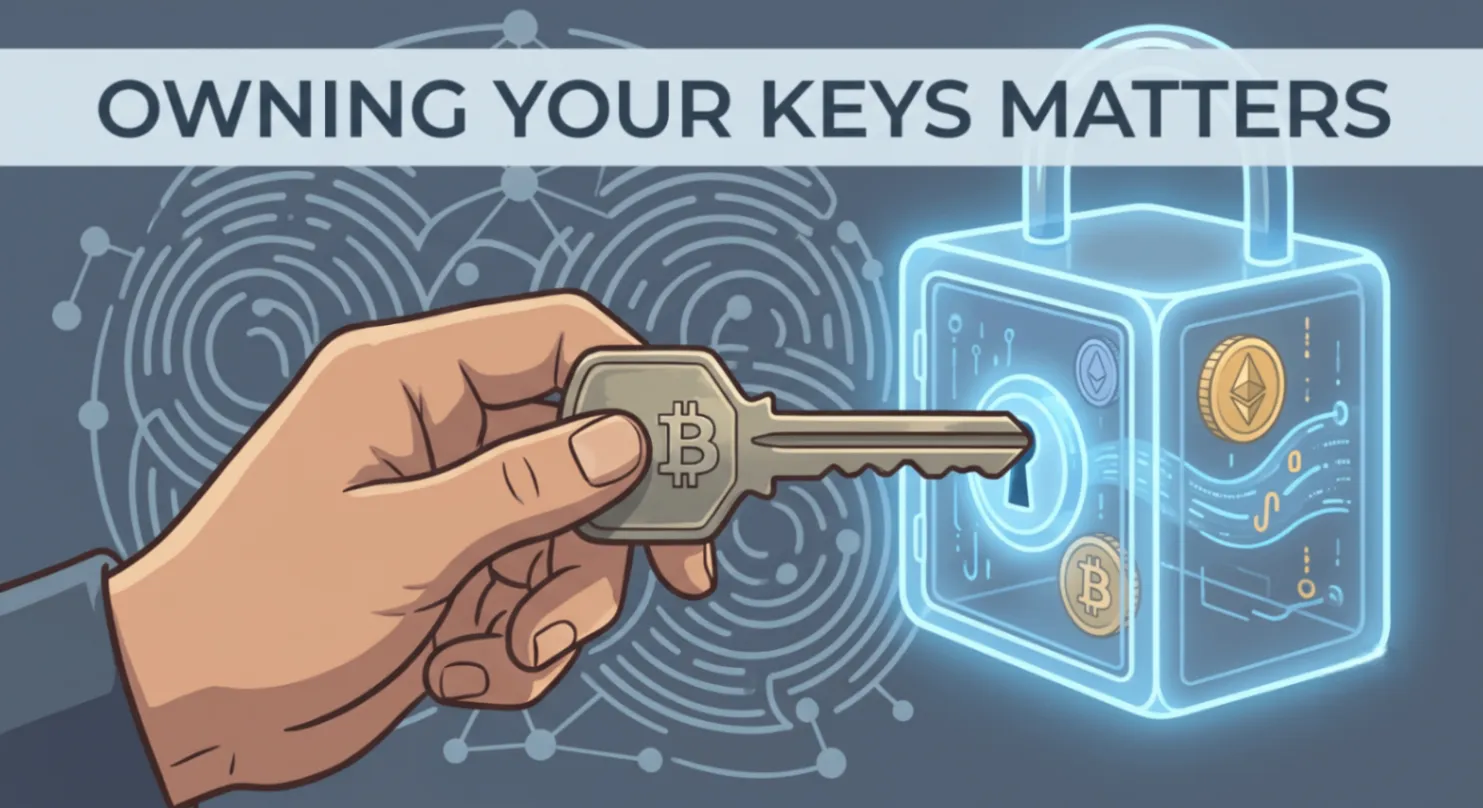
Every few years, crypto gets another reminder of what happens when users don't control their own funds. A platform pauses withdrawals, a company files for bankruptcy, or an account gets frozen over a compliance flag — and suddenly, balances that looked real on a screen become inaccessible. A non-custodial crypto wallet exists specifically to prevent that scenario by putting the keys, and the control, in your hands.
This article explains what “non-custodial” really means, how it differs from custodial storage, and the practical trade-offs you should understand before switching over.
Defining Non-Custodial in Plain Terms
“Custody” in crypto refers to who holds the private keys that control a wallet address. A custodial service — like most centralized exchanges — holds those keys on your behalf. You log in with a username and password, and the platform executes trades and withdrawals internally.
A non-custodial wallet flips this: the private key is generated and stored on your own device, and only you can authorize transactions. The platform or app developer never has access to your funds, cannot freeze your account, and cannot recover your password if you lose it — because there is no centralized account to reset.
In short, non-custodial means self-custody. You are the bank.
Why This Distinction Exists at All
Blockchains were designed to remove intermediaries from financial transactions. But early on, most people accessed crypto exclusively through exchanges, because exchanges were easier to use than raw wallet software. That convenience came at a cost: users were trusting a company with the same kind of blind faith they'd place in a traditional bank, except often without deposit insurance or regulatory protections.
Non-custodial wallets emerged to preserve the original promise of blockchain technology — verifiable, direct ownership — while gradually becoming easier to use, until today's versions look and feel much like any other mobile app.
How Ownership Actually Works
When a non-custodial wallet is created, it generates a private key and a corresponding seed phrase (usually 12–24 words). This seed phrase is mathematically tied to every address and asset the wallet controls. Two consequences follow from this:
- If you have the seed phrase, you have the funds — even if the original device is lost, stolen, or destroyed.
- If someone else obtains the seed phrase, they have the funds too — there is no support team to intervene or reverse a theft.
This is the central trade-off of self-custody: total control comes with total responsibility.
Non-Custodial vs. Custodial: A Side-by-Side Look
| Consideration | Non-Custodial Wallet | Custodial Platform |
|---|---|---|
| Who holds the keys | You | The platform |
| Withdrawal restrictions | None | Possible during outages, audits, or freezes |
| Password recovery | Not possible without seed phrase | Standard reset process |
| Exposure to platform failure | None | Direct exposure |
| Direct DeFi/dApp access | Yes | Usually no |
| Learning curve | Slightly higher | Lower |
Neither option is universally “better” — they serve different needs. Custodial accounts are convenient for frequent trading and fiat conversion. Non-custodial wallets are the right tool for holding assets securely and interacting directly with decentralized applications.
What You Gain by Going Non-Custodial
- No counterparty risk. Your funds cannot be lost because a company mismanaged reserves.
- Direct access to DeFi and Web3. Non-custodial wallets connect natively to decentralized exchanges, staking protocols, and NFT platforms.
- Portability. Assets can move between devices and even between different wallet apps using the same seed phrase, since the underlying blockchain address doesn't change.
- Privacy. No account creation, KYC document upload, or ongoing data collection is required simply to hold funds.
What You Take On in Return
- Full responsibility for backups. There's no “forgot password” option — only your own seed phrase backup.
- Personal security practices matter more. Phishing attempts, fake apps, and malicious browser extensions specifically target self-custody users.
- No reversals. Sending funds to the wrong address, or approving a malicious transaction, cannot be undone by a support ticket.
Best Practices for Non-Custodial Wallet Security
- Write your seed phrase on paper or metal, never digitally. No legitimate wallet provider will ever ask for it.
- Verify app authenticity before downloading — check the developer name and official website link.
- Use a hardware wallet for large balances, keeping the private key fully offline.
- Double-check every transaction detail — recipient address, network, and amount — before confirming.
- Separate wallets by purpose. Keep a small “hot” wallet for daily use and a separate, rarely-touched wallet for long-term holdings. For a deeper look at daily security habits, read our non-custodial wallet security guide.
Frequently Asked Questions
Can a non-custodial wallet be hacked remotely?
The wallet software itself can have vulnerabilities like any app, which is why choosing audited, reputable wallets matters. However, the funds themselves can only be moved with the private key or seed phrase, so remote theft typically requires tricking the user into revealing it (phishing) rather than breaking the cryptography.
Is it harder to use a non-custodial wallet than an exchange account?
The initial setup — generating and securely backing up a seed phrase — takes a few extra minutes compared to signing up with an email and password. After that, day-to-day use (sending, receiving, swapping) is comparable to any modern finance app.
What happens if I forget my seed phrase and lose my device?
The funds become permanently inaccessible. This is why secure, redundant backups are non-negotiable when using self-custody.
The Historical Cases That Shaped Non-Custodial Adoption
Non-custodial wallets didn't gain mainstream traction because of a marketing campaign — they gained traction because of repeated, well-documented failures of custodial platforms. Exchanges have gone insolvent while owing users far more than they held in reserve. Others have frozen withdrawals during periods of market stress, only to resume them weeks or months later, if at all. Some have suffered breaches where attackers drained hot wallets holding customer funds, with users left waiting on reimbursement processes that dragged on for years.
None of these scenarios are possible with a properly used non-custodial wallet, not because non-custodial wallets are immune to all risk, but because the specific risk of a third party mismanaging or losing your funds simply doesn't apply when there's no third party holding them in the first place.
Non-Custodial Doesn't Mean Anonymous
A common misconception is that non-custodial wallets provide anonymity. In reality, most blockchains are pseudonymous, not anonymous — every transaction is permanently recorded and publicly viewable, tied to a wallet address rather than a name. Sophisticated blockchain analysis can often link addresses to real-world identities, particularly when funds move to or from a regulated exchange that has collected identity information. Non-custodial simply means no company controls your keys; it does not mean your on-chain activity is untraceable.
Building Good Habits Early
The learning curve for self-custody is front-loaded — the concepts of seed phrases, gas fees, and transaction finality take a bit of upfront effort to internalize, but they don't get more complicated with experience. Users who take the time to understand these fundamentals early tend to avoid the costly mistakes — sending to the wrong network, falling for phishing links, losing an unbacked seed phrase — that account for the vast majority of self-custody losses. The wallet software handles the cryptography; your job is simply to protect the one piece of information — the seed phrase — that the entire system depends on.
Transitioning From Custodial to Non-Custodial Gradually
For holders currently keeping most or all funds on a custodial platform, the shift to non-custodial storage doesn't need to happen all at once. A common, sensible approach is to start by moving a small, non-critical amount to a newly set up non-custodial wallet, practicing the full send-and-receive process, confirming the seed phrase backup works by restoring the wallet on a second device, and only then gradually moving larger holdings over as confidence and familiarity build. This staged approach reduces the risk of a costly early mistake — like sending to an untested address or mishandling a seed phrase backup — while still moving steadily toward the security benefits of full self-custody.
Choosing a Wallet Provider You Can Verify
Since a non-custodial wallet's core promise depends on the software behaving exactly as claimed, it's worth taking a moment to verify the provider behind any wallet before installing it. Look for a clearly identified development team or company, official documentation explaining how keys are generated and stored, and — ideally — independent security audits or open-source code that can be reviewed by outside researchers. Downloading only from the developer's official website, and double-checking the URL before entering it, further reduces the risk of installing a counterfeit version of a legitimate wallet designed to intercept seed phrases during setup.
The Bottom Line
A non-custodial crypto wallet gives you what centralized platforms structurally cannot: direct, verifiable ownership of your assets. That ownership comes with real responsibility, but for anyone holding crypto for more than a quick trade, understanding and adopting non-custodial storage is one of the most important security decisions you can make.
Download DOK Wallet and take full ownership of your keys at dokwallet.com.