
Multi-Chain Crypto Wallet: Managing Assets Across Blockchains
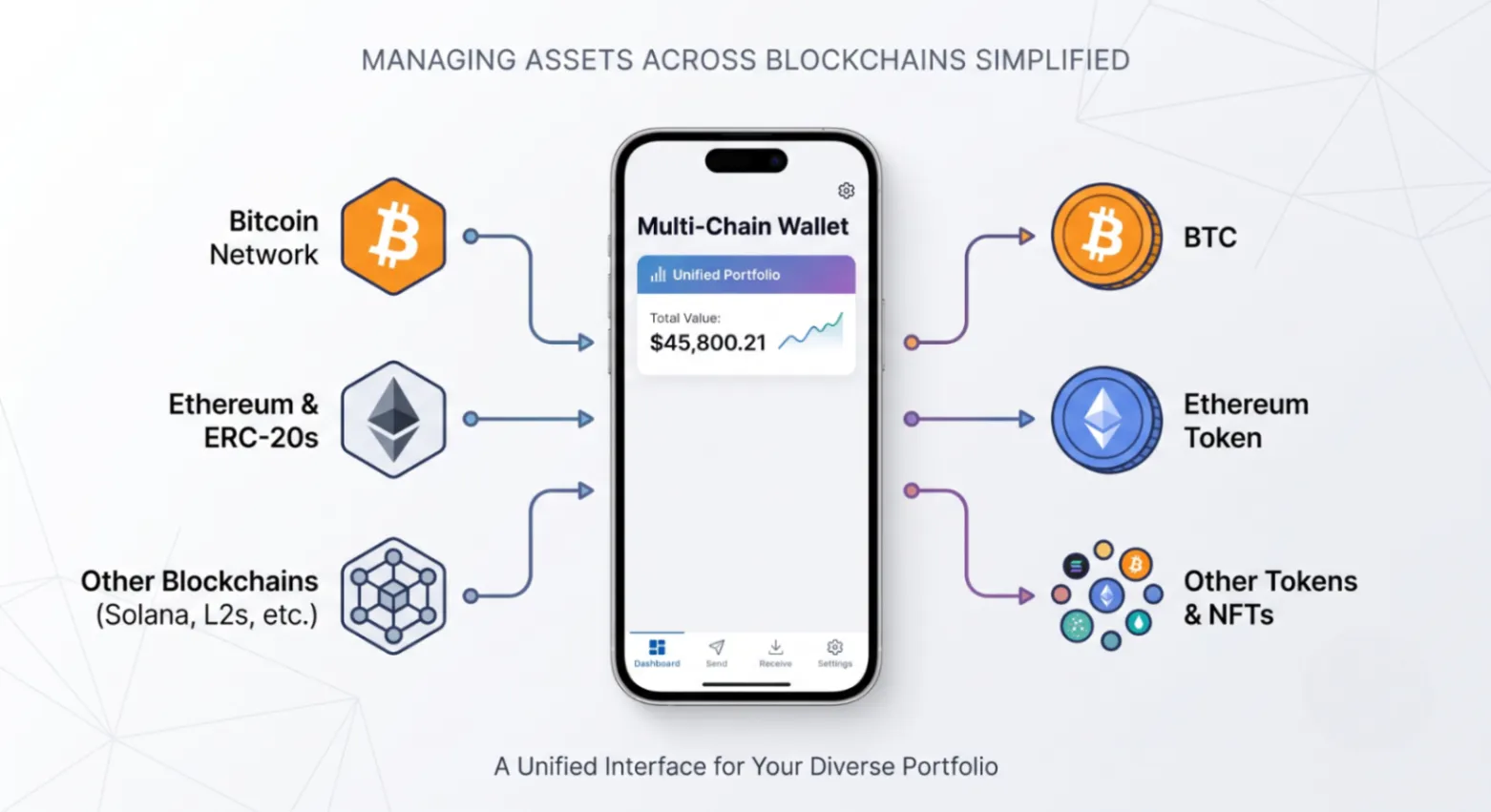
Crypto portfolios rarely stay confined to a single blockchain for long. A holder might start with Bitcoin, move into Ethereum-based tokens, pick up assets on a faster or cheaper alternative chain, and eventually end up juggling four or five separate wallet apps just to see the full picture of what they own. A multi-chain crypto wallet solves this by consolidating access to multiple blockchains into a single interface — without giving up self-custody.
What Makes a Wallet “Multi-Chain”
A multi-chain wallet generates and manages separate key pairs for each supported blockchain, but presents them to the user through one unified app. Under the hood, Bitcoin, Ethereum, and other networks all use different address formats and signing mechanisms — a multi-chain wallet handles that complexity internally, so from the user's perspective, switching between assets on different chains feels seamless.
This differs from a single-chain wallet, which is purpose-built for one network (a Bitcoin-only wallet, for example) and simply cannot hold assets from other blockchains.
Why Portfolio Diversification Made This Necessary
As the number of active blockchains grew, so did the number of assets living outside Ethereum and Bitcoin. Layer-2 networks, alternative smart contract platforms, and specialized chains for gaming, payments, or DeFi each attracted their own ecosystems of tokens. For an active participant in crypto, holding assets across three, four, or more networks became normal rather than exceptional.
Without a multi-chain wallet, managing that portfolio means installing a separate app for every chain, tracking multiple seed phrases, and manually piecing together a picture of total holdings — a process that is both inconvenient and a security liability, since more apps mean more attack surface.
Core Benefits of Consolidation
- Single interface for portfolio visibility. See balances across all supported chains without switching apps.
- Fewer seed phrases to manage. Many multi-chain wallets use a single recovery phrase to derive keys for multiple networks, reducing backup complexity.
- Simplified sending and receiving. The wallet automatically selects the correct network and address format for each asset. See our guide to crypto wallets for multiple coins for more on this.
- Consistent security practices. One set of security settings — biometric lock, PIN, backup — applies across all your holdings rather than being fragmented across separate apps.
How Multi-Chain Wallets Handle Different Networks
Each blockchain has its own rules for addresses, transaction formats, and confirmation times. A well-built multi-chain wallet typically uses hierarchical deterministic (HD) key derivation — a standard that allows one seed phrase to mathematically generate distinct key pairs for each supported chain. This means you get one backup to protect, even though the wallet is technically managing several independent sets of keys behind the scenes.
When you send a transaction, the wallet automatically applies the correct network fee structure and confirmation logic for that specific chain, rather than requiring you to understand the technical differences yourself.
What to Check Before Choosing a Multi-Chain Wallet
- Does it support the specific chains you actually use? “Multi-chain” can mean two networks or twenty — check the supported list directly.
- Is key derivation handled transparently and audited? The mechanism linking one seed phrase to multiple chains should be well-documented and independently reviewed.
- Does it clearly separate assets by network in the interface, so you're never confused about which chain a token lives on?
- Are network fees displayed per-transaction, since gas costs vary significantly between chains?
Common Pitfalls With Multi-Chain Wallets
- Sending assets to the wrong network. Because addresses can look similar across chains, always confirm the network before sending — a token sent to the wrong chain's address format is often unrecoverable.
- Assuming all chains are equally secure. Newer or less-established networks may carry higher smart contract or bridge risk than established chains.
- Overlooking per-chain fees. Some networks have significantly higher transaction costs; check estimated fees before confirming.
- Not verifying chain-specific token contracts. Scam tokens sometimes mimic legitimate assets on less-monitored chains — always verify contract addresses from official sources.
Multi-Chain vs. Using Separate Single-Chain Wallets
| Factor | Multi-Chain Wallet | Multiple Single-Chain Wallets |
|---|---|---|
| Backup complexity | One seed phrase (typically) | Separate backup per wallet |
| Portfolio visibility | Unified dashboard | Manual aggregation required |
| App management | One app | Multiple apps to maintain and update |
| Attack surface | Consolidated | Larger, spread across apps |
| Chain-specific features | May lag specialized wallets | Often more advanced per chain |
For most users holding assets across more than one or two networks, the convenience and reduced attack surface of a multi-chain wallet outweighs the marginal feature advantages of specialized single-chain apps.
Frequently Asked Questions
Does a multi-chain wallet mean my assets are stored in one place?
No — each blockchain still stores its own assets on its own ledger. The wallet simply provides unified access and management; it doesn't merge the underlying networks.
Is a multi-chain wallet less secure than a single-chain wallet?
Not inherently. Security depends on the wallet's architecture — non-custodial key storage, audit history, and code quality — rather than the number of chains it supports.
Can I add support for a new chain later without losing my existing assets?
Most reputable multi-chain wallets allow new network support to be added via updates without affecting previously stored assets, since each chain's keys are managed independently within the same seed phrase structure.
A Real-World Scenario: Managing a Diversified Portfolio
Consider a holder with Bitcoin acquired several years ago, Ethereum-based tokens from more recent DeFi activity, and a smaller position on a newer, faster chain used for a specific gaming application. Without a multi-chain wallet, tracking this portfolio means opening three separate apps just to see a complete balance snapshot, and separately backing up three seed phrases — any one of which, if lost or exposed, puts a portion of the total portfolio at risk.
With a multi-chain wallet using proper HD key derivation, that same holder backs up a single seed phrase, opens one app to check total portfolio value across all three positions, and applies one consistent set of security settings — biometric lock, auto-lock timer, transaction previews — across the entire spread of assets. The underlying blockchains haven't changed; what's changed is the operational burden of managing exposure to all three safely.
Interoperability Standards Worth Knowing
As multi-chain wallets have matured, certain technical standards have emerged to make cross-chain compatibility more consistent:
- BIP-32/BIP-44, the standards underlying hierarchical deterministic wallets, define how a single seed can derive keys for multiple accounts and, with chain-specific derivation paths, multiple blockchains
- Chain ID standards, helping wallets and applications correctly identify which network a given transaction is intended for, reducing the risk of cross-network confusion
- WalletConnect and similar protocols, allowing a single wallet to securely interact with dApps across different chains through a standardized connection method
Understanding that these standards exist — even without needing to understand their technical implementation in depth — helps explain why reputable multi-chain wallets can offer a single, coherent seed phrase backup while still operating across genuinely separate blockchain networks.
Looking Ahead: Where Multi-Chain Management Is Heading
Wallet technology continues to move toward abstracting away the underlying complexity of individual blockchains even further. Emerging approaches like account abstraction aim to let users interact with multiple chains using more flexible, programmable account structures, potentially reducing friction points like needing to hold a chain's native asset just to pay transaction fees on that chain. While these developments are still maturing, the general direction is clear: multi-chain wallets will likely keep getting simpler to use, even as the number of underlying blockchains they support continues to grow.
Keeping Multi-Chain Holdings Organized Long-Term
As a multi-chain portfolio grows, small organizational habits make a meaningful difference in avoiding costly mistakes. Keeping a personal, offline record of which assets live on which chain, periodically cross-checking wallet balances against a blockchain explorer for accuracy, and labeling addresses within the wallet where the feature is supported all help maintain clarity as the number of chains and assets involved grows over time. These habits cost little effort but meaningfully reduce the chance of a costly network mix-up down the line.
A Note on Fee Transparency Across Chains
Because gas costs can vary dramatically between networks — sometimes by a factor of ten or more depending on congestion — a genuinely helpful multi-chain wallet displays estimated fees clearly for each transaction before you confirm, rather than surfacing a single generic fee estimate. This transparency matters most when moving smaller amounts, where a disproportionately high fee on a congested network can meaningfully eat into the value being transferred.
The Bottom Line
A multi-chain crypto wallet reflects how crypto portfolios actually look today — spread across several ecosystems rather than confined to one network. Consolidating that management into a single, secure, non-custodial app reduces both the friction and the security risk of juggling multiple standalone wallets.
Download DOK Wallet and manage every chain from one app at dokwallet.com.