What Is a Non-Custodial Crypto Wallet and Why Does It Matter?
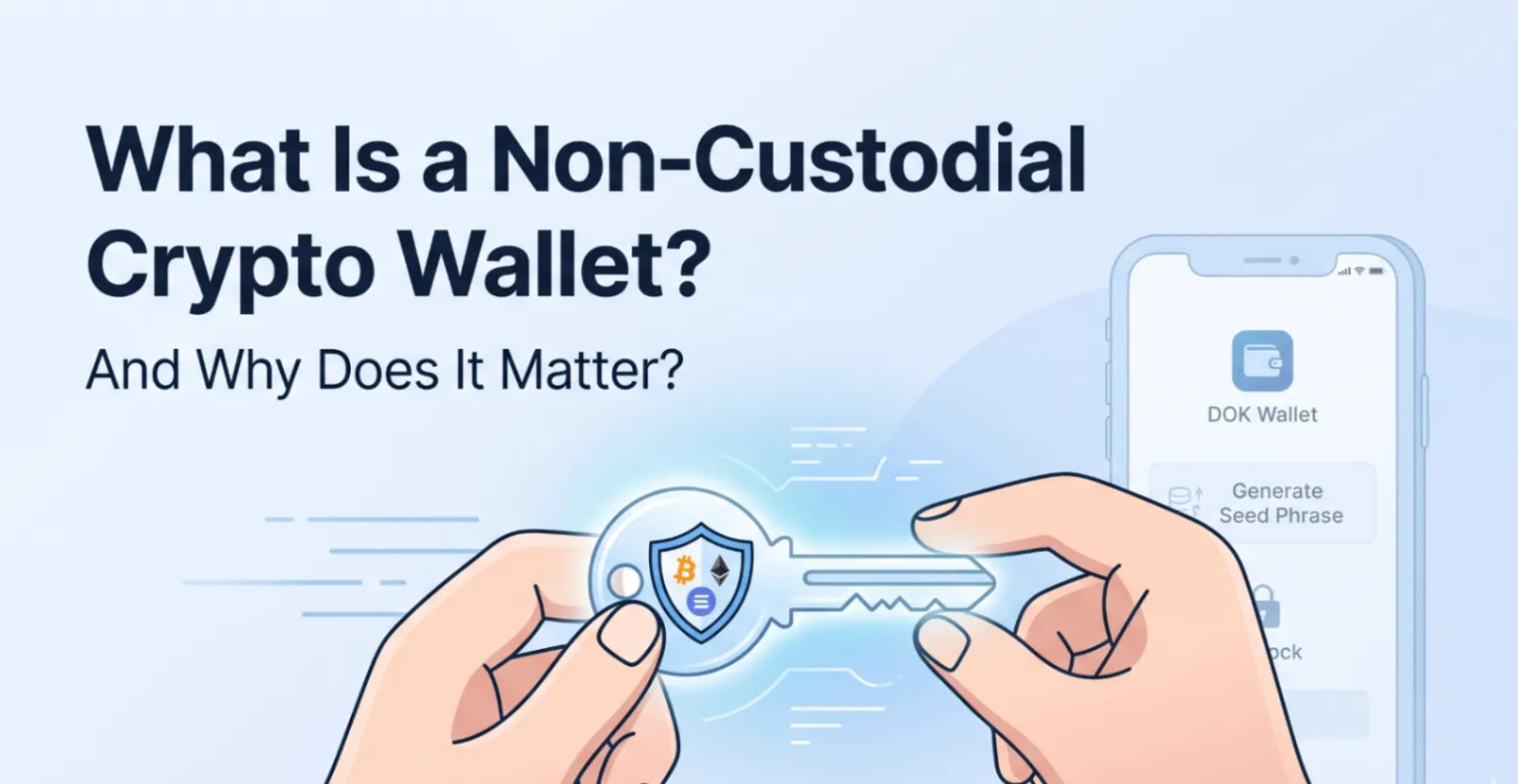
Crypto ownership is not just about buying digital assets. It is about controlling them. The moment you purchase Bitcoin or Ethereum on a centralised exchange, you are not actually the owner of that crypto. You hold a balance that the exchange owes you, and the exchange holds the real keys. A non-custodial crypto wallet changes that arrangement entirely.
This guide explains what a non-custodial wallet is, how it compares to custodial alternatives, and why DOK Wallet is built around this model as a core design principle.
The Meaning of Custody in Crypto
Custody refers to who holds the private keys to a blockchain address. Private keys are cryptographic credentials that prove ownership of assets at a given address. Whoever controls the private key controls the assets. No private key access means no asset access.
When you store crypto on an exchange, the exchange holds the private keys in its own wallets. Your account balance is a database entry representing what the exchange owes you. When you use a non-custodial crypto wallet, you hold your own private keys on your own device. The difference is total.
For a broader look at how wallet types compare, visit the DOK Wallet open-source page.
How a Non-Custodial Wallet Actually Works
When you create a wallet in DOK Wallet for the first time, the app generates a seed phrase of twelve or twenty-four words on your device. This seed phrase is the master key to your wallet. Every private key for every blockchain address in your wallet is mathematically derived from this seed phrase.
DOK Wallet never transmits this seed phrase to any server. It is generated locally, stored locally, and known only to you. When you confirm your seed phrase during setup, you are taking full ownership of your assets from that moment forward.
Why Non-Custodial Ownership Matters
The risks of custodial storage have played out publicly and repeatedly over the years. Exchanges have been hacked, frozen withdrawals, collapsed due to mismanagement, and been shut down by regulators. In every case, users who held assets on those platforms lost access, sometimes permanently. Users who held their own keys through non-custodial wallets were unaffected.
- Exchange hacks cannot reach assets in your own wallet.
- Platform insolvency does not affect your self-custodied holdings.
- Regulatory actions against a company cannot freeze your private wallet.
- Withdrawal restrictions imposed by exchanges do not apply to your own wallet.
What Self-Custody Requires From You
Non-custodial ownership comes with one critical responsibility: you must protect your seed phrase. Write it down on paper, store it securely, and never photograph it or save it digitally. If your seed phrase is lost, there is no recovery option. If someone else obtains it, they own your assets.
This responsibility is not a flaw in the system. It is the mechanism that makes true ownership possible. DOK Wallet guides users through the seed phrase setup clearly, ensuring every new user understands what they are taking on before proceeding.
DOK Wallet as a Non-Custodial Platform
DOK Wallet is built on a fully non-custodial architecture. The app supports multiple blockchains and hundreds of assets, all under a single seed phrase that lives only on your device. The codebase is open source, meaning anyone can review how key management is handled.
Explore DOK Wallet's open-source repository at dokwallet.com/open-source. For a detailed comparison of DOK Wallet against other wallet types, read our full DOK Wallet review.
The Long-Term Case for Non-Custodial Storage
For short-term traders who need rapid access to order books, an exchange is a practical tool. But for anyone holding crypto over the medium or long term, non-custodial storage eliminates a category of risk that has destroyed portfolios repeatedly throughout crypto history.
DOK Wallet makes non-custodial ownership accessible to users without technical backgrounds. The interface is clean and mobile-first, the setup takes minutes, and the security model is institutional-grade without requiring institutional knowledge.
See how DOK Wallet handles mobile wallet security in our mobile wallet guide. Learn how DOK Wallet supports multiple blockchains at once in our multi-chain wallet guide.
Frequently Asked Questions
What is a non-custodial crypto wallet?
A non-custodial wallet is one where you hold your own private keys. The wallet app is simply an interface for your keys and the blockchain — no company holds your funds or can restrict access to them.
Why is a non-custodial wallet safer than a custodial one?
With a custodial wallet, a third party controls your private keys. If that platform is hacked, goes insolvent, or freezes withdrawals, you have no access to your funds. A non-custodial wallet eliminates this counterparty risk entirely.
What happens if I lose my phone?
As long as you have your seed phrase written down and stored safely, you can restore your full wallet on any new device by installing DOK Wallet and importing your phrase. Your funds are tied to your seed phrase, not your hardware.
Does DOK Wallet store my private keys?
No. DOK Wallet generates your private keys locally on your device and never transmits them anywhere. No DOK Wallet server holds any user key material.
Is DOK Wallet free to use?
Yes. DOK Wallet is free to download and use on iOS and Android. Network transaction fees are paid to the relevant blockchains, not to DOK Wallet.
What is a seed phrase?
A seed phrase is a sequence of 12 or 24 words generated when you create your wallet. It is the master key that can restore your entire wallet — all addresses across all supported blockchains — on any compatible device.
Final Thoughts
A non-custodial crypto wallet is not just a technical product. It is a statement about who should control your financial assets. DOK Wallet answers that question clearly: you should. The tools, the security model, and the open-source code all exist to make that possible.
Download DOK Wallet and take full ownership of your crypto at dokwallet.com.