
All-in-One Crypto Wallet: Simplifying Your Digital Asset Management
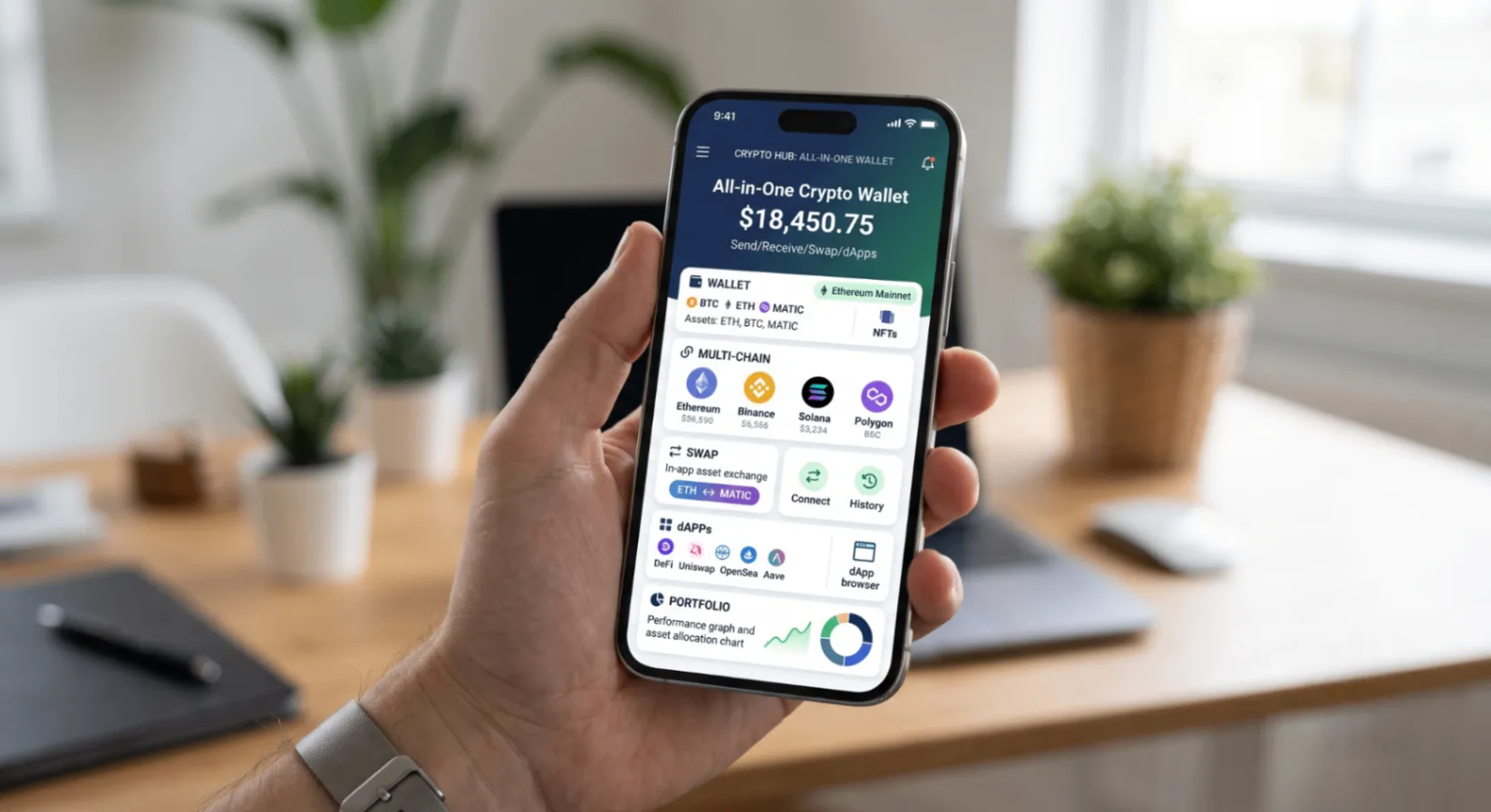
Early crypto users often needed a small toolkit of separate apps: one wallet for storage, another platform for trading, a browser extension for DeFi, and yet another app for tracking portfolio value. An all-in-one crypto wallet consolidates that toolkit into a single application — the goal being to handle storage, swaps, multi-chain management, and dApp access without forcing users to bounce between platforms.
What “All-in-One” Actually Covers
The term gets used loosely, so it's worth defining clearly. A genuinely all-in-one wallet typically bundles:
- Multi-chain asset storage — holding coins, tokens, and NFTs across several blockchains
- Built-in swap/exchange functionality — trading assets without leaving the app
- dApp browser and Web3 connectivity — interacting with DeFi protocols, marketplaces, and other decentralized applications
- Portfolio tracking — a consolidated view of holdings and value across chains
- Fiat on/off-ramp integration — buying or selling crypto using traditional payment methods, where regulation allows
A wallet missing several of these isn't necessarily worse — it may simply be more specialized — but it shouldn't be marketed or evaluated as “all-in-one” if it only covers basic storage and transfers.
Why Consolidation Appeals to Users
Every additional app in a crypto workflow introduces friction and risk:
- More seed phrases and accounts to manage and secure
- More permissions granted across more platforms
- More opportunities for phishing, since attackers often impersonate the specific apps a user is known to rely on
- More cognitive overhead, tracking which asset lives where and which app to open for which task
An all-in-one wallet reduces this surface area by handling the majority of common crypto activities within one, presumably well-vetted, application.
The Trade-off: Convenience vs. Specialization
Consolidation isn't free of downsides. Specialized tools — a dedicated DEX aggregator, a hardware-only cold storage device, a chain-specific wallet — often outperform an all-in-one app in their specific niche, offering better rates, more advanced features, or stronger isolation of risk.
The practical question isn't “is all-in-one better,” but rather: does the convenience of consolidation outweigh the marginal advantages of specialized tools, for your specific usage pattern?
For most users managing a moderate, diversified portfolio without highly advanced trading needs, the answer is generally yes.
Evaluating an All-in-One Wallet's Core Components
Storage security
- Non-custodial key generation and storage, confirmed independently of marketing claims
- Support for pairing with a hardware wallet for larger balances
Swap functionality
- Transparent pricing, showing the actual exchange rate versus the quoted rate
- Routing through reputable, audited decentralized exchange protocols
- Clear breakdown of network fees versus any service fee
dApp connectivity
- Permission visibility and management for connected applications
- Transaction preview before signing any smart contract interaction
Portfolio tracking
- Accurate, real-time balance aggregation across all supported chains
- Historical transaction records with links to verify independently on a blockchain explorer
A Comparison Framework
| Need | All-in-One Wallet | Multiple Specialized Tools |
|---|---|---|
| Simplicity | High — one app for most tasks | Lower — multiple apps required |
| Attack surface | Reduced, consolidated in one app | Larger, spread across tools |
| Feature depth per function | Generally solid, sometimes less advanced | Often more advanced per specialty |
| Backup/security management | Simplified — fewer seed phrases | More complex — multiple accounts |
| Ideal user | Most individual holders and active users | Advanced traders with specific needs |
Practical Guidance for Choosing One
- List your actual activities — storage, swapping, DeFi, NFTs, spending — before comparing apps.
- Confirm non-custodial architecture as a baseline requirement, regardless of how many features are bundled.
- Test the swap feature with a small amount before relying on it for larger trades, to confirm pricing transparency.
- Check chain and token support against your actual holdings, not just a general “multi-chain” claim.
- Review how permissions are managed for connected dApps, since an all-in-one wallet becomes your primary Web3 identity.
Common Misconceptions
- “All-in-one means less secure.” Not inherently true — security depends on architecture (non-custodial key storage, audits), not the number of features bundled.
- “More features always means more value.” Features you don't use add complexity without benefit; match the wallet to your actual needs.
- “All-in-one wallets are only for beginners.” Many active, experienced users prefer consolidated wallets specifically to reduce the number of trust decisions and attack surfaces in their workflow.
Frequently Asked Questions
Does an all-in-one wallet cost more to use than separate apps?
Not necessarily. The wallet itself is typically free; you'll pay standard network fees for transactions and, in some cases, a small service fee for in-app swaps — similar to what you'd pay using separate tools.
Can I still use a hardware wallet alongside an all-in-one app?
Yes. Many all-in-one wallets support pairing with hardware devices, letting you keep the convenience of the consolidated interface while storing keys for larger balances offline.
Is an all-in-one wallet non-custodial by default?
Not automatically — always verify. Some apps marketed as all-in-one platforms are actually custodial. Check specifically whether the private key is generated and stored on your device.
A Look at How Consolidated Wallets Reduce Phishing Exposure
Phishing remains one of the most common ways crypto users lose funds, and the attack surface generally grows with the number of separate apps and platforms a user relies on. Each additional app is a separate opportunity for an attacker to create a convincing fake version, a separate login or connection flow to imitate, and a separate brand for a user to learn to recognize (and therefore, potentially confuse with an impersonator).
An all-in-one wallet doesn't eliminate phishing risk, but it does reduce the number of distinct platforms a user needs to interact with regularly, which correspondingly reduces the number of contexts in which a convincing fake could plausibly insert itself into a user's routine. This is a secondary but genuine security benefit of consolidation, beyond the more obvious convenience factor.
When Specialized Tools Still Make Sense
Despite the advantages of consolidation, there are scenarios where reaching for a specialized tool alongside an all-in-one wallet still makes sense:
- High-frequency or professional trading, where a dedicated exchange or DEX aggregator may offer better execution and lower fees at scale
- Cold storage for very large, long-term holdings, where a dedicated hardware wallet with minimal software surface area is preferable
- Advanced DeFi strategies involving protocols not yet integrated into the all-in-one wallet's dApp browser
In these cases, the all-in-one wallet can still serve as the central hub — holding the bulk of assets and handling everyday activity — while specialized tools are used deliberately and occasionally for specific advanced needs.
Assessing Total Cost of Ownership
When comparing an all-in-one wallet against a collection of specialized tools, it's worth thinking beyond individual transaction fees to the total cost of ownership over time — including the time spent managing multiple apps, the cognitive cost of tracking several sets of security settings, and the compounding risk of maintaining a larger number of separate accounts and backups. For most individual users, the modest convenience fees sometimes associated with in-app swaps or bundled features in an all-in-one wallet are offset by the reduced overhead and lower operational risk of managing a single, well-secured application rather than several loosely connected ones.
Onboarding Simplicity Without Cutting Corners
Part of the appeal of an all-in-one wallet is a smoother onboarding experience — one setup flow, one seed phrase backup, one set of initial security choices, rather than repeating that process across several separate apps. This is a genuine usability benefit, but it's worth confirming the onboarding process doesn't sacrifice the important steps, like a mandatory, guided seed phrase backup, simply in the name of a faster setup. A well-built all-in-one wallet should manage to be both quick to get started with and thorough about the security fundamentals along the way.
Keeping Feature Bloat in Check
There's a natural tension in all-in-one design between adding more functionality and preserving a clean, understandable interface. The best-executed all-in-one wallets manage to bundle storage, swaps, dApp access, and portfolio tracking without burying core actions like sending and receiving under layers of secondary features. When evaluating an app, it's worth checking whether the most common actions remain quick and obvious, even after all the additional functionality has been added. A useful practical test: open the app for the first time and see how many taps it takes to complete the most basic action — sending funds — without needing to search through menus or guess where a feature might be hiding.
The Bottom Line
An all-in-one crypto wallet trades a small amount of specialized feature depth for a meaningful reduction in complexity and attack surface. For most individual users managing a multi-chain portfolio, that trade-off is worthwhile — provided the wallet maintains non-custodial security as its foundation rather than sacrificing it for convenience.
Download DOK Wallet and manage your entire portfolio from one app at dokwallet.com.