
Cross-Border Crypto Payments: The Future of Global Money Transfers
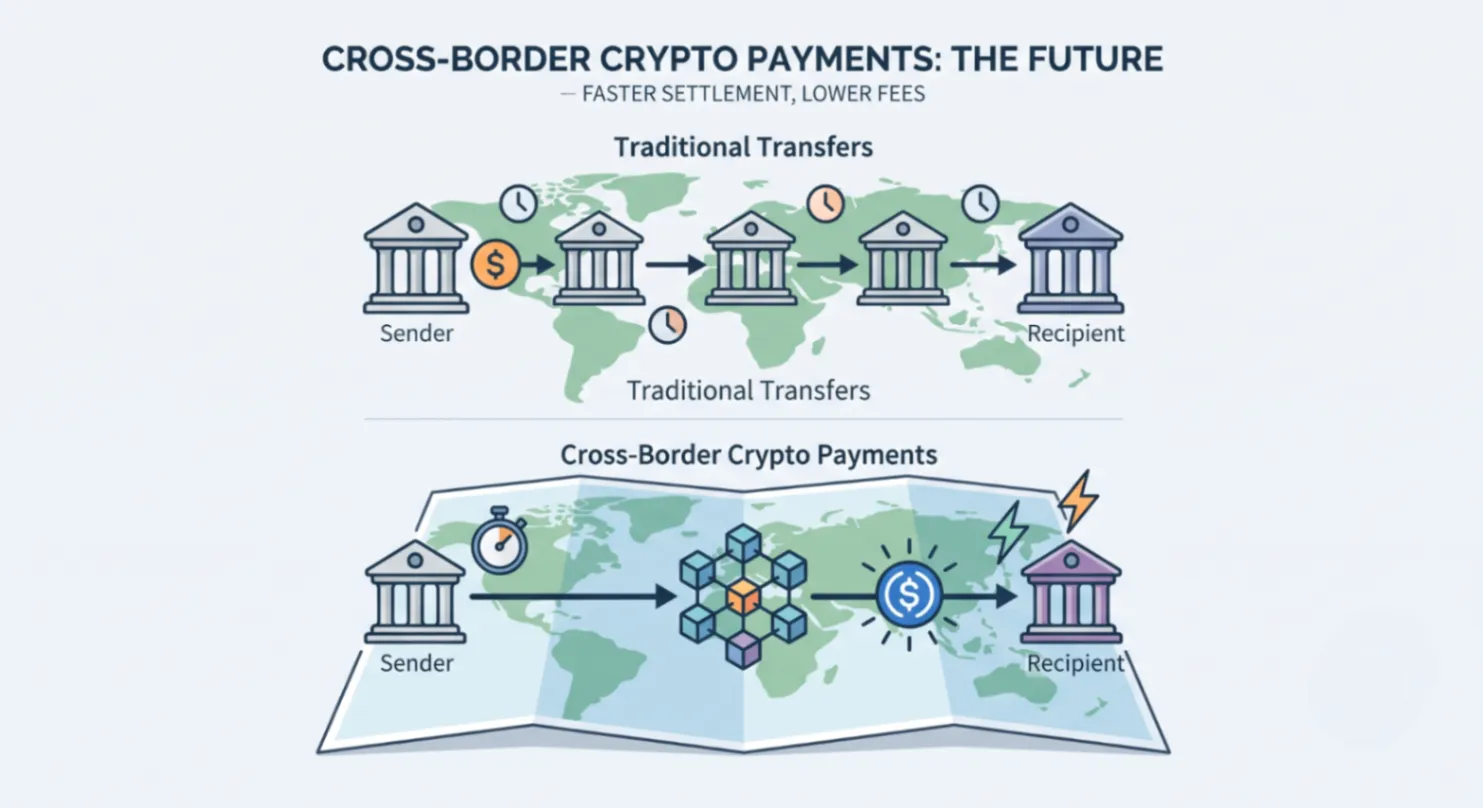
Sending money internationally through traditional channels has always meant accepting a familiar set of trade-offs: multi-day settlement times, layered intermediary fees, and unfavorable currency conversion rates. Cross-border crypto payments offer a fundamentally different model — near-instant settlement on public blockchains, without the chain of correspondent banks that traditional wire transfers rely on. Understanding how this actually works, and where the real risks lie, matters before relying on it for anything significant.
Why Traditional Cross-Border Payments Are Slow and Expensive
A typical international wire transfer passes through several intermediary banks, each taking a cut and adding processing time. Currency conversion happens at rates set by the banks involved, often with a spread that isn't fully disclosed upfront. The result: transfers that can take two to five business days and cost anywhere from a small percentage to a significant flat fee, depending on the corridor and provider.
For underbanked regions or countries with less-developed banking infrastructure, these delays and costs are often even more pronounced.
How Crypto Changes the Equation
A cross-border crypto payment moves value directly on a blockchain network, without requiring the sender's and recipient's banks to have a pre-established relationship. In practical terms:
- Settlement happens on-chain, typically within minutes, regardless of the sender's and recipient's location
- Fees are determined by network conditions, not by a chain of intermediary banks each adding their own charge
- The transaction is verifiable independently on a public blockchain explorer, rather than relying on opaque bank-to-bank confirmations
This is particularly relevant for stablecoins — cryptocurrencies pegged to a fiat currency like the US dollar — which combine blockchain settlement speed with price stability, avoiding the volatility concerns of using a fluctuating asset like Bitcoin for payments.
How a Typical Cross-Border Crypto Payment Works
- The sender converts fiat currency to crypto (often a stablecoin) through an exchange or wallet with fiat on-ramp support.
- The crypto is sent directly to the recipient's wallet address on the relevant blockchain.
- The recipient either holds the crypto or converts it back to local fiat currency through a local exchange or off-ramp service.
The entire on-chain portion of this process — step two — typically settles in minutes, regardless of the geographic distance between sender and recipient.
Real Advantages Over Traditional Transfers
- Speed: On-chain settlement is dramatically faster than correspondent banking networks.
- Transparency: Network fees are visible and predictable before sending, unlike bank fee structures that are often only partially disclosed.
- Accessibility: A crypto wallet can be set up without a traditional bank account, which matters significantly in regions with limited banking access.
- Reduced intermediary dependency: Fewer parties are involved in moving the value itself, reducing both delay and cumulative fees.
What Cross-Border Crypto Payments Don't Solve
- On/off-ramp friction remains. Converting fiat to crypto and back still depends on local exchanges or services, which vary in speed, fees, and availability by region.
- Regulatory status varies by country. Some jurisdictions have clear frameworks for crypto payments; others restrict or heavily regulate them.
- Recipient readiness matters. The recipient needs a compatible wallet and, in many cases, a way to convert the crypto to usable local currency.
- Volatility risk exists for non-stablecoin transfers. Sending a volatile asset exposes both parties to price movement between the time of sending and receiving.
Choosing the Right Asset for Cross-Border Payments
| Asset Type | Speed | Price Stability | Best For |
|---|---|---|---|
| Stablecoins | Fast | High (pegged to fiat) | Everyday payments, remittances |
| Bitcoin | Fast to moderate | Low | Larger transfers where volatility is acceptable |
| Other major cryptocurrencies | Fast | Variable | Specific use cases, ecosystem-dependent |
For most practical cross-border payment use cases — remittances, freelance payments, business settlements — stablecoins have become the preferred choice specifically because they remove the volatility variable from the equation.
Practical Considerations Before Sending
- Confirm the recipient's wallet and network compatibility — sending on the wrong blockchain network is a common and often irreversible mistake.
- Understand the off-ramp process on the recipient's end, including any local exchange fees or availability constraints.
- Check the regulatory status of crypto payments in both the sender's and recipient's jurisdictions.
- Factor in on-ramp and off-ramp fees, not just the on-chain network fee, when comparing total cost to traditional transfer methods.
- Send a test transaction first for larger, first-time transfers to a new recipient.
Frequently Asked Questions
Are cross-border crypto payments legal?
This varies significantly by country. Many jurisdictions permit crypto payments with certain regulatory requirements, while others impose restrictions. Always verify the current regulatory status in the relevant jurisdictions before relying on crypto for cross-border transfers.
Why are stablecoins preferred for cross-border payments?
Because they're pegged to a fiat currency, stablecoins provide the settlement speed of blockchain transactions without exposing either party to the price volatility associated with assets like Bitcoin or Ethereum.
How do fees compare to traditional wire transfers?
Network fees for crypto transactions are often lower than traditional wire transfer fees, though total cost depends heavily on the on-ramp and off-ramp services used to convert between fiat and crypto on each end.
Who Benefits Most From Cross-Border Crypto Payments
While the technology is available to anyone, certain groups see disproportionately larger practical benefits:
- Migrant workers sending remittances home, where traditional transfer fees can consume a meaningful percentage of the amount sent, particularly on smaller, frequent transfers
- Freelancers and remote workers being paid by international clients, who often face both delays and unfavorable conversion rates through traditional payment processors
- Small businesses conducting cross-border trade, where faster settlement can meaningfully improve cash flow compared to multi-day traditional transfers
- Individuals in regions with limited or unstable banking infrastructure, where a crypto wallet can serve as a functional alternative to a traditional bank account for receiving international payments
The Role of Regulation in Shaping Adoption
Regulatory clarity — or the lack of it — significantly shapes how practical cross-border crypto payments are in any given corridor. Some countries have established clear frameworks for stablecoin and crypto payment use, including licensing requirements for on/off-ramp providers. Others maintain restrictive or ambiguous positions that create real uncertainty for both individuals and businesses considering crypto for cross-border settlement.
This regulatory landscape continues to evolve, and it's worth checking current rules in the specific jurisdictions involved before relying on crypto payments for anything beyond a small, exploratory transfer — what's permitted and how it's taxed can differ substantially from one country to the next, and rules can change with little notice.
Looking at Real Settlement Time Differences
To put the speed advantage in concrete terms: a traditional international wire transfer routed through multiple correspondent banks commonly takes between one and five business days to fully settle, depending on the corridor and the banks involved, and that timeline can extend further around weekends or bank holidays in either the sending or receiving country. A comparable transfer settled on-chain, by contrast, typically confirms within minutes regardless of the day or time, since blockchain networks operate continuously rather than within banking hours. This difference becomes particularly meaningful for time-sensitive payments, such as urgent contractor payments or remittances needed to cover immediate expenses.
Preparing for Your First Cross-Border Transfer
If you're considering crypto for a cross-border payment for the first time, a careful first attempt goes a long way toward a smooth experience: confirm the recipient's wallet address and preferred network in advance, send a small test amount before committing to the full transfer, and have a clear plan for how the recipient will convert the funds to local currency if needed. Walking through this process once, deliberately and at a small scale, builds the confidence needed to rely on it for larger, more time-sensitive transfers later.
Comparing the Full Cost Picture, Not Just the Headline Fee
When comparing crypto payments to traditional cross-border transfer methods, it's worth looking beyond the advertised network fee to the full cost picture: any fee charged to convert fiat to crypto on the sending end, the network fee itself, and any fee charged to convert back to fiat on the receiving end. In some corridors this full picture still favors crypto significantly; in others, particularly where on/off-ramp services charge higher spreads, the total cost advantage narrows. Comparing the complete cost on both sides gives a far more accurate picture than comparing network fees alone.
The Bottom Line
Cross-border crypto payments address the core inefficiencies of traditional international transfers — speed, transparency, and intermediary costs — but they don't eliminate every friction point, particularly around converting to and from local currency. Understanding both the genuine advantages and the remaining practical considerations is essential before relying on crypto for cross-border money movement.
Download DOK Wallet and send value across borders at dokwallet.com.