Blockchain Wallet App: Features Every User Should Know
A blockchain wallet app is often described in one sentence — “it stores your crypto” — which undersells what these apps have become. Modern wallet apps are the primary gateway to an entire ecosystem: sending and receiving assets, interacting with decentralized applications, swapping tokens, and increasingly, spending crypto directly. Understanding the features behind that gateway helps you evaluate whether a given app is actually built to protect your funds, or just built to look simple.
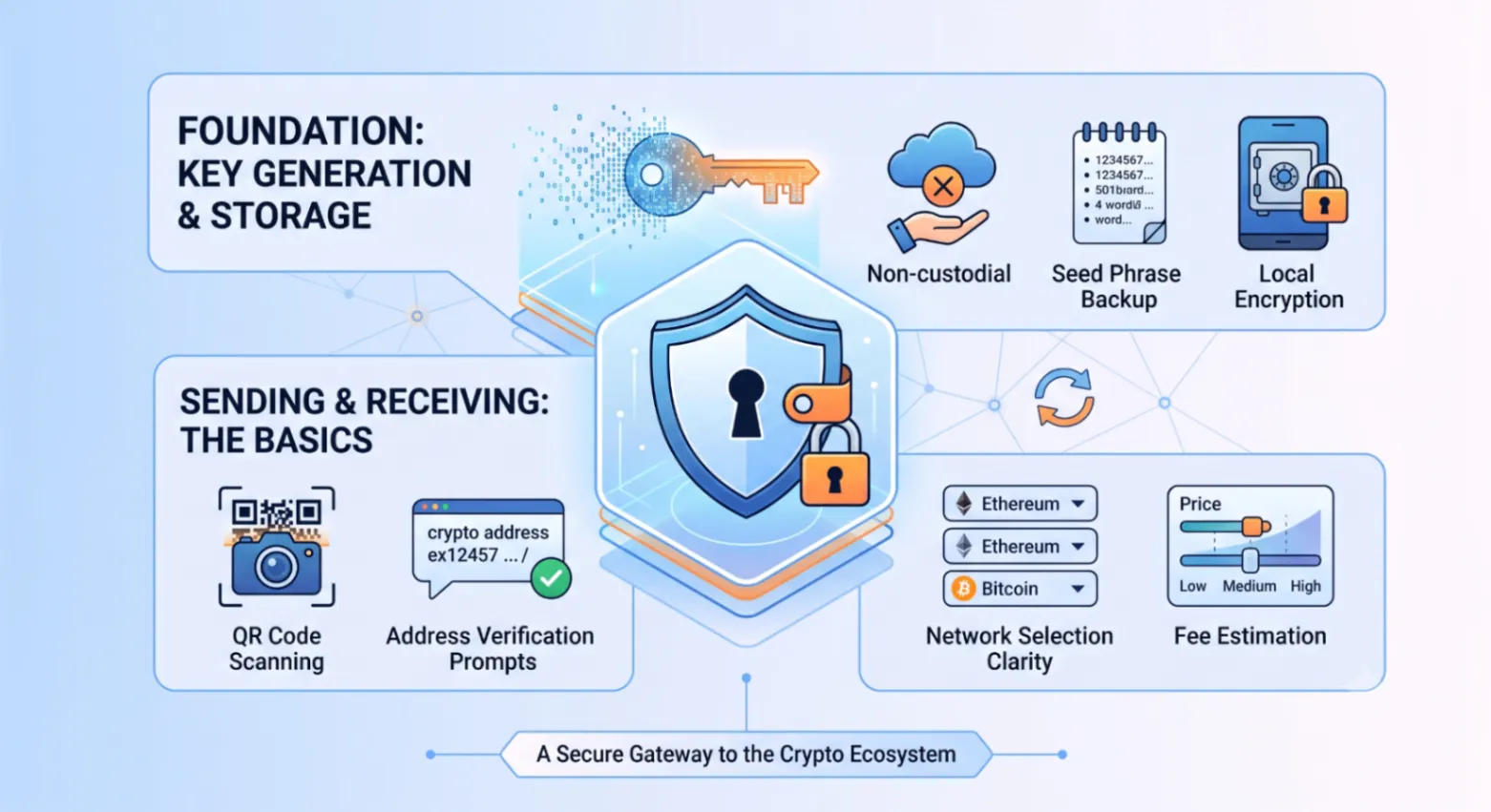
The Foundation: Key Generation and Storage
Every blockchain wallet app starts with the same core function — generating a cryptographic key pair. How it handles that key pair defines almost everything else about the app's security:
- Non-custodial storage keeps the private key on your device, never transmitted to a server. See our non-custodial wallet guide for more on this.
- Seed phrase generation provides a human-readable backup, typically 12 or 24 words, that can restore the wallet on any compatible device.
- Local encryption protects the key while it's stored on your device, adding a layer of defense even if the device itself is compromised.
Any wallet app that deviates from local, non-custodial key generation should be treated as fundamentally different from — and generally riskier than — a true self-custody wallet.
Sending and Receiving: The Basics Done Right
While sending and receiving crypto sounds simple, the details matter:
- QR code scanning reduces the risk of manual address entry errors.
- Address verification prompts, confirming the recipient address before finalizing a transaction.
- Network selection clarity, especially important for tokens that exist on multiple blockchains under similar names.
- Fee estimation, showing the expected network cost before you confirm, with options to adjust for faster or cheaper confirmation.
These small usability details directly reduce the risk of the most common — and often irreversible — mistake in crypto: sending funds to the wrong address or network.
dApp Browser and Web3 Connectivity
One of the features that separates a basic wallet from a full blockchain wallet app is built-in connectivity to decentralized applications (dApps). This typically includes:
- An in-app browser for accessing DeFi platforms, NFT marketplaces, and other on-chain applications directly.
- WalletConnect or similar protocols, allowing the wallet to securely connect to dApps accessed through a desktop browser.
- Permission management, letting you review and revoke what a connected dApp is allowed to do with your wallet.
This connectivity is what allows a wallet to function as more than storage — it becomes the identity and signing tool you use across the broader decentralized web.
Token and Asset Management
A well-built wallet app organizes your holdings clearly rather than presenting a confusing list of addresses and hashes:
- Automatic token detection, recognizing new tokens received without manual setup
- Custom token addition, for adding less common tokens by contract address
- NFT display, showing collectibles visually rather than as raw metadata
- Portfolio value tracking, converting holdings into a readable total using live market data
Security Features Beyond Key Storage
- Biometric or PIN authentication for opening the app, separate from device-level locks
- Transaction simulation or preview, showing what a transaction will actually do before you approve it
- Phishing and scam detection, flagging known malicious contracts or addresses
- Session management, allowing you to see and revoke active dApp connections
In-App Swaps and Exchange Features
Many blockchain wallet apps now include built-in swap functionality, letting you exchange one token for another without leaving the app or exposing funds to a separate custodial platform. When evaluating this feature, check:
- Whether the swap rate and fees are transparent before confirming
- Whether the swap routes through reputable, audited decentralized exchange protocols
- Whether there's a clear breakdown of network fees versus service fees
A Feature Checklist for Evaluating Any Wallet App
| Feature Category | What to Look For |
|---|---|
| Key storage | Non-custodial, local seed phrase generation |
| Transaction safety | Address/network verification, fee transparency |
| Web3 access | dApp browser, permission management |
| Asset visibility | Multi-chain token and NFT support |
| Security layers | Biometric lock, transaction previews |
| Trading | Transparent in-app swap functionality |
Frequently Asked Questions
Do all blockchain wallet apps support dApps?
No — some wallets are built purely for storage and basic transfers, without dApp browser functionality. If DeFi or NFT interaction matters to you, confirm this feature is included before choosing an app.
Is an in-app swap feature safe to use?
Generally yes, as long as it routes through reputable, audited protocols and displays transparent pricing. Always compare the quoted rate against the actual market rate before confirming a swap.
What's the difference between a wallet app and an exchange app?
A wallet app (non-custodial) gives you direct control of your private keys and blockchain assets. An exchange app is typically custodial — the platform holds your keys, and you're trusting their internal ledger and security practices.
How App Design Reflects Security Priorities
The way a blockchain wallet app is designed often reveals how seriously its developers take security, even before you dig into technical documentation. Apps that make the seed phrase backup process feel like an afterthought, or that bury transaction details behind a single “confirm” button without a clear preview, are signaling design priorities that favor speed over safety. By contrast, apps that slow you down at the right moments — confirming you've backed up your seed phrase, clearly displaying what a transaction will do before you sign it — are making a deliberate trade-off in favor of protecting users from irreversible mistakes.
This is worth paying attention to during initial setup, before you've committed any real funds: does the app feel like it's guiding you toward safe habits, or racing you past the details that matter?
Staying Current With App Updates
Blockchain wallet apps are not “set and forget” software. New vulnerabilities are occasionally discovered in wallet code, new chains and token standards emerge, and phishing techniques evolve. A wallet app that receives regular updates — and clearly communicates what each update addresses — is generally a stronger long-term choice than one that hasn't been updated in months, even if the current version looks polished.
Enabling automatic updates where possible, and periodically checking the app's changelog or release notes, helps ensure you're benefiting from security improvements as they're released rather than running an increasingly outdated version.
Evaluating Customer Support Without Compromising Security
Even the most well-designed blockchain wallet app occasionally requires user support — a transaction question, a sync issue, a feature clarification. Legitimate support channels should be verifiable directly through the wallet's official website, should never ask for a seed phrase or private key under any circumstance, and should be clearly distinguishable from the flood of fake “support” accounts that often appear in social media replies to wallet providers, impersonating official help channels. Knowing in advance what legitimate support looks like — and, just as importantly, what it never asks for — is a useful piece of preparation before you ever actually need it.
Why Documentation Quality Is a Trust Signal
A blockchain wallet app's official documentation — the material explaining how it generates keys, handles backups, and processes transactions — often says as much about its trustworthiness as the interface itself. Clear, thorough documentation that doesn't shy away from technical detail suggests a team confident in, and transparent about, their own security practices. Vague or missing documentation, particularly around how private keys are generated and stored, is worth treating as a caution sign regardless of how capable the app appears on the surface.
The Value of a Consistent, Predictable Interface
Beyond individual features, consistency matters more than it might initially seem. A wallet app that presents information — balances, transaction status, fee estimates — in a predictable, consistent way across every interaction reduces the chance of a costly misread during a routine action. This matters most during moments that already carry some inherent risk, like confirming a large transaction or connecting to a new dApp for the first time, when a familiar, predictable layout helps you catch something that looks off before proceeding. Interfaces that vary unpredictably between similar actions, or bury critical details like network selection in inconsistent places, increase the likelihood of an avoidable mistake, even for experienced users who know what to look for in principle. Over time, this predictability becomes part of what makes a wallet feel genuinely trustworthy, beyond any individual feature it offers.
The Bottom Line
The right blockchain wallet app is judged less by its visual polish and more by what happens underneath: how keys are generated and stored, how clearly transactions are previewed, and how safely it connects you to the wider decentralized ecosystem. Use this feature checklist to separate genuinely secure, full-featured wallets from apps that only look the part.
Download DOK Wallet and see these features in action at dokwallet.com.