
Cross-Chain Crypto Wallet: Bridging Assets Without the Risk
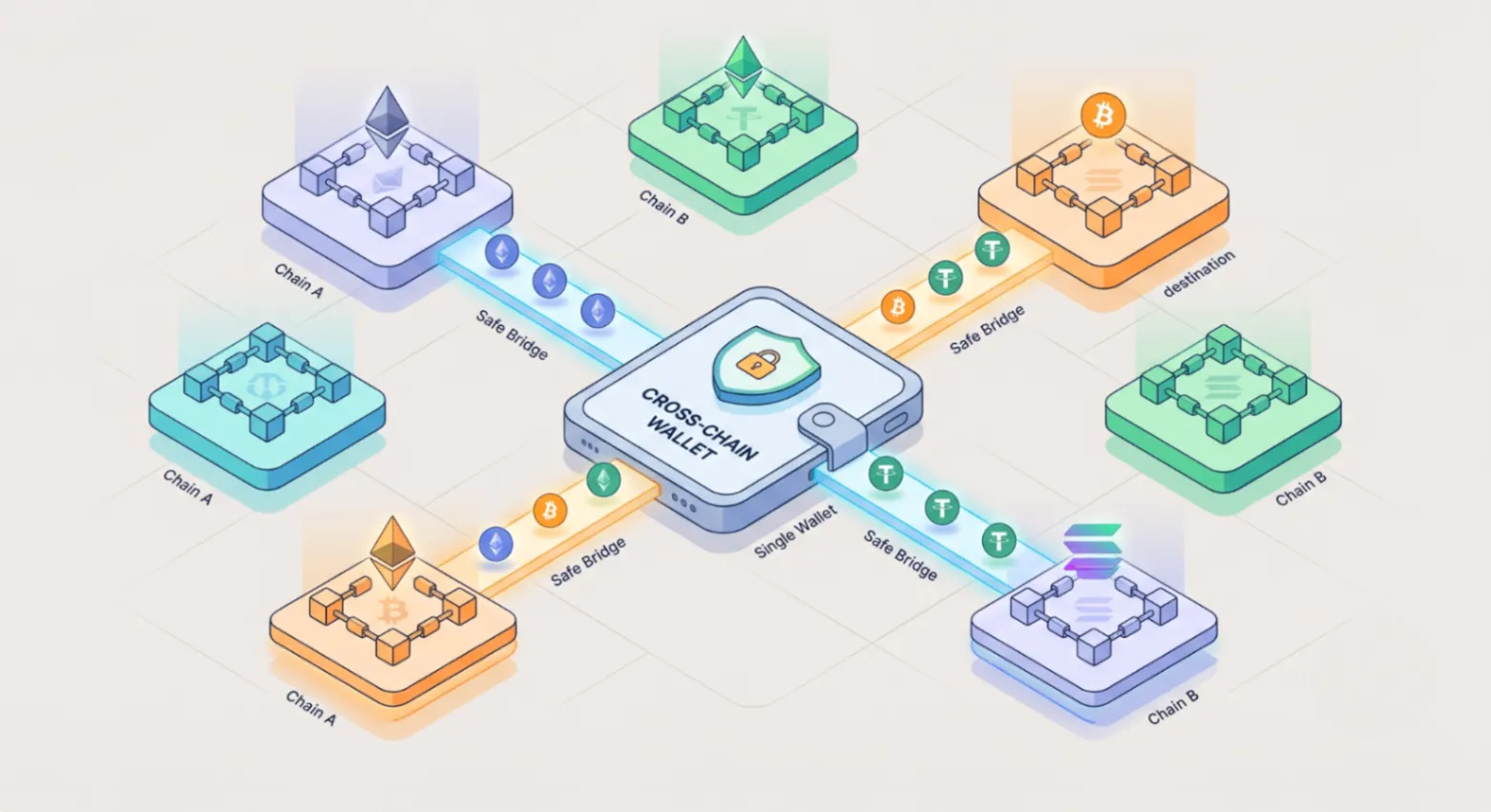
Blockchains were not originally designed to talk to each other. Bitcoin operates on its own ledger, Ethereum on another, and each subsequent network runs independently, with no native way to move an asset from one chain to another. A cross-chain crypto wallet exists to solve this practical problem — letting you interact with, and move value between, otherwise isolated blockchain networks, all from a single app.
What “Cross-Chain” Actually Means
A cross-chain wallet does two related but distinct things:
- Multi-chain management — holding and displaying assets from multiple blockchains in one interface (a baseline feature many modern wallets now offer).
- Cross-chain transfers (bridging) — actually moving an asset's value from one blockchain to another, which requires more than just a shared interface.
Bridging is the more technically complex piece, because blockchains have no native mechanism to recognize or transfer assets between each other. A cross-chain wallet either integrates directly with bridge protocols or partners with them to make this process accessible without requiring users to understand the underlying mechanics.
How Bridging Actually Works
Since asset X on Chain A cannot literally move to Chain B — they are separate ledgers — bridges use one of a few common mechanisms:
- Lock-and-mint: The original asset is locked in a smart contract on the source chain, and an equivalent “wrapped” token is minted on the destination chain, representing the locked value.
- Burn-and-mint: The asset is destroyed (burned) on the source chain, and a native equivalent is minted on the destination chain.
- Liquidity pool swaps: Rather than locking or burning, a bridge uses liquidity pools on both chains, swapping the asset for its counterpart directly.
A cross-chain wallet abstracts this complexity, presenting the process to the user as a simple “send from Chain A to Chain B” action, while handling the underlying bridge mechanism behind the scenes.
Why Cross-Chain Functionality Matters
As more valuable applications — DeFi protocols, NFT platforms, payment systems — launch across different blockchains, users increasingly need assets to move where the opportunity is, rather than being stuck on whichever chain they originally acquired the asset. Cross-chain wallets remove the need to manually use separate bridge websites, which are historically one of the more frequently exploited categories of DeFi infrastructure.
The Real Risks of Cross-Chain Bridging
Bridging is genuinely one of the higher-risk activities in crypto, and it's worth understanding why before using it:
- Smart contract risk. Bridge contracts holding locked assets have historically been high-value targets for exploits.
- Wrapped asset risk. A wrapped token's value depends on the bridge maintaining sufficient backing reserves — if the bridge is compromised, wrapped tokens can lose their peg.
- Liquidity risk. Some bridges rely on liquidity pools that can experience slippage or temporary imbalances during high-volume transfers.
- Irreversible transfers. Once a cross-chain transaction is confirmed, it typically cannot be reversed, even if sent through the wrong bridge route.
A well-designed cross-chain wallet mitigates some of this risk by routing transfers only through vetted, audited bridge protocols — but the underlying technical risk of bridging never fully disappears.
How to Evaluate a Cross-Chain Wallet's Safety
- Does it disclose which bridge protocol it uses for each cross-chain transfer, rather than obscuring the mechanism entirely?
- Are the underlying bridges independently audited, with a public track record?
- Does the wallet show estimated transfer time and fees before you confirm, since cross-chain transactions often take longer than same-chain transfers?
- Is there a clear transaction status tracker, so you can monitor a cross-chain transfer as it moves through intermediate steps?
Practical Best Practices for Cross-Chain Transfers
- Start with a small test transaction before moving a large amount across chains for the first time.
- Double-check the destination address format, since address structures differ between blockchains.
- Confirm the specific bridge route the wallet is using, especially for less common chain pairs.
- Account for longer confirmation times — cross-chain transfers typically take longer than transfers on a single network.
- Avoid bridging during periods of unusual network congestion, which can increase both fees and exploit risk.
Cross-Chain Wallets vs. Standalone Bridge Websites
| Factor | Cross-Chain Wallet | Standalone Bridge Website |
|---|---|---|
| Interface | Integrated into wallet you already trust | Separate site, separate trust decision each time |
| Key exposure | Signs directly from your existing wallet | May require connecting wallet to unfamiliar site |
| Transaction tracking | Often built-in | Varies by bridge |
| Route transparency | Depends on wallet | Depends on bridge |
Using bridging functionality integrated into a wallet you already trust generally reduces the number of separate, unfamiliar platforms you need to connect your wallet to — each of which represents an additional trust decision.
Frequently Asked Questions
Is bridging the same as swapping tokens?
No. A swap exchanges one token for another, typically on the same chain. Bridging moves the same underlying asset's value from one blockchain to another, often via a wrapped representation.
Why do cross-chain transfers take longer than regular transactions?
Because the process usually involves confirmation on the source chain, a bridge mechanism processing the transfer, and confirmation on the destination chain — three steps instead of one.
Are wrapped tokens worth the same as the original asset?
In principle, yes, as long as the bridge maintains full backing reserves. In practice, wrapped token value can deviate from the original asset if the bridge experiences a liquidity issue or security breach.
A Closer Look at Bridge Exploits and What They Teach Us
Bridge protocols have historically been among the most exploited category of infrastructure in the broader crypto ecosystem, largely because they concentrate significant value into a relatively small number of smart contracts responsible for locking or minting assets. When a bridge's contract logic contains a flaw, or its validator set is compromised, the impact can be severe precisely because bridges are designed to hold large pooled amounts of locked assets to back the wrapped tokens circulating on the destination chain.
This history isn't a reason to avoid cross-chain functionality altogether — it's a reason to be selective about which bridges you rely on. Established bridges with long operational track records, multiple independent audits, and transparent validator or security models have generally proven more resilient than newer, unaudited alternatives offering marginally better rates or faster transfers.
Why Wallet-Integrated Bridging Adds a Layer of Protection
When a cross-chain wallet curates which bridge protocols it integrates with, it's effectively performing a layer of due diligence on your behalf — filtering out bridges that haven't met a baseline security standard. This doesn't eliminate bridge risk entirely, but it does reduce the chance of unknowingly routing funds through an obscure, unaudited bridge that happens to offer a slightly better rate. When in doubt, it's reasonable to ask a wallet provider directly which specific bridge protocols they integrate with and what due diligence process governs that selection.
Alternatives to Bridging Worth Considering
Depending on the specific goal, bridging isn't always the only — or the best — option for accessing assets or opportunities on another chain. Centralized exchanges that support both the source and destination chains can sometimes offer a simpler, if less decentralized, path for moving value across ecosystems, particularly for larger transfers where minimizing smart contract exposure is a priority. Similarly, some projects issue native versions of an asset directly on multiple chains, rather than relying on wrapped representations, which can reduce the specific risks associated with bridge-dependent wrapped tokens. Weighing these alternatives against direct bridging, based on transfer size and risk tolerance, is a reasonable step before defaulting to whichever bridge a wallet happens to surface first.
Setting Realistic Expectations for Transfer Costs
Cross-chain transfers typically involve more than one fee component: a network fee on the source chain, a fee associated with the bridge mechanism itself, and a network fee on the destination chain to complete the process. Together, these can add up to noticeably more than a same-chain transaction. Before initiating a larger cross-chain transfer, it's worth reviewing the full estimated cost breakdown the wallet provides, rather than assuming the displayed fee reflects only a single component of the total cost. For frequent cross-chain activity, tracking these combined costs over time can also reveal whether a particular bridge route consistently runs more expensive than reasonable alternatives, which is useful information for choosing routes going forward.
The Bottom Line
Cross-chain crypto wallets make moving assets between blockchains dramatically more accessible, but bridging remains one of the more technically complex and higher-risk actions in crypto. Choosing a wallet that routes transfers through audited, transparent bridge protocols — and following basic precautions like test transactions — meaningfully reduces that risk without giving up the convenience of cross-chain access.
Download DOK Wallet and move assets across chains safely at dokwallet.com.