Cross-Border Crypto Payments: How Stablecoins Are Rewriting International Money Transfers
Sending money across borders has always been slow, expensive, and opaque. Bank wire transfers take days and cost dozens of dollars in fees. Remittance services take large percentage cuts. Currency conversions add another layer of cost. Crypto, and stablecoins in particular, offers a fundamentally different model.
This guide explains how cross-border crypto payments work, why stablecoins are central to the use case, and how DOK Wallet functions as a practical tool for international payments.
The Problem With Traditional International Transfers
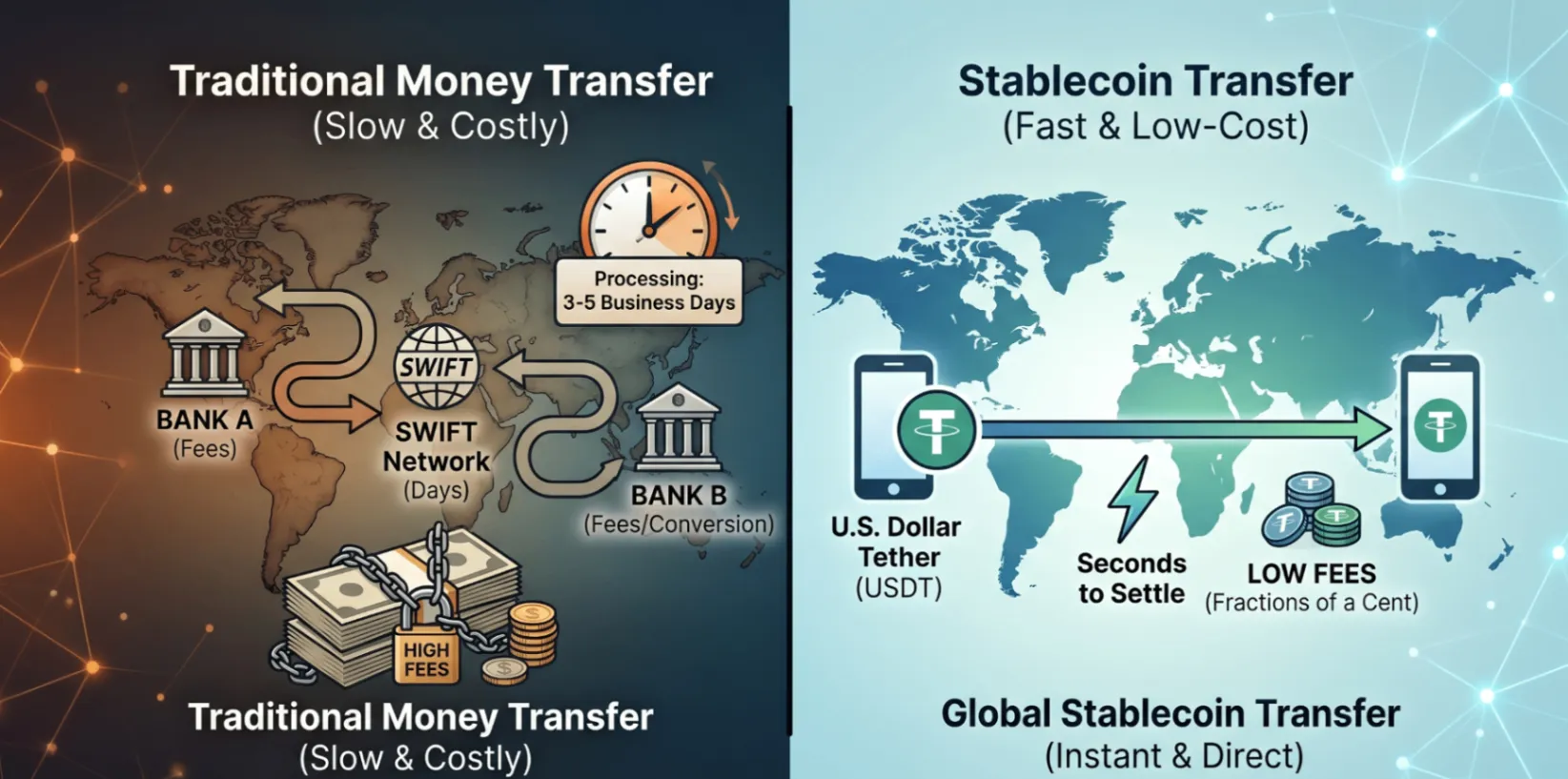
A traditional international wire transfer involves your bank, a correspondent bank or SWIFT network, a receiving bank, and sometimes an intermediary institution in between. Each party extracts a fee. Processing times range from one to five business days. Exchange rates are set by institutions, not markets, and often include a hidden spread on top of published fees.
For large corporate transfers, this friction is manageable. For freelancers receiving international payments, for migrant workers sending remittances, and for small businesses paying suppliers abroad, the cumulative cost can represent a significant portion of the total amount transferred.
How Crypto Changes the Equation
A crypto transaction is a direct peer-to-peer transfer that settles on a blockchain network. There are no correspondent banks, no SWIFT fees, and no multi-day clearing periods. Bitcoin transactions settle in about an hour. Ethereum transactions settle in seconds to minutes. Stablecoin transfers on lower-fee networks like Polygon or BNB Chain settle in seconds and cost fractions of a cent.
The recipient does not need a bank account. They need a crypto wallet address. This makes crypto payments accessible to people in regions with limited banking infrastructure, a demographic that represents a significant share of global remittance recipients.
For how to set up a non-custodial wallet for receiving payments, read our non-custodial wallet guide.
Why Stablecoins Are the Right Tool for Payments
Bitcoin and Ethereum are volatile assets. Sending Bitcoin as a payment introduces exchange-rate risk between the time you send and the time the recipient converts to local currency. Stablecoins solve this. A stablecoin like USDC or USDT maintains a one-to-one peg with the US dollar, meaning the value sent and the value received are predictably equal.
DOK Wallet supports USDC and USDT across multiple blockchain networks. A user in one country can send USDC to a recipient in another country within seconds, at near-zero cost, with no exchange rate risk. The recipient holds USDC in their DOK Wallet until they choose to convert or spend it.
DOK Wallet as a Stablecoin Payment App
DOK Wallet functions as a stablecoin payment app by combining multi-chain stablecoin support with a clean sending interface. You can hold USDC on Ethereum, BNB Chain, or Polygon simultaneously, and send from whichever network offers the lowest fees for a given transaction size.
The send flow in DOK Wallet requires the recipient's wallet address, the stablecoin and network, and the amount. Network fee estimates appear before confirmation. The transaction broadcasts immediately and settles on-chain within the block time of the chosen network.
For how DOK Wallet manages assets across multiple networks, see our multi-chain wallet guide. For a practical guide to making crypto payments, read how to pay with a crypto app.
Real-World Use Cases for Cross-Border Crypto Payments
- Freelancers receiving payment from international clients without wire transfer fees.
- Migrant workers sending remittances home at a fraction of traditional service costs.
- Small businesses paying international suppliers quickly and transparently.
- Remote workers receiving salary from overseas employers in stablecoins.
- Individuals in countries with volatile local currencies holding savings in USDC.
What You Need to Get Started
Getting started with cross-border crypto payments requires three things: a DOK Wallet installed on your device, a funded stablecoin balance, and the recipient's wallet address. The recipient also needs a wallet capable of receiving the stablecoin on the chosen network.
For first-time cross-border transactions, starting with a small test payment before sending larger amounts is good practice. Confirm the recipient receives it and can access it before transferring significant value.
Frequently Asked Questions
How are crypto payments faster than wire transfers?
Wire transfers route through multiple correspondent banks and the SWIFT network, taking one to five business days and extracting fees at each step. Crypto payments settle directly on-chain — stablecoin transfers on networks like Polygon settle in seconds at fractions of a cent.
Why are stablecoins better than Bitcoin for cross-border payments?
Bitcoin's price volatility creates exchange-rate risk between the time of sending and the time the recipient converts to local currency. Stablecoins like USDC maintain a one-to-one peg with the US dollar, so the value sent and the value received are predictably equal.
Which stablecoins does DOK Wallet support?
DOK Wallet supports USDC and USDT across multiple blockchain networks including Ethereum, BNB Chain, and Polygon. You can hold stablecoins on multiple networks simultaneously and choose the lowest-fee network for each payment.
How fast are cross-border crypto payments with DOK Wallet?
On fast, low-fee networks like Polygon or BNB Chain, stablecoin transactions settle in seconds to under one minute. Ethereum stablecoin transfers typically settle within a few minutes depending on network congestion.
Does the recipient need a bank account to receive crypto?
No. The recipient only needs a crypto wallet address compatible with the asset and network being sent. This makes crypto payments accessible to people in regions with limited banking infrastructure.
What is needed to start sending cross-border payments with DOK Wallet?
You need DOK Wallet installed and a funded stablecoin balance. The recipient needs a wallet address for the stablecoin and network you are using. For first-time cross-border transfers, sending a small test amount first is recommended.
Final Thoughts
Cross-border crypto payments represent one of the most compelling real-world applications of blockchain technology. For individuals and businesses who send or receive international payments regularly, stablecoins held in a non-custodial wallet like DOK Wallet offer speed, low cost, and transparency that traditional financial infrastructure cannot match.
Get started with DOK Wallet today at dokwallet.com.