Multi-Chain Crypto Wallet: How to Manage Assets Across Every Blockchain
The days when a single blockchain held most of crypto's activity are long gone. Today, assets exist across dozens of networks, each with its own tokens, applications, and use cases. Managing them efficiently requires a multi-chain crypto wallet that brings all these networks together in one interface.
This guide explains how multi-chain wallets work, why they matter for modern crypto users, and how DOK Wallet handles multi-blockchain management in practice.
What Is a Multi-Chain Crypto Wallet?
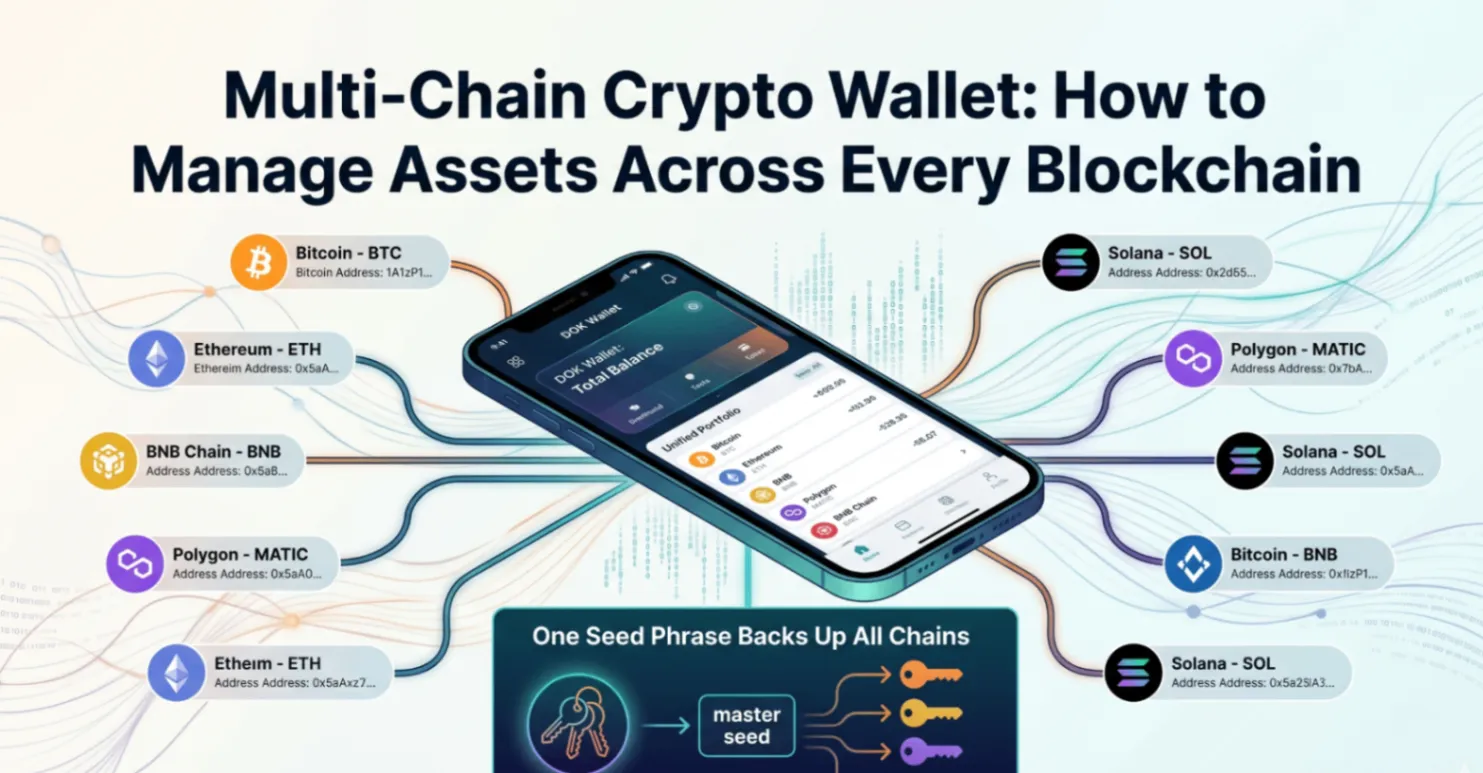
A multi-chain crypto wallet is one that maintains addresses on multiple blockchain networks simultaneously, all derived from a single seed phrase. Instead of downloading a separate wallet for Bitcoin, another for Ethereum, another for BNB Chain, and another for Solana, you manage everything from one app.
The underlying technology that makes this possible is hierarchical deterministic key derivation. When you create a DOK Wallet, a single master seed generates child keys for each supported blockchain through a mathematically deterministic path. One backup covers all chains.
Why a Multi-Blockchain Wallet Changes Everything
The practical impact of a multi-blockchain wallet goes beyond convenience. It changes how you think about your portfolio. Instead of mentally accounting for assets scattered across multiple apps with separate security requirements, you manage a unified portfolio with one seed phrase backup and one security discipline.
- One seed phrase backs up all chains simultaneously.
- One interface shows your full portfolio value across networks.
- Asset movements across chains are visible in one transaction history.
- Security hygiene is focused on protecting one recovery phrase.
DOK Wallet's Multi-Chain Architecture
DOK Wallet supports major blockchain networks including Bitcoin, Ethereum, BNB Chain, Polygon, and several other leading networks. For each supported chain, DOK Wallet generates a dedicated address derived from your seed phrase. Switching between chains in the app is seamless, and your full portfolio is always visible from the main dashboard.
Because DOK Wallet is a non-custodial wallet, every address on every chain is under your exclusive control. No network's assets are held by DOK Wallet. Your multi-chain portfolio is entirely self-custodied.
For context on why non-custodial ownership matters across multiple chains, read our guide to non-custodial wallets.
Managing a Crypto Wallet for Multiple Coins
Holding a crypto wallet for multiple coins introduces questions that single-chain users never face. Which chain holds the best version of a given token? How do you avoid sending assets to the wrong network? How do you track gas fees across different networks?
DOK Wallet addresses these questions through clear chain labelling within the interface. Every token is displayed alongside its network identifier, so you always know which chain an asset lives on. Network fee estimates are shown before any transaction is confirmed, covering gas on Ethereum, transaction fees on Bitcoin, and equivalent costs on other networks.
Multi-Asset Crypto Wallet: Beyond Native Tokens
A genuine multi-chain wallet must handle not just native blockchain tokens but also the thousands of tokens deployed on each chain. DOK Wallet supports ERC-20 tokens on Ethereum, BEP-20 tokens on BNB Chain, and equivalent token standards on supported networks.
This means your DOK Wallet can hold stablecoins like USDC and USDT on multiple chains simultaneously, alongside native assets like ETH and BNB, alongside DeFi tokens and NFT-related assets, all within the same wallet interface.
See how DOK Wallet handles cross-chain transactions in our cross-chain wallet guide. For DOK Wallet's approach to payments across chains, read our cross-border payments guide.
Security Across Multiple Chains
The security model of a multi-chain wallet centres on one point: the seed phrase. Because all chain addresses derive from one master seed, securing that seed phrase is the single most important action in your multi-chain security posture. DOK Wallet reinforces this during onboarding and includes clear guidance on physical backup storage.
The open-source codebase of DOK Wallet means the key derivation paths for each chain are publicly verifiable. Any developer can confirm that private keys are generated correctly and stored securely on device.
Review DOK Wallet's open-source code at dokwallet.com/open-source.
Frequently Asked Questions
What is a multi-chain crypto wallet?
A multi-chain wallet manages addresses on multiple blockchain networks simultaneously, all derived from a single seed phrase. Instead of a separate app for each chain, you manage Bitcoin, Ethereum, BNB Chain, and others from one interface.
How does DOK Wallet support multiple blockchains from one seed phrase?
DOK Wallet uses hierarchical deterministic key derivation. A single master seed generates unique private keys for each supported blockchain through mathematically deterministic paths defined by the BIP-44 standard. One backup covers all chains.
Does DOK Wallet support ERC-20 tokens?
Yes. DOK Wallet supports ERC-20 tokens on Ethereum alongside native ETH, meaning stablecoins, DeFi tokens, and other Ethereum-based assets are visible and manageable in the same wallet interface.
What networks does DOK Wallet support?
DOK Wallet supports major blockchain networks including Bitcoin, Ethereum, BNB Chain, Polygon, and several other leading networks. New network support is added with regular app updates.
Is one seed phrase enough to back up all my chains?
Yes. Because all blockchain addresses in DOK Wallet derive from a single master seed, one written seed phrase backup protects every asset on every supported chain simultaneously.
What is the security model for a multi-chain wallet?
The entire security posture of a multi-chain wallet centres on one point: your seed phrase. Securing it physically is the single most important action. DOK Wallet reinforces this during onboarding and guides users through proper backup storage.
Final Thoughts
The modern crypto landscape is multi-chain by nature. A wallet that supports only one network creates friction, additional risk through multiple seed phrases, and an incomplete view of your portfolio. DOK Wallet's multi-chain architecture solves all of this, giving you one unified, non-custodial wallet for the entire blockchain ecosystem.
Download DOK Wallet and manage all your crypto in one place at dokwallet.com.