Stablecoin Payment App: Why USDC and USDT Are Changing How We Send Money
Stablecoins have moved from a niche DeFi tool to one of the most practically useful financial instruments available. Their ability to hold a consistent dollar value while moving with the speed and cost-efficiency of crypto makes them the ideal tool for everyday payments. And as stablecoin adoption grows, the wallets that support them well become increasingly important.
This guide covers what stablecoins are, why they matter for payments, and how DOK Wallet functions as a stablecoin payment app that works across multiple networks.
What Is a Stablecoin?
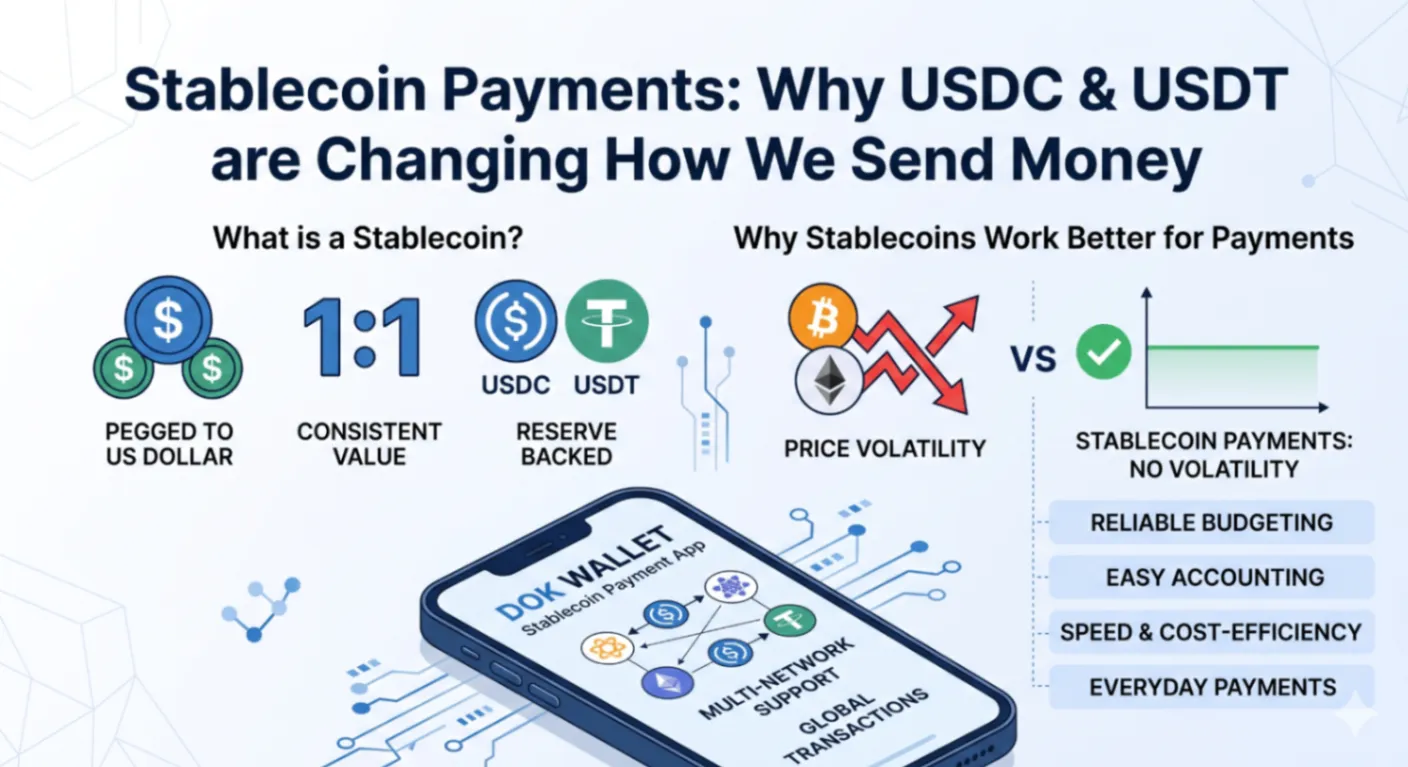
A stablecoin is a cryptocurrency designed to maintain a consistent value, typically pegged to the US dollar on a one-to-one basis. USDC (USD Coin) and USDT (Tether) are the two most widely used dollar-pegged stablecoins. Each unit is intended to be worth exactly one US dollar, maintained through collateral reserves (in the case of USDC) or a basket of assets (in the case of USDT).
Unlike Bitcoin or Ethereum, stablecoins do not experience significant price volatility from day to day. Sending ten USDC today means the recipient receives the equivalent of ten US dollars today, tomorrow, and next week.
Why Stablecoins Work Better Than Volatile Crypto for Payments
The volatility of Bitcoin and Ethereum creates a fundamental problem for payment use cases. If you invoice a client for one hundred dollars worth of Bitcoin and the price drops ten percent before they pay, you effectively received ninety dollars. If they overpay, you received more. Neither party can budget reliably around a volatile payment instrument.
Stablecoins remove this problem. A payment denominated in USDC is a payment denominated in dollars, on the blockchain. Both parties know exactly what value is being transferred. Accounting, invoicing, and budgeting all work the same way they do with traditional currencies.
For how stablecoins work in cross-border payment contexts, read our cross-border crypto payments guide.
DOK Wallet as a Stablecoin Payment App
DOK Wallet supports USDC and USDT on multiple blockchain networks including Ethereum, BNB Chain, and Polygon. This multi-network stablecoin support gives users flexibility in choosing which network to use for a given payment, based on the fee environment and the recipient's preferred network.
For small everyday payments, Polygon or BNB Chain offer near-zero transaction fees and settlement times under one minute. For larger transfers where the absolute fee matters less, Ethereum's USDC is the most widely accepted and the most liquid. DOK Wallet holds all of these simultaneously and lets you choose per transaction.
For how DOK Wallet manages multi-network assets, see our multi-chain wallet guide. For a full step-by-step payment guide, read how to pay with crypto.
Practical Stablecoin Payment Scenarios
- Paying a remote contractor in USDC avoids wire transfer fees and currency exchange costs.
- Splitting expenses with friends using USDT on BNB Chain costs fractions of a cent.
- Receiving client payments in USDC maintains dollar-value stability without exchange rate risk.
- Holding savings in USDC in regions with high local inflation preserves purchasing power.
- Sending emergency funds internationally in stablecoins reaches the recipient within minutes.
Stablecoin Risks to Understand
Stablecoins are not without risk. USDT has faced scrutiny over the composition of its reserves. De-pegging events, where a stablecoin temporarily trades below one dollar, have occurred under market stress conditions. Regulatory risk exists as governments develop frameworks for stablecoin issuers.
USDC, issued by Circle, is generally considered the more transparent option due to regular reserve audits by independent accounting firms. For users who want maximum confidence in the peg, USDC is the more conservative choice.
Whatever stablecoin you hold, keeping it in a non-custodial wallet like DOK Wallet means you own the actual stablecoin tokens, not a platform's IOU. For why non-custodial ownership matters for stablecoin holders, read our non-custodial wallet guide.
Getting Started With Stablecoin Payments in DOK Wallet
To start using DOK Wallet as a stablecoin payment app: install the app, create your wallet and secure your seed phrase, add a stablecoin balance by receiving from another wallet or purchasing through an onramp, and share your wallet address with payment senders.
For outgoing payments, tap send, select the stablecoin and network, enter the recipient address, confirm the amount and fee, and send. The recipient sees the incoming transaction within seconds on fast networks.
Frequently Asked Questions
What is a stablecoin?
A stablecoin is a cryptocurrency designed to maintain a consistent value, typically pegged one-to-one to the US dollar. USDC and USDT are the two most widely used dollar-pegged stablecoins. Unlike Bitcoin or Ethereum, they do not experience significant day-to-day price volatility.
What is the difference between USDC and USDT?
Both are dollar-pegged stablecoins, but USDC is issued by Circle and undergoes regular reserve audits by independent accounting firms, making it the more transparent option. USDT is issued by Tether and has faced scrutiny over its reserve composition. For users prioritising peg confidence, USDC is the more conservative choice.
Can stablecoins lose their dollar peg?
Yes, though it is uncommon for major stablecoins. De-pegging events have occurred under extreme market stress conditions. Regulatory risk also exists as governments develop frameworks for stablecoin issuers. Keeping stablecoins in a non-custodial wallet like DOK Wallet means you own the actual tokens, not a platform's IOU.
Which network should I use for everyday stablecoin payments?
For small everyday payments, Polygon or BNB Chain offer near-zero transaction fees and settlement under one minute. For larger transfers where fee amounts matter less, Ethereum's USDC is the most widely accepted. DOK Wallet holds stablecoins on all networks and lets you choose per transaction.
Does DOK Wallet support stablecoins across multiple networks?
Yes. DOK Wallet supports USDC and USDT on Ethereum, BNB Chain, and Polygon simultaneously. You can hold stablecoin balances on multiple networks at once and select the lowest-fee network for each outgoing payment.
How do I start receiving stablecoin payments in DOK Wallet?
Install DOK Wallet, create your wallet, and share your relevant wallet address with payment senders. For USDC on Polygon, share your Polygon address; for USDC on Ethereum, share your Ethereum address. Confirm the network with senders to ensure payments arrive on the correct chain.
Final Thoughts
Stablecoins represent a genuine improvement over both traditional international bank transfers and volatile crypto for everyday payments. They combine blockchain speed and low cost with dollar-value stability. DOK Wallet makes stablecoin payments practical by supporting multiple stablecoins across multiple networks in a clean, non-custodial mobile interface.
Download DOK Wallet and start sending stablecoin payments at dokwallet.com.