
Crypto Wallet for Multiple Coins: How to Manage a Diverse Portfolio
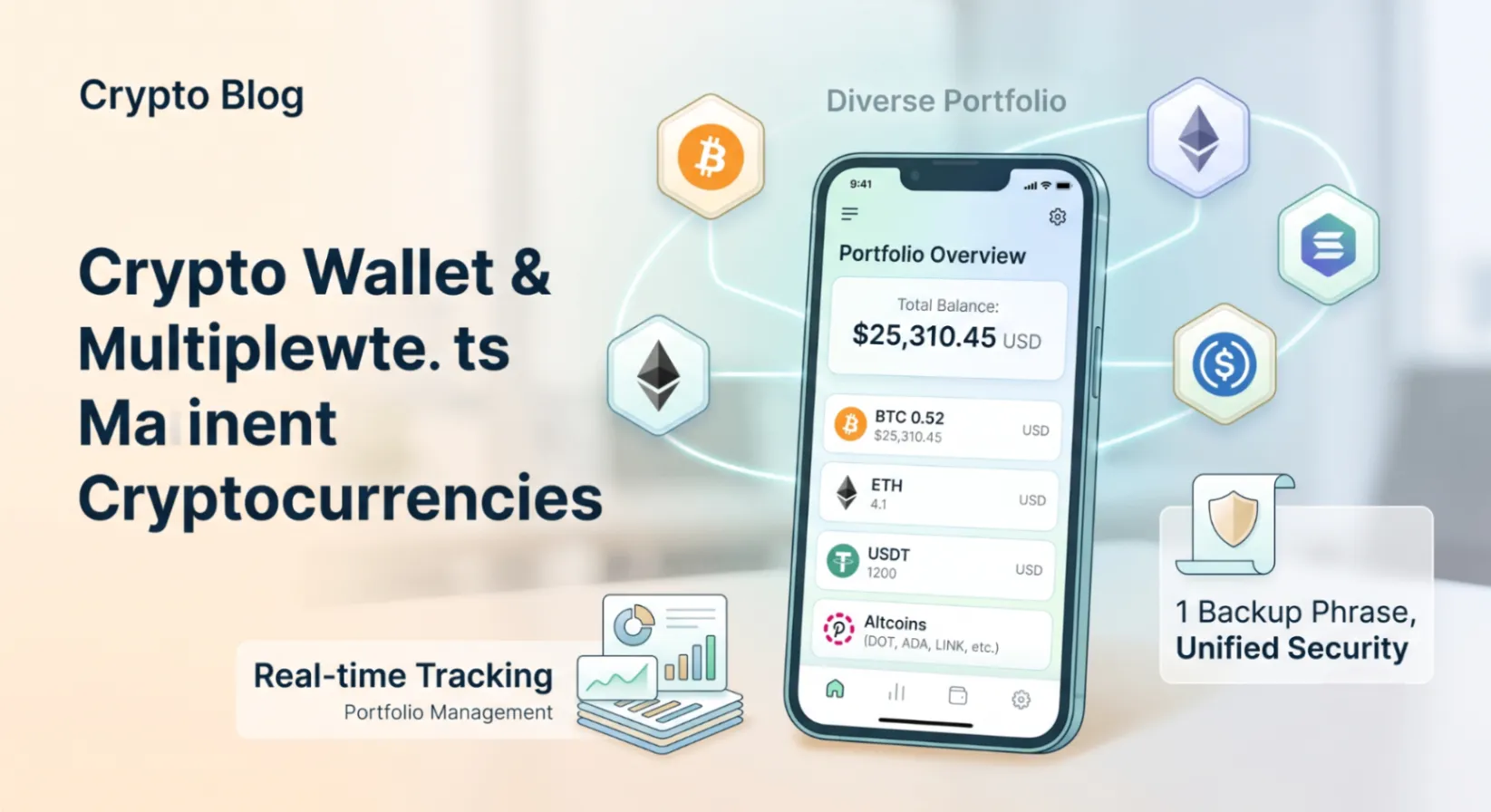
Most crypto holders don't stay invested in a single coin for long. A portfolio that starts with Bitcoin often grows to include Ethereum, a handful of altcoins, and perhaps a stablecoin or two for stability. Managing that spread across multiple single-coin wallets quickly becomes impractical — which is exactly the problem a crypto wallet built for multiple coins is designed to solve.
The Practical Problem With Single-Coin Wallets
Some wallets are built to support exactly one blockchain and its native asset. That's a reasonable choice for someone holding only Bitcoin, for instance — but the moment a portfolio diversifies, single-coin wallets create real friction:
- A separate app (and separate seed phrase) is needed for each additional coin
- There's no unified view of total portfolio value
- Security practices — backups, updates, monitoring — must be repeated across every app
- The overall attack surface grows with each additional wallet installed
A wallet designed to hold multiple coins removes this friction by managing several assets, potentially across several blockchains, within a single application and (often) a single backup phrase.
What “Multiple Coins” Actually Requires Technically
Supporting multiple coins isn't just a matter of interface design — different coins may exist on entirely separate blockchains with different address formats, transaction structures, and confirmation mechanics. A wallet that genuinely supports multiple coins well typically uses:
- Hierarchical deterministic (HD) key derivation, allowing one seed phrase to generate distinct keys for each supported asset or chain
- Per-chain transaction logic, correctly applying the right fee structure and confirmation process for each network
- Unified balance aggregation, converting holdings into a consistent value display (often fiat-equivalent) for easy portfolio tracking
Core Benefits for a Diversified Holder
- One backup to protect. Rather than managing a separate seed phrase for every coin, a single recovery phrase typically covers the entire portfolio.
- Consolidated portfolio view. See total holdings and allocation across all coins at a glance, rather than manually adding up balances from separate apps.
- Simplified security maintenance. Updates, biometric locks, and monitoring apply uniformly across the whole portfolio.
- Easier tracking of transaction history across assets, useful for both personal recordkeeping and tax reporting purposes.
What to Verify Before Trusting a Wallet With a Diverse Portfolio
- Does it explicitly list every coin you currently hold — not just a general claim of “multi-coin support”?
- Is each supported coin's key derivation properly isolated and audited, so a vulnerability in one chain's implementation doesn't compromise others?
- Does the interface clearly separate assets by network, avoiding confusion between similarly-named tokens on different chains?
- Can you add support for new coins later without disrupting existing holdings or requiring a new wallet setup?
Organizing a Multi-Coin Portfolio Within One Wallet
Even within a single wallet app, some organizational practices help maintain clarity and security:
- Label wallets or sub-accounts by purpose if the app supports it — for example, separating long-term holdings from active trading funds.
- Regularly verify balances against a blockchain explorer, independent of the app's internal display, especially for larger holdings.
- Keep a personal record of which coins live on which network, particularly for tokens with similar names across different blockchains.
- Review and revoke unused dApp permissions periodically, since each connected application represents a potential point of exposure across your entire multi-coin portfolio.
Multi-Coin Wallet vs. Separate Wallets: Weighing the Trade-off
| Factor | Multi-Coin Wallet | Separate Single-Coin Wallets |
|---|---|---|
| Backup complexity | One seed phrase (typically) | Multiple seed phrases |
| Portfolio visibility | Consolidated | Manual aggregation |
| Security consistency | Uniform across all assets | Varies by app |
| Attack surface | Smaller, consolidated | Larger, distributed |
| Specialized chain features | May be less deep per chain | Often more advanced |
For the majority of holders managing a genuinely diverse portfolio, the reduced complexity and consolidated backup of a multi-coin wallet outweighs the marginal feature depth of maintaining separate, specialized wallets per coin.
A Note on Security With Larger, Diversified Holdings
As a multi-coin portfolio grows in value, consider pairing the software wallet with a hardware wallet for the bulk of long-term holdings, keeping only actively used funds in the hot wallet. This limits exposure if the software wallet or device is ever compromised, without sacrificing the convenience of a consolidated view for day-to-day management.
Frequently Asked Questions
Can one seed phrase really secure coins on completely different blockchains?
Yes, through hierarchical deterministic (HD) key derivation, a single seed phrase can mathematically generate separate, independent key pairs for multiple blockchains, while still allowing full recovery from that one phrase.
What happens if a wallet adds support for a new coin after I've already set it up?
Typically, the new coin becomes available through a standard app update, without requiring you to create a new wallet or seed phrase, since the underlying key derivation structure can extend to additional chains.
Is it riskier to hold many different coins in one wallet versus separate wallets?
Not inherently — the risk depends on the wallet's security architecture (non-custodial storage, audited code) rather than the number of coins held within it. A well-built multi-coin wallet can be more secure overall, simply because it reduces the number of separate apps and backups you need to manage correctly.
Tracking Performance Across a Multi-Coin Portfolio
One underrated benefit of a wallet built for multiple coins is the ability to see not just total value, but how that value is distributed and how it has changed over time. This kind of visibility supports better decision-making than checking isolated balances across separate apps:
- Allocation percentages, showing what proportion of total holdings each coin represents, useful for understanding concentration risk
- Historical value trends, when the wallet integrates market data, helping contextualize current holdings against past performance
- Transaction-level records, useful for personal budgeting and for compiling the information needed for tax reporting in jurisdictions where crypto transactions are taxable events
Without this consolidated view, a holder relying on separate single-coin wallets typically has to manually compile this information from multiple sources, a process that's both time-consuming and prone to error.
Rebalancing a Diversified Crypto Portfolio
Just as with traditional investment portfolios, holders sometimes choose to periodically rebalance a diversified crypto portfolio — adjusting allocations back toward a target distribution as different assets grow or shrink in relative value. A multi-coin wallet with built-in swap functionality can make this process considerably more convenient, allowing rebalancing trades to happen directly within the same app used for storage, without needing to move funds to a separate exchange platform for each adjustment.
That said, rebalancing decisions themselves are a matter of personal investment strategy and risk tolerance — this article describes the practical mechanics involved, not a recommendation about how or whether to rebalance any specific portfolio.
When a Single-Chain Wallet Still Makes Sense
Despite the clear advantages of a multi-coin wallet for diversified holders, there are still scenarios where a dedicated single-coin or single-chain wallet is the more sensible choice — most notably for very large, long-term holdings of a single asset, where isolating that asset in its own dedicated, minimal-surface-area wallet (often paired with hardware storage) can reduce exposure compared to keeping it alongside more actively used, multi-coin holdings. The two approaches aren't mutually exclusive: many experienced holders use a multi-coin wallet for their active, diversified portfolio while keeping a separate, dedicated wallet for their largest single-asset position.
Avoiding Overexposure to a Single Emerging Asset
Diversification within a multi-coin wallet is only genuinely protective if the mix reflects real risk distribution rather than simply spreading funds across several similarly speculative assets. It's worth periodically reviewing not just how many coins you hold, but how correlated their risk profiles actually are — several tokens built on the same underlying chain or narrative can move together in ways that don't provide the diversification benefit a scattered-looking portfolio might suggest at first glance.
Keeping Records for Long-Term Portfolio Clarity
Beyond security and convenience, a multi-coin wallet's consolidated transaction history can be genuinely useful for personal recordkeeping — tracking cost basis, monitoring how allocation has shifted over time, and having a single reliable source to reference if questions arise later about when and how specific holdings were acquired. This kind of ongoing recordkeeping is easy to neglect early on but becomes considerably more valuable, and harder to reconstruct after the fact, the longer a diversified portfolio has been actively managed.
The Bottom Line
A crypto wallet built to handle multiple coins turns portfolio management from a scattered, error-prone process into a single, coherent system — one backup, one interface, and one consistent set of security practices covering an entire diversified portfolio. For anyone holding more than a single asset, that consolidation is less a convenience and more a practical security improvement.
Download DOK Wallet and manage your diverse portfolio in one place at dokwallet.com.