
What Is a Non-Custodial Crypto Wallet? A Complete Beginner’s Guide
If you’re new to crypto, you’ve probably run into a phrase that sounds more technical than it actually is: non-custodial crypto wallet. Understanding this concept is one of the first real decisions you’ll make as a crypto holder, and it’s a decision that determines who actually controls your money.
In simple terms, a non-custodial wallet is a wallet where you, and only you, hold the private keys to your funds. No exchange, no bank, no third party can freeze, move, or access your assets without your permission. That single distinction is the foundation of what makes crypto different from traditional finance, and it’s why understanding self-custody early can save you from costly mistakes later.
Custodial vs. Non-Custodial: The Core Difference
Every crypto wallet falls into one of two categories.
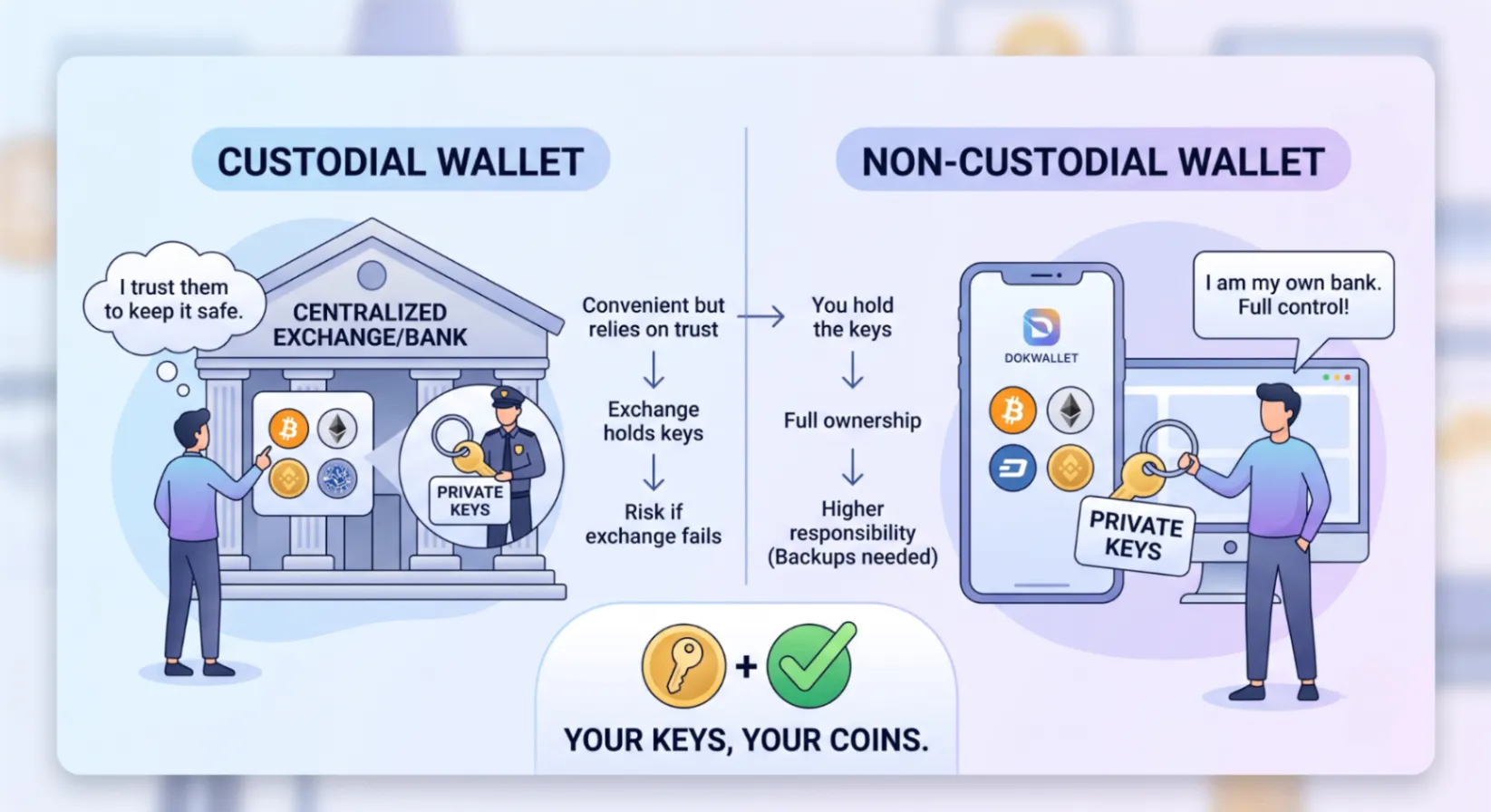
A custodial wallet is one where a third party, usually a centralized exchange, holds your private keys on your behalf. You log in with a username and password, much like a bank account, and the platform manages the technical side of storing your assets. This is convenient, but it means you don’t actually control your crypto. The platform does. If the exchange freezes withdrawals, gets hacked, or shuts down, your funds are at risk. The saying “not your keys, not your coins” exists precisely because of this arrangement.
A non-custodial wallet, on the other hand, generates and stores private keys directly on your device, whether that’s a mobile app, browser extension, or hardware device. Nobody else has a copy. You are solely responsible for keeping your recovery phrase safe, but in exchange, you get full, unrestricted control over your assets at all times.
This is the model DokWallet is built on. Every wallet created within DokWallet gives users complete ownership of their private keys from the very first transaction.
Why Non-Custodial Ownership Matters
The importance of non-custodial wallets becomes obvious once you look at the history of centralized exchange failures. Collapses, security breaches, and sudden withdrawal freezes have cost users billions of dollars over the years, not because the underlying blockchain technology failed, but because a centralized custodian mismanaged or lost access to user funds.
With a non-custodial wallet, that risk is removed from the equation. Your funds live on the blockchain, secured by cryptography, and only your private key or recovery phrase can authorize a transaction. This is often described as “being your own bank,” and it comes with real advantages:
- True ownership: Your assets can’t be frozen, seized, or restricted by a company decision.
- Censorship resistance: No platform can block your transactions based on geography, policy changes, or account flags.
- Direct blockchain interaction: You can connect directly to decentralized applications, staking protocols, and DeFi platforms without routing through an intermediary.
- Reduced counterparty risk: You’re not exposed to a company’s solvency, security practices, or internal decision-making.
How a Non-Custodial Wallet Actually Works
At the technical level, a non-custodial wallet like DokWallet generates a cryptographic key pair: a public key (your wallet address, which you can share to receive funds) and a private key (which must never be shared, and which authorizes outgoing transactions). When you set up the wallet, you’re also given a recovery phrase, typically 12 or 24 words, that can restore full access to your wallet on any compatible device if you lose your original one.
This is the single most important piece of information in the entire wallet: the recovery phrase is the master key. Anyone who has it can access your funds, and if you lose it with no other backup, there is no “forgot password” option. There is no customer support line that can reset it. This is the trade-off for true ownership, and it’s why responsible key management is treated as a core skill for every crypto user, not an afterthought.
Getting Started the Right Way
If you’re setting up your first non-custodial wallet, a few practices will keep you significantly safer:
- Write your recovery phrase on paper, not in a screenshot, cloud note, or email. Digital copies are vulnerable to hacks; a physical copy stored securely is not.
- Never share your recovery phrase, even with someone claiming to be “support.” No legitimate wallet provider will ever ask for it.
- Verify the app source before downloading, ideally directly from the official website or verified app store listing.
- Start with a small test transaction when sending funds to a new wallet, to confirm the address and network are correct before moving larger amounts.
- Consider a hardware wallet for long-term storage of larger balances, using your software wallet for day-to-day transactions.
Non-Custodial Wallets and Decentralization
Non-custodial ownership is closely tied to the broader idea of a decentralized crypto wallet, where control is distributed to the individual user rather than concentrated in a single company’s servers. This aligns with the original philosophy behind blockchain technology: removing single points of failure and putting financial control back in the hands of the people using the network.
As your crypto activity grows, you may find yourself holding assets across several blockchains. That’s where understanding a multi-chain crypto wallet becomes useful, since managing multiple non-custodial wallets across different networks separately can quickly become inconvenient.
Common Misconceptions About Non-Custodial Wallets
“Non-custodial wallets are only for advanced users.”
Not anymore. Modern non-custodial wallets, including DokWallet, are designed with intuitive mobile-first interfaces that make self-custody accessible to complete beginners, without sacrificing security.
“If I lose my phone, I lose my crypto.”
As long as you have your recovery phrase backed up safely, your funds can be restored on a new device in minutes. It’s the recovery phrase that matters, not the physical device.
“Non-custodial means less secure.”
In reality, it shifts security responsibility rather than reducing it. You avoid the risks of centralized hacks and exchange insolvency, in exchange for taking personal responsibility for key storage.
Non-Custodial Wallets and Regulatory Trust
One reason non-custodial wallets have grown so quickly in adoption is the increasing scrutiny centralized platforms face from regulators worldwide. When a custodian is required to freeze accounts, restrict access based on jurisdiction, or comply with sudden policy shifts, users holding funds on that platform are directly affected, regardless of their own compliance or intentions. A non-custodial wallet sidesteps this dynamic almost entirely, because there’s no central account for a regulator or company to act upon. Your wallet is a set of cryptographic keys, not a managed account subject to a company’s terms of service.
This doesn’t mean non-custodial wallets exist outside the law. Users are still responsible for complying with tax obligations and local regulations in their own jurisdiction. What it does mean is that access to your own funds isn’t contingent on a company’s operational decisions, licensing status, or banking relationships. For anyone who has watched a centralized platform pause withdrawals during a market downturn, the appeal of self-custody becomes very concrete.
Building Confidence Through Transparency
A wallet provider’s trustworthiness isn’t just about the technology; it’s also about how transparent the company is about its security practices, audit history, and open-source commitments. Reputable non-custodial wallet providers publish information about how private keys are generated and stored locally, whether the app has undergone independent security audits, and how the recovery process works. When evaluating any non-custodial wallet, it’s worth checking whether the provider is upfront about these details, since a lack of transparency is often a red flag regardless of how polished the app interface looks.
DokWallet is built around this principle of transparency, with private key generation happening entirely on-device and no server-side storage of sensitive recovery data at any point in the account lifecycle.
Frequently Asked Questions
Is a non-custodial wallet safer than an exchange wallet?
It removes counterparty risk entirely, since no third party holds your keys. However, safety also depends on how well you protect your recovery phrase and device.
Can I use a non-custodial wallet for daily transactions?
Yes. Non-custodial wallets like DokWallet are built for everyday use, including sending, receiving, swapping, and connecting to decentralized apps.
What happens if I lose my recovery phrase?
If you lose your recovery phrase and your device, there is no way to recover your funds. This is why secure, offline backup is essential from day one.
Final Thoughts
Choosing a non-custodial wallet is one of the most important first steps in taking real ownership of your crypto assets. It puts you in full control, removes reliance on centralized platforms, and aligns your holdings with the core principles blockchain technology was built on. Once you understand the fundamentals covered here, you’ll be equipped to compare your options and pick a wallet that matches how you actually plan to use crypto.
For a deeper look at how non-custodial wallets stack up against custodial platforms, read our comparison guide on decentralized versus custodial wallets. If security is your top priority, our crypto wallet security best practices guide walks through advanced protection strategies. And if you want to see how DokWallet brings all of this together in one place, check out our full DokWallet review.