
Crypto Wallet for Multiple Coins: Managing a Diverse Portfolio Without the Chaos
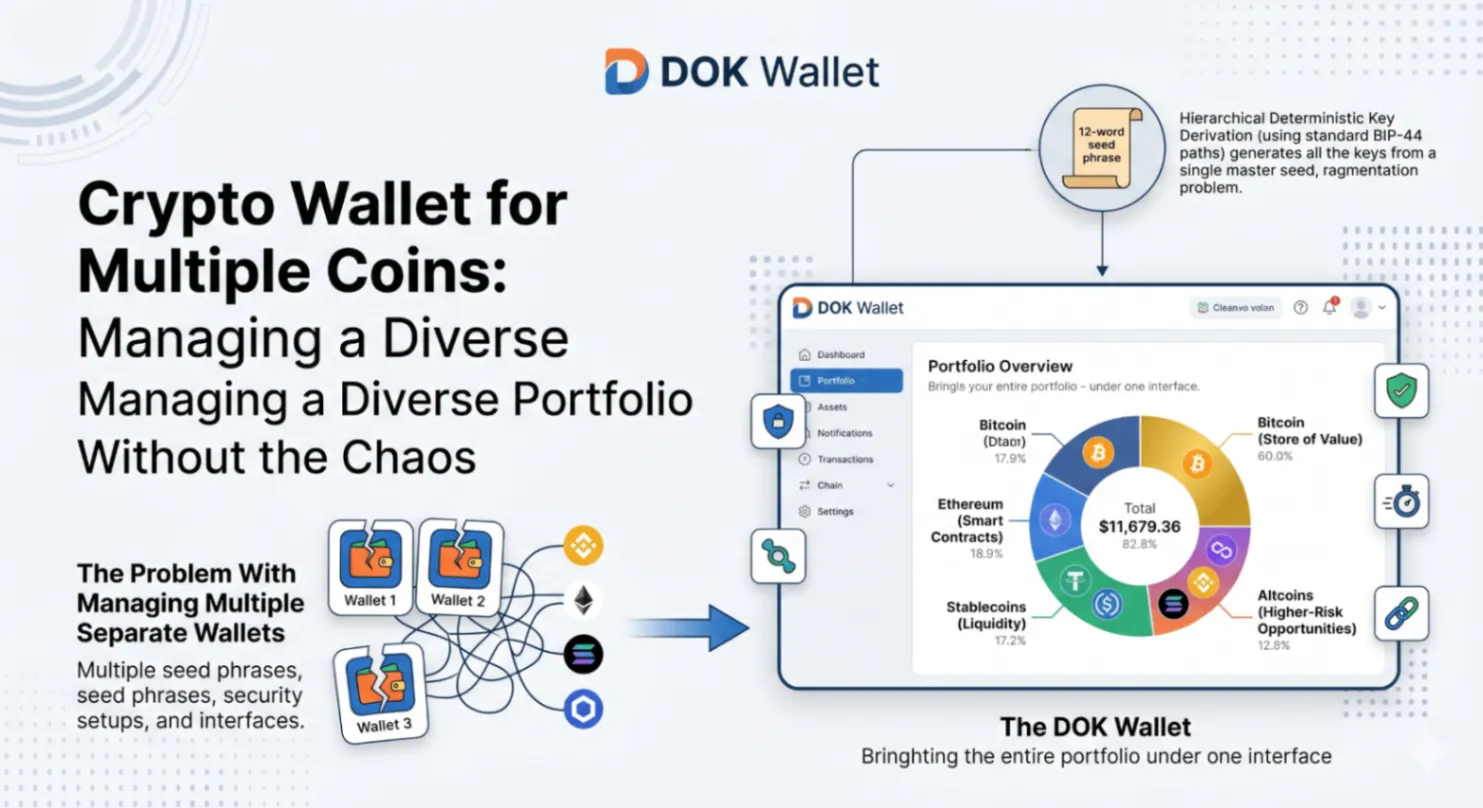
A diversified crypto portfolio is a common goal. Bitcoin for store of value, Ethereum for smart contract exposure, stablecoins for liquidity, and various altcoins for higher-risk opportunities. The challenge is managing all of this efficiently. A crypto wallet for multiple coins makes that possible by bringing your entire portfolio under one interface.
This guide covers what to look for in a multi-coin wallet, the technical foundations that make it work, and how DOK Wallet handles portfolio management across dozens of assets.
The Problem With Managing Multiple Separate Wallets
Using a different wallet for each blockchain or asset type is the default approach for many new crypto users. They might use one app for Bitcoin, another for Ethereum, and a third for BNB Chain tokens. Each app has its own seed phrase, its own security setup, and its own interface quirks.
This fragmentation creates compounding risks. Multiple seed phrases mean multiple points of failure. Portfolio visibility requires opening several apps and mentally combining the values. Security discipline is harder to maintain across multiple apps. When an asset needs to move between chains, the process involves multiple wallets and multiple signing operations.
DOK Wallet solves this with a multi-chain architecture explained in our multi-chain wallet guide.
How a Crypto Wallet for Multiple Coins Actually Works
A multi-coin wallet uses hierarchical deterministic key derivation to generate unique private keys for each blockchain address from a single master seed. The derivation paths are standardised through BIP-44, a Bitcoin Improvement Proposal that defines how multi-coin wallets should derive keys for different blockchain networks.
Because DOK Wallet follows these standards, your wallet addresses are deterministic and reproducible. Any compatible wallet software can restore all your addresses from the same twelve-word seed phrase. You are not locked into DOK Wallet's specific implementation.
What Assets Does DOK Wallet Support?
DOK Wallet supports major native blockchain assets including Bitcoin (BTC), Ether (ETH), BNB, and MATIC, alongside thousands of tokens deployed on supported networks. This includes:
- ERC-20 tokens on Ethereum (USDC, USDT, DAI, LINK, UNI, and many others).
- BEP-20 tokens on BNB Chain (BUSD, CAKE, and BNB Chain native tokens).
- Polygon network tokens for lower-fee DeFi and payment use cases.
- Stablecoins across multiple networks for cross-chain payment flexibility.
New token and network support is added with regular app updates.
Portfolio Visibility Across All Assets
DOK Wallet's main dashboard shows your total portfolio value in your chosen fiat currency, calculated by summing the current market value of every asset across every supported network. Individual asset holdings are listed below with their current price, 24-hour price change, and balance.
This unified view eliminates the need to open multiple apps to understand your full financial position. For users who actively manage their crypto, this clarity is practically valuable and reduces the risk of making decisions based on an incomplete picture.
For how DOK Wallet handles cross-chain asset movements, read our cross-chain wallet guide.
Security When Holding Multiple Coins
The security implications of a multi-coin wallet are straightforward but important. Because one seed phrase controls assets on all supported chains, the seed phrase is the single point of access to everything. This concentrates the security responsibility onto one piece of information, which is actually simpler to protect than multiple seed phrases.
Write your seed phrase once, store it in a secure physical location, and every coin in your DOK Wallet is protected by that single backup. Losing any one asset's address is recoverable from the seed phrase. Losing the seed phrase means losing all assets with no recovery option.
For security best practices for non-custodial wallets, read our non-custodial wallet security guide.
Swapping Between Coins Within DOK Wallet
Managing multiple coins is not just about holding them. It also means being able to rebalance, take profits, and reallocate between assets without using a centralised exchange. DOK Wallet's built-in swap functionality allows you to exchange supported assets directly from the app, keeping your assets in self-custody throughout the process.
For a full review of DOK Wallet's features including multi-coin management, see our comprehensive DOK Wallet review.
Frequently Asked Questions
What is BIP-44 and why does it matter?
BIP-44 is a Bitcoin Improvement Proposal that standardises how multi-coin wallets derive keys for different blockchain networks from a single seed phrase. DOK Wallet follows BIP-44, meaning your wallet addresses are deterministic and recoverable using any compatible wallet software — you are not locked into DOK Wallet.
How do I find my wallet address to share with a sender?
In DOK Wallet, tap the receive button from the main screen, select the specific coin and network you want to receive, and your unique address is displayed as text and a QR code.
Can I swap between coins directly in DOK Wallet?
Yes. DOK Wallet's built-in swap feature allows you to exchange supported assets directly from the app without transferring to a centralised exchange. Your assets remain in self-custody throughout the swap process.
What happens if I send Bitcoin to an Ethereum address?
Sending an asset to the wrong network address is a permanent loss. Bitcoin and Ethereum use different address formats, and DOK Wallet clearly labels each network within the interface. Always verify both the asset and the network before confirming any send transaction.
How many cryptocurrencies does DOK Wallet support?
DOK Wallet supports major native assets including Bitcoin, Ether, BNB, and MATIC, alongside thousands of tokens on supported networks including ERC-20 tokens on Ethereum, BEP-20 tokens on BNB Chain, and Polygon network tokens.
Is a single-wallet approach more or less secure than multiple wallets?
A single multi-coin wallet with one seed phrase is simpler to secure than multiple wallets with multiple seed phrases. Concentrating security onto one well-protected phrase reduces the number of attack surfaces and simplifies your backup discipline.
Final Thoughts
A crypto wallet for multiple coins is not a luxury for power users. It is the practical choice for anyone holding more than one asset. DOK Wallet provides multi-coin management through a clean, non-custodial interface that gives you full portfolio visibility, one-seed-phrase security, and built-in swap capability.
Download DOK Wallet and manage your full crypto portfolio at dokwallet.com.