
Decentralized Crypto Wallets vs. Custodial Alternatives: Which Should You Trust?
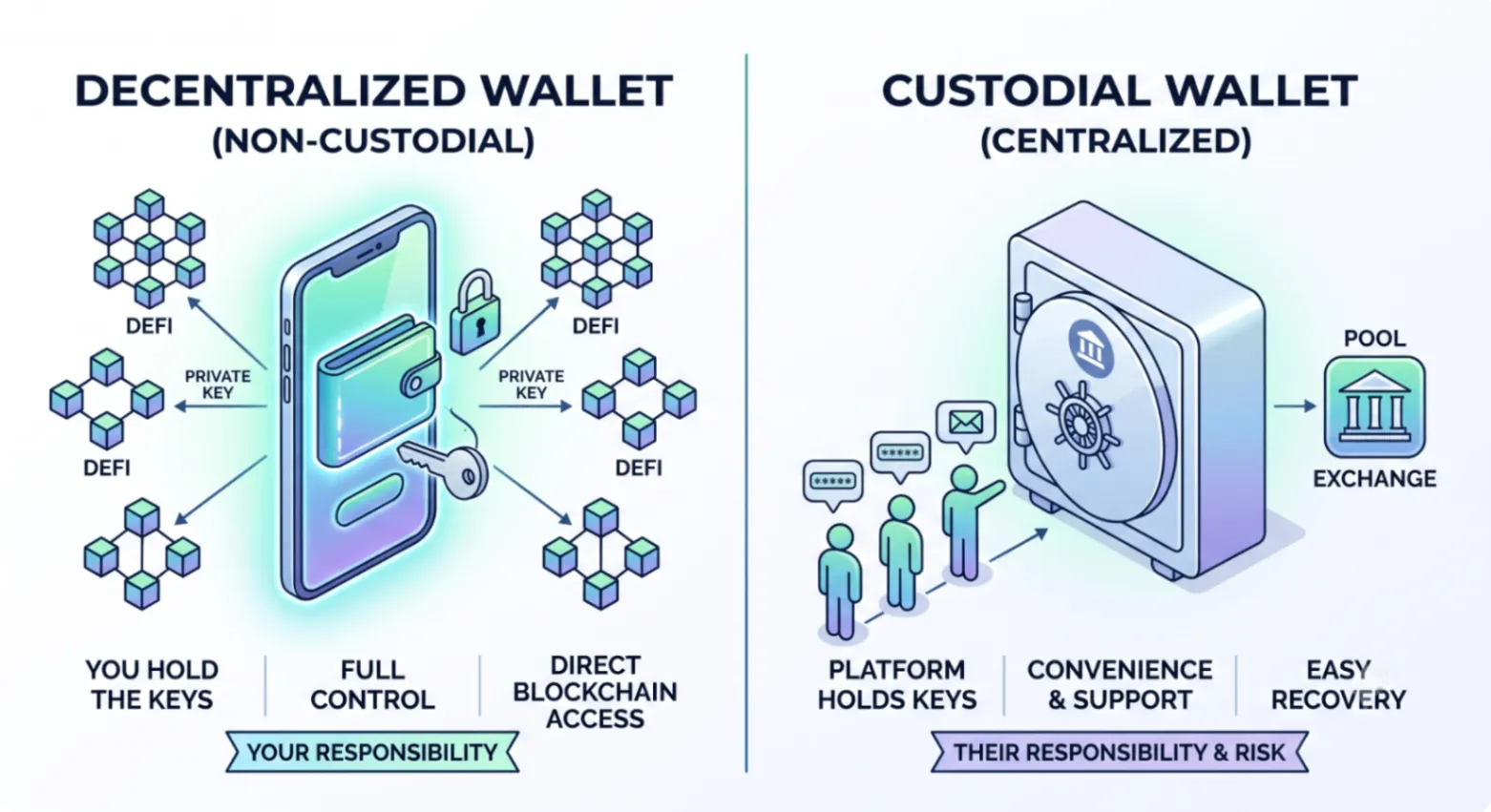
Every crypto holder eventually faces the same fork in the road: keep assets on a centralized platform where a company manages the technical heavy lifting, or move to a decentralized wallet where you hold full control yourself. Neither option is universally “correct,” but the differences between them affect your security, your access to funds, and how much responsibility you’re willing to take on. This guide breaks down exactly how decentralized and custodial wallets compare, so you can make an informed decision rather than a default one.
What Makes a Wallet “Decentralized”
A decentralized crypto wallet is a type of non-custodial wallet that generates and stores private keys locally, on your device, rather than on a company’s servers. There’s no central authority managing your account, approving withdrawals, or holding your funds in a pooled reserve. Every transaction you make is signed directly by your device using your private key and broadcast to the blockchain network.
This is fundamentally different from how custodial platforms operate. On a custodial exchange, your balance is really just a database entry reflecting what the platform owes you. The actual crypto sits in the exchange’s own wallets, often pooled together with other users’ funds. When you “withdraw,” you’re asking the platform to release real crypto to an address you control.
Custodial Wallets: The Convenience Trade-Off
Custodial wallets, typically offered by centralized exchanges, remain popular for good reason. They offer:
- Simple onboarding: Sign up with an email and password, no need to manage a recovery phrase.
- Account recovery: Forgot your password? Reset it like any other online account.
- Built-in trading tools: Buy, sell, and trade directly within the same platform.
- Customer support: A team you can contact if something goes wrong.
These conveniences come at a cost, however. You’re trusting the platform’s security practices, solvency, and regulatory standing with your funds. History has shown that even large, well-known exchanges can face insolvency, regulatory shutdowns, or security breaches that leave users unable to access their assets, sometimes permanently.
Decentralized Wallets: Control With Responsibility
Decentralized wallets flip this arrangement. You hold your own keys, which means:
- No third-party risk: Your funds can’t be affected by another company’s insolvency or mismanagement.
- Direct DeFi access: Connect straight to decentralized exchanges, lending protocols, and staking platforms.
- Full transaction control: No withdrawal limits, freezes, or approval delays imposed by a platform.
- Greater privacy: Many decentralized wallets require no personal information to create an account.
The trade-off is responsibility. If you lose your recovery phrase, there’s no support line to call. If you send funds to the wrong address, there’s no reversal option. This is why understanding what a non-custodial wallet is and how key management works matters so much before making the switch.
Security: A Side-by-Side Look
| Factor | Custodial Wallet | Decentralized Wallet |
|---|---|---|
| Who holds the keys | The platform | You |
| Risk of platform hack | Affects all users on the platform | Isolated to your own device |
| Account recovery | Password reset available | Only via recovery phrase |
| Regulatory freeze risk | Possible | Not applicable |
| DeFi/dApp access | Usually limited or unavailable | Direct and unrestricted |
Security in a decentralized wallet is really a function of how well you protect your own recovery phrase and device. There’s no “platform-level” hack risk in the traditional sense, but personal security hygiene becomes non-negotiable. That’s why pairing a decentralized wallet with strong habits, and a resource like our crypto wallet security best practices guide, is one of the smartest moves a new user can make.
When Custodial Might Still Make Sense
There are scenarios where a custodial wallet remains a reasonable, even preferable, choice. If you’re actively day-trading and need instant fiat on/off ramps, a reputable exchange’s custodial wallet may offer speed and liquidity advantages. If you’re managing crypto for a business with strict internal recovery and compliance requirements, a regulated custodian might simplify accounting and reporting.
That said, best practice for most long-term holders is to treat exchanges as a temporary holding point, not a storage solution, and move assets to a decentralized wallet once a purchase is complete.
Making the Switch to Decentralized Ownership
If you’re moving from a custodial exchange to a decentralized wallet like DokWallet, the transition is straightforward:
- Download the wallet app from an official, verified source.
- Generate your new wallet and securely record your recovery phrase offline.
- Send a small test amount from your exchange to your new wallet address first.
- Once confirmed, transfer the remainder of your holdings.
- Store your recovery phrase in a secure, offline location, separate from your device.
For users managing assets across several networks, this is also a natural point to explore a multi-chain crypto wallet, since consolidating multiple blockchain balances into a single decentralized interface significantly simplifies portfolio management.
The Bigger Picture: Why This Decision Matters
The custodial-versus-decentralized decision isn’t just a technical preference; it reflects a broader philosophy about who should control financial access. Crypto was built on the premise of removing intermediaries, and every time funds sit on a custodial platform, that premise is partially set aside for convenience. That’s not inherently wrong, but it’s worth being a deliberate choice rather than a default habit carried over from setting up your first exchange account.
Evaluating a Wallet Provider Before You Commit
Whichever direction you lean, it’s worth applying a consistent evaluation framework before trusting any provider, custodial or decentralized, with meaningful funds. Look at how long the platform has operated, whether it has published security audit results, how transparent it is about its architecture, and whether its support channels are responsive and well-documented. For decentralized wallets specifically, check whether private key generation happens entirely on-device, whether the app has a verifiable track record of app store reviews, and whether the company is transparent about what data, if any, it collects during setup.
It’s also worth reading independent reviews rather than relying solely on a provider’s own marketing claims. A wallet that repeatedly shows up in community discussions for reliability, responsive updates, and clear communication during network issues is generally a safer long-term bet than one with flashy branding but little verifiable history.
Portability Between Wallet Types
One underappreciated advantage of understanding both wallet types is portability. Because decentralized wallets are built on open blockchain standards, your recovery phrase can typically restore your wallet on any compatible app, not just the one you originally used. This means you’re never permanently locked into a single provider’s ecosystem, unlike a custodial account, which is fully tied to that specific platform’s infrastructure and policies. This portability is one of the quieter, but genuinely important, benefits of choosing decentralized ownership from the start.
Frequently Asked Questions
Can I use both custodial and decentralized wallets?
Yes, many users keep a small trading balance on an exchange for liquidity while holding the majority of assets in a decentralized wallet for long-term security.
Is switching from custodial to decentralized difficult?
Not technically. The main adjustment is a mindset shift toward personal responsibility for key security, since there’s no support team to fall back on.
Do decentralized wallets support the same coins as exchanges?
Most modern decentralized wallets, including those with multi-chain support, cover a broad range of major cryptocurrencies and tokens across multiple blockchains.
What happens to a decentralized wallet if the app company shuts down?
Because your recovery phrase is based on open blockchain standards, you can restore access using a different compatible wallet app even if the original provider ceases operations. This is a key structural advantage over custodial accounts, which become inaccessible if the company itself disappears.
Final Thoughts
Choosing between a custodial and decentralized wallet ultimately comes down to how much control, privacy, and independence you want over your crypto holdings, weighed against the convenience of a managed platform. For most people building a long-term crypto strategy, decentralized ownership offers meaningful security advantages that are worth the small learning curve involved.
To understand the fundamentals of self-custody in more depth, revisit our guide on what a non-custodial wallet is. If you’re ready to see how a fully decentralized, multi-chain solution comes together in one app, our complete DokWallet review covers everything the platform offers.