What Is a Decentralized Crypto Wallet? A Complete Guide for 2026
Anyone who has spent time around crypto exchanges eventually hears the phrase “not your keys, not your coins.” It sounds like a slogan, but it is really a warning built from years of hard lessons — collapsed exchanges, frozen withdrawals, and accounts locked overnight. A decentralized crypto wallet is the tool that lets you avoid that risk entirely by holding your assets yourself, without a company standing between you and your money.
This guide breaks down what a decentralized wallet actually is, how it differs from the custodial accounts most beginners start with, and what to check before you trust one with real funds.
What “Decentralized” Actually Means in a Wallet
A decentralized crypto wallet is software (and sometimes hardware) that generates and stores a private key directly on your device rather than on a company's server. That private key is the only thing that proves ownership of the assets recorded on the blockchain. When you send a transaction, the wallet signs it locally using your key and broadcasts it to the network — no intermediary approves, delays, or reverses it.
This is different from a centralized wallet or exchange account, where the platform holds the private keys on your behalf. In that setup, you technically own an IOU from the exchange, not the asset itself. If the exchange freezes withdrawals, gets hacked, or becomes insolvent, your balance can vanish regardless of what the app shows you.
Decentralization removes that single point of failure. Your funds live on the blockchain; the wallet is simply the interface you use to access and move them.
How a Decentralized Wallet Works Under the Hood
Every decentralized wallet is built around a cryptographic key pair:
- A private key, which must never be shared. It is used to sign transactions and prove ownership.
- A public key/address, derived from the private key, which you can share freely to receive funds.
Most modern wallets generate a 12- or 24-word seed phrase when you first set them up. This phrase is a human-readable backup of your private key. Anyone who has the seed phrase can restore the wallet on a new device and control the funds — which is exactly why it must be written down offline and never stored as a screenshot, email, or cloud note.
When you approve a transaction, the wallet software signs it using elliptic curve cryptography, then submits the signed transaction to the blockchain network for validation. No customer support team is involved, and none is needed, because the math itself verifies that you authorized the transfer.
Decentralized vs. Custodial Wallets: The Real Differences
| Factor | Decentralized Wallet | Custodial Wallet |
|---|---|---|
| Key ownership | You hold the private key | Platform holds the private key |
| Withdrawal freezes | Not possible by a third party | Possible at platform's discretion |
| Recovery | Seed phrase (your responsibility) | Password reset via support |
| Counterparty risk | None | Exposed to platform insolvency/hacks |
| Ease of use for beginners | Slightly more setup | Simple sign-up |
Custodial wallets remain useful for short-term trading or moving in and out of fiat currency. But for holding assets over time, a decentralized wallet is the safer long-term home because it removes reliance on a third party's solvency and security practices.
Why This Matters More in 2026
Regulatory scrutiny of centralized platforms has increased steadily, and several high-profile exchange failures in recent years pushed a large share of long-term holders toward self-custody. At the same time, decentralized wallets have become far more usable — biometric unlock, in-app swaps, multi-chain support, and integrated dApp browsers now come standard, closing the gap that used to exist between “secure” and “convenient.”
This shift also lines up with the growth of DeFi, NFTs, and on-chain payments, all of which require a wallet that can interact directly with smart contracts rather than one that only holds a balance.
Key Features to Look for in a Decentralized Wallet
- Non-custodial key storage — the wallet should never transmit your private key or seed phrase to a server.
- Open-source or independently audited code — lets security researchers verify there are no hidden backdoors.
- Multi-chain support — the ability to manage assets across networks like Ethereum, Bitcoin, and other major chains from one interface.
- Built-in dApp browser — for interacting with decentralized exchanges, lending protocols, and NFT marketplaces.
- Local backup and recovery tools — clear, guided seed phrase backup during setup, not buried in settings.
- Biometric and PIN protection — an extra layer of device-level security on top of the seed phrase. See our blockchain wallet app features guide for a fuller breakdown.
Common Mistakes New Users Make
- Storing the seed phrase digitally. A screenshot or note-app entry is one data breach away from being stolen.
- Skipping the backup step. Losing a device without a backed-up seed phrase means permanent loss of funds — there is no password reset.
- Approving transactions without reading them. Malicious dApps can request excessive permissions; always review what a transaction actually authorizes before signing.
- Downloading wallets from unofficial sources. Always install from the official website or a verified, developer-confirmed source to avoid counterfeit apps designed to steal seed phrases.
- Treating a hot wallet like a savings account. For large, long-term holdings, pairing a software wallet with a hardware device adds meaningful protection. Read our non-custodial wallet security guide for more.
Getting Started Safely
If you are setting up a decentralized wallet for the first time:
- Download the app only from the official source and verify the publisher.
- Generate a new wallet and write the seed phrase on paper (or a metal backup plate for durability).
- Store the backup in a secure physical location — never online.
- Send a small test transaction before moving significant funds.
- Enable any available biometric or PIN lock on the device itself.
Frequently Asked Questions
Is a decentralized wallet the same as a hardware wallet?
Not necessarily. A decentralized wallet refers to who controls the private key — it can be software (a mobile app) or hardware (a physical device). Hardware wallets are a subset that add offline key storage for extra protection.
What happens if I lose my phone?
As long as you have your seed phrase backed up, you can restore your wallet and funds on a new device. Without the seed phrase, the funds are unrecoverable.
Are decentralized wallets free to use?
The wallet software itself is typically free. You still pay standard network (gas) fees when sending transactions, since those go to the blockchain, not the wallet provider.
How Decentralized Wallets Interact With the Broader Ecosystem
A decentralized wallet isn't just a place to park assets — it functions as your identity across the decentralized web. When you connect to a lending protocol, mint an NFT, or vote in a DAO governance proposal, you're typically doing so by signing a message or transaction with the same wallet that holds your funds. This is a meaningful shift from how people relate to traditional financial accounts, where the account itself has no function beyond holding and moving money.
This dual role — storage and identity — is part of why security habits matter so much more with decentralized wallets. A compromised custodial account usually just means lost funds. A compromised decentralized wallet can also mean a compromised identity across every application you've ever connected it to, since an attacker with your private key can interact with those same protocols on your behalf.
Hardware Wallets: Extending Decentralization Offline
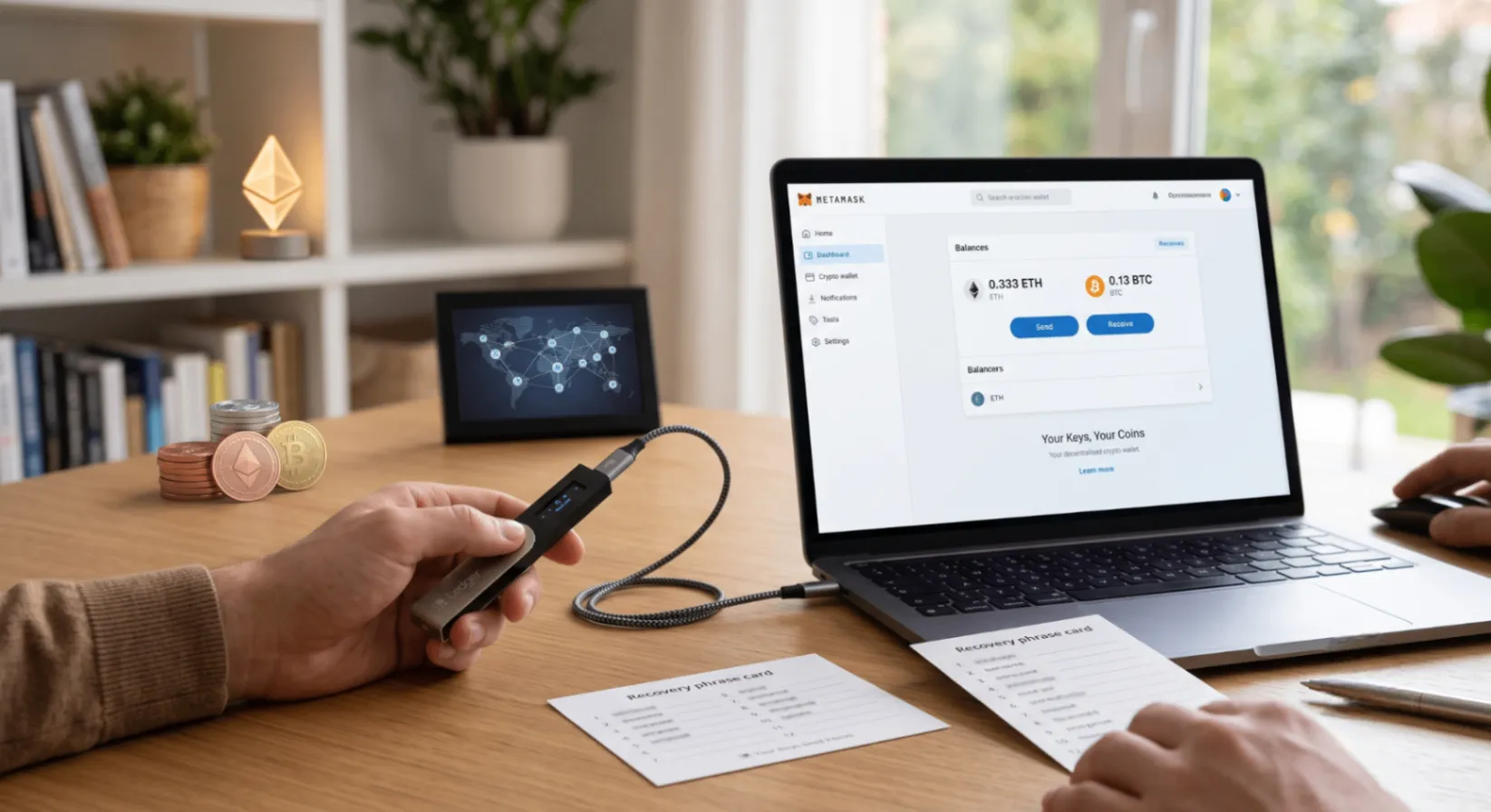
For holders with significant balances, a hardware wallet takes the decentralized model a step further by keeping the private key on a dedicated offline device rather than a general-purpose smartphone or computer. Transactions are still signed locally — nothing changes about the core non-custodial principle — but the signing happens on a device that's never connected to the internet, dramatically reducing exposure to malware or remote attacks.
Many decentralized software wallets support pairing with a hardware device, letting you keep the familiar interface for checking balances and building transactions while the actual private key never touches an internet-connected device. This combination — a software wallet for usability, a hardware wallet for key isolation — is generally considered the strongest practical setup available to individual holders today.
The Trust Model Shift, in Perspective
It's worth stepping back to appreciate what decentralized wallets actually change about trust. In traditional finance, you trust a bank's solvency, security team, and regulatory compliance. With a decentralized wallet, that trust shifts to the mathematics of public-key cryptography, the correctness of the wallet software's code, and your own operational security. Two of those three are far more verifiable than a bank's internal risk management — cryptographic security has been studied and stress-tested for decades, and open-source wallet code can be independently reviewed. The third — your own security habits — is the variable most within your control, which is exactly why the practices outlined above matter so much.
Recovery Planning: Beyond the Basic Backup
A single seed phrase written on paper is a good start, but experienced holders often go a step further with recovery planning. This can include storing a backup copy in a second, geographically separate location to protect against fire or flood at a single site, using a fireproof and waterproof metal seed storage plate instead of paper for long-term durability, and, for larger holdings, considering a multi-signature setup that requires more than one key to authorize a transaction — meaning a single lost or stolen seed phrase isn't enough on its own to move funds. None of these steps are strictly necessary for smaller, everyday balances, but they become increasingly worth considering as the value held in a decentralized wallet grows.
The Bottom Line
A decentralized crypto wallet shifts responsibility — and control — back to you. That means no company can freeze your funds or lose them to a breach, but it also means the security of your assets depends entirely on how carefully you protect your private key. Understanding how these wallets work is the first real step toward using crypto the way it was designed to be used: directly, without a middleman.
Download DOK Wallet and take control of your digital assets at dokwallet.com.