Blockchain Wallet App Features That Actually Matter in 2025
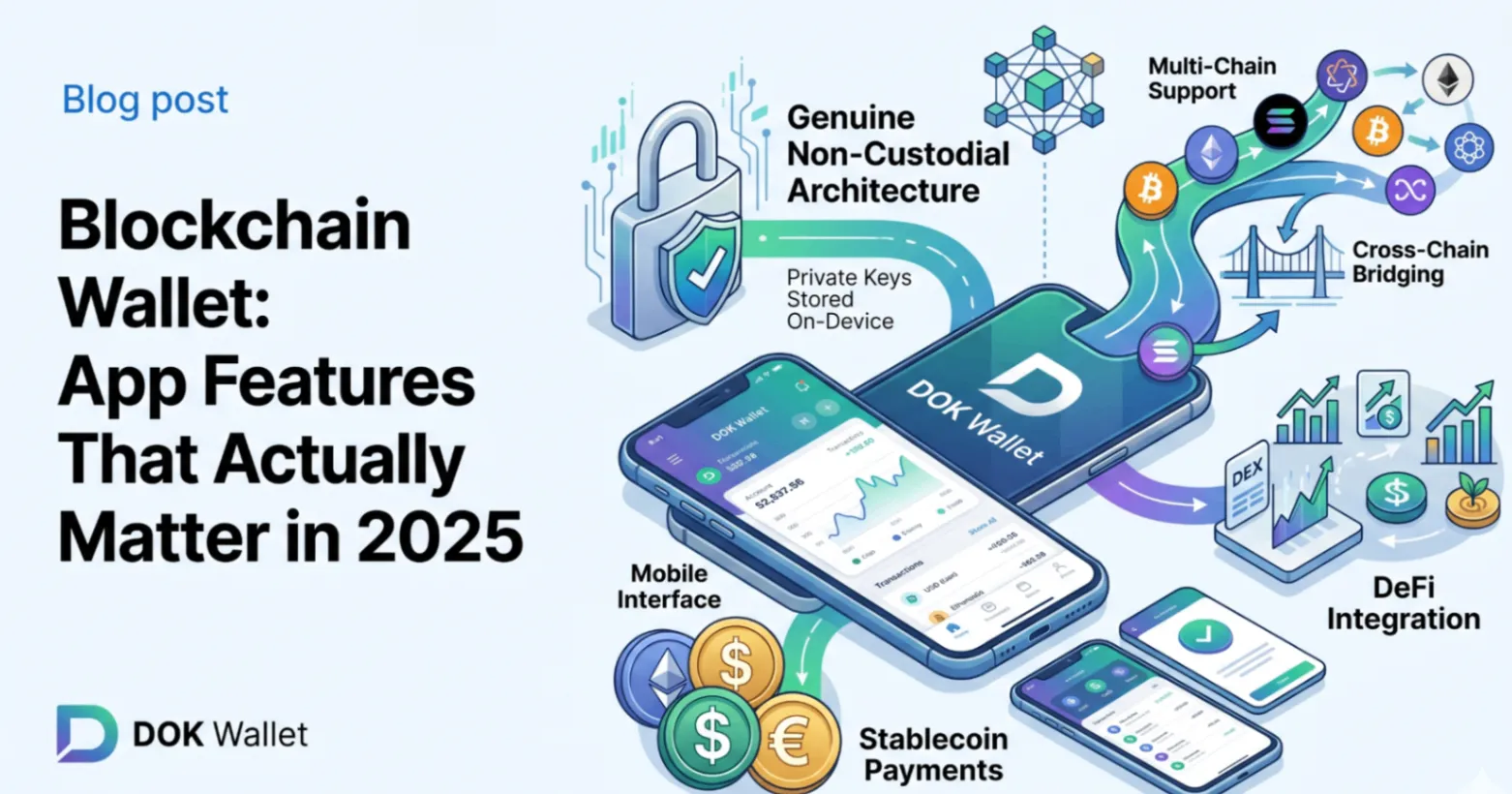
The blockchain wallet app market has matured. In the early days of crypto, any app that could send and receive Bitcoin was considered functional. Today, users expect multi-chain support, DeFi integration, stablecoin payments, cross-chain bridging, and a clean mobile interface, all in a single non-custodial app.
This guide cuts through the feature noise and identifies the blockchain wallet app capabilities that genuinely make a difference in daily use, with specific reference to how DOK Wallet delivers on each one.
Feature One: Genuine Non-Custodial Architecture
The most fundamental feature of a blockchain wallet app is whether it actually gives you control of your private keys. Many apps market themselves as wallets but are really exchange interfaces that hold your keys on their own servers. A genuine non-custodial architecture means keys are generated on your device, stored on your device, and never transmitted to any server.
DOK Wallet is fully non-custodial. Your seed phrase is generated locally on first use and stays on your device. The app signs transactions locally and broadcasts the signed result. No key material ever reaches DOK Wallet's infrastructure.
For why this architecture matters, read our full non-custodial wallet guide.
Feature Two: Open-Source Code
Open-source code is the strongest security claim a wallet can make. It means any developer in the world can audit the key generation, storage, and transaction signing implementation. Hidden backdoors, unexpected data collection, and insecure cryptography cannot survive public code inspection.
DOK Wallet is fully open source. The code is maintained on GitHub and has been available for public review since launch. For users who care about security, this transparency is more valuable than any marketing claim.
Review the code yourself at dokwallet.com/open-source.
Feature Three: Multi-Chain and Multi-Asset Support
A blockchain wallet app that supports only one network is increasingly insufficient. Modern crypto portfolios span Bitcoin, Ethereum, BNB Chain, Polygon, and other networks. A wallet that requires separate installs and separate seed phrases for each network creates fragmentation and risk.
DOK Wallet's multi-chain architecture derives all network addresses from a single seed phrase, giving you a unified portfolio view and a single backup that covers everything.
For a detailed look at multi-chain features, read our multi-chain wallet guide.
Feature Four: Built-In Swap Functionality
The ability to swap between assets without leaving the wallet removes a significant source of friction and risk. Swapping within DOK Wallet means your assets stay in self-custody throughout the process. There is no transfer to an exchange, no custodial risk during the swap, and no need to manage an exchange account.
DOK Wallet's swap feature supports major asset pairs with fee estimates shown before confirmation. The swap operation happens through integrated liquidity sources, and the resulting assets arrive directly in your DOK Wallet.
Feature Five: Stablecoin and Payment Support
A modern blockchain wallet app should handle stablecoin payments as smoothly as it handles asset storage. This means supporting USDC and USDT on multiple networks, providing clear fee estimates for stablecoin transactions, and making the send flow fast enough for practical payment use.
DOK Wallet supports stablecoins across Ethereum, BNB Chain, and Polygon, with a send flow optimised for payment use cases.
For the payment use case in detail, read how to pay with crypto. And for stablecoin specifics, see our stablecoin payment app guide.
Feature Six: Biometric Authentication and Device Security
Biometric authentication is table stakes for any mobile crypto app in 2025. Face ID, Touch ID, and fingerprint unlock provide a strong balance of security and convenience. DOK Wallet implements biometric authentication on both iOS and Android, requiring it every time the app is opened.
Beyond biometrics, DOK Wallet uses platform-native secure storage for key material, implements screenshot blocking on sensitive screens, and enforces clipboard timeout behaviour for wallet addresses.
Feature Seven: Cross-Border Payment Capability
For an increasingly global user base, the ability to send and receive international payments in stablecoins is a genuinely useful feature, not a nice-to-have. DOK Wallet's multi-chain stablecoin support covers the most practical cross-border payment scenarios.
For the international payment use case, read our cross-border crypto payments guide.
Frequently Asked Questions
What is the most important feature of a blockchain wallet app?
Genuine non-custodial architecture — where keys are generated on your device, stored on your device, and never transmitted to any server — is the foundational feature. Without it, no other feature matters because you do not actually own your assets.
Why does open-source code matter for wallet security?
Open-source code allows any developer to audit key generation, storage, and transaction signing. Hidden backdoors, unexpected data collection, and insecure cryptography cannot survive public code inspection. For a wallet, this transparency is more valuable than any marketing security claim.
Does DOK Wallet support in-app asset swaps?
Yes. DOK Wallet's built-in swap feature allows you to exchange supported asset pairs directly from the app, without transferring funds to an exchange. Your assets remain in self-custody throughout the entire swap operation.
What biometric options does DOK Wallet support?
DOK Wallet supports Face ID and Touch ID on iOS, and fingerprint authentication on Android. Biometric authentication is required every time the app is opened, providing strong access security without requiring a manual PIN entry each time.
Is DOK Wallet free to download?
Yes. DOK Wallet is free to download and use on both iOS and Android. The full feature set — including send, receive, swap, and multi-chain portfolio management — is available at no cost. Network transaction fees are paid to the blockchains, not to DOK Wallet.
What makes DOK Wallet suitable for cross-border payments?
DOK Wallet supports USDC and USDT across Ethereum, BNB Chain, and Polygon — the most practical networks for international stablecoin transfers. The send flow is designed for payment use cases with clear fee estimates and straightforward address entry.
Final Thoughts
Not all blockchain wallet app features are created equal. The ones that matter most are non-custodial key management, open-source transparency, multi-chain support, built-in swap, stablecoin payments, and strong mobile authentication. DOK Wallet delivers on all of these in one free, open-source application.
Download DOK Wallet at dokwallet.com.