
Cross-Chain Crypto Transfers Explained: How Bridge Technology Actually Works
Moving crypto between different blockchains used to require a complicated, multi-step process involving centralized exchanges, manual conversions, and a fair amount of technical risk. Today, a cross-chain crypto wallet simplifies this into a far more direct experience, letting you move assets from one network to another without leaving your wallet app. This guide walks through how cross-chain transfers actually work, what bridge technology does under the hood, and how to move assets safely between blockchains.
What Does “Cross-Chain” Actually Mean?
Cross-chain functionality refers to the ability to transfer value or data between two fundamentally different blockchain networks that don’t natively communicate with each other. Bitcoin’s blockchain, for example, doesn’t inherently understand Ethereum transactions, and vice versa. Each network operates as its own independent ledger with its own rules, validators, and consensus mechanisms.
Cross-chain technology bridges this gap, allowing an asset that exists on one chain to be represented, transferred, or effectively “moved” to another chain, even though the underlying blockchains were never designed to interact directly.
This is a distinct capability from simply holding assets on multiple chains, which is what a multi-chain crypto wallet provides. Cross-chain adds the ability to actually move value between those networks.
How Bridge Technology Works
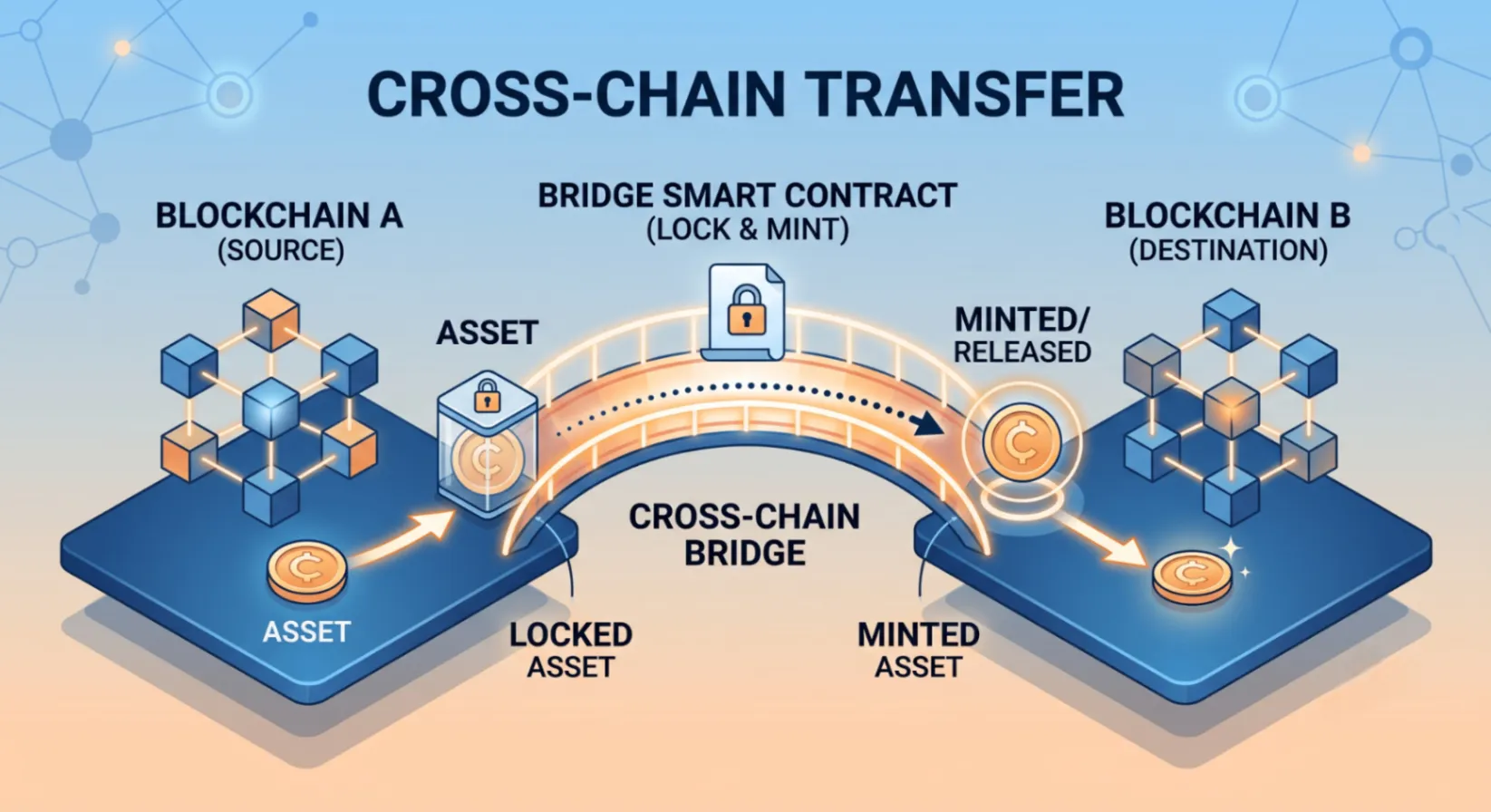
Most cross-chain transfers rely on a mechanism called a “bridge.” While implementations vary, the general process works like this:
- You send your asset (for example, a token on Network A) to a bridge contract or custodian.
- The bridge locks or burns the original asset on Network A.
- An equivalent representation of that asset is minted or released on Network B.
- You receive the bridged asset on the destination network, usable within that chain’s ecosystem.
Some bridges are decentralized, relying on smart contracts and validator networks to secure the process. Others are more centralized, relying on a trusted operator to manage the lock-and-mint process. The security model of the specific bridge matters significantly, since bridge exploits have historically been among the most costly security incidents in crypto — a topic covered in more depth in our crypto wallet security best practices guide.
Why Cross-Chain Transfers Matter for Everyday Users
Cross-chain capability isn’t just a technical curiosity, it solves real, practical problems:
- Accessing better opportunities. If a promising decentralized application or yield opportunity exists on a different chain than where your assets currently sit, cross-chain transfers let you participate without a complicated manual process.
- Reducing transaction costs. Some networks offer significantly lower fees than others. Moving assets to a cheaper network for certain activities can meaningfully reduce costs.
- Consolidating fragmented holdings. If you’ve accumulated assets across multiple chains over time, cross-chain transfers help consolidate them into your preferred network.
- Avoiding centralized exchange dependency. Historically, moving assets between chains required routing through a centralized exchange. Cross-chain wallets remove this middle step entirely.
How DokWallet Handles Cross-Chain Transfers
DokWallet integrates cross-chain transfer functionality directly into its multi-chain interface, allowing users to move supported assets between networks without needing to manually interact with external bridge protocols or leave the app. This reduces both the technical complexity and the number of steps involved, which in turn reduces the opportunity for user error, one of the most common causes of lost funds during manual cross-chain transactions.
Because this functionality builds directly on DokWallet’s multi-chain wallet architecture, users get a consistent experience whether they’re simply holding assets on different chains or actively moving value between them.
Risks to Understand Before Bridging Assets
Cross-chain transfers, while increasingly reliable, still carry some inherent risks worth understanding:
- Bridge security varies widely. Not all bridges use the same security model. Some rely on a small set of trusted validators, which introduces centralization risk, while others use fully decentralized smart contract mechanisms with different trade-offs.
- Transfer times differ by network. Depending on the networks involved and current congestion, cross-chain transfers can take anywhere from a few minutes to significantly longer. Always account for this when timing a transfer around a specific need.
- Bridged assets aren’t always identical to native assets. A bridged token is technically a wrapped representation of the original asset, backed by the locked original. In rare cases, if the bridge itself is compromised, this backing can be affected, which is why using well-established, audited bridge infrastructure matters.
Best Practices for Safe Cross-Chain Transfers
- Start with a small test transfer before moving a large balance across an unfamiliar bridge route.
- Double-check destination network details before confirming any cross-chain transaction.
- Understand estimated transfer times so you’re not left wondering whether a transaction has failed.
- Use wallets with integrated bridging, like DokWallet, rather than manually interacting with third-party bridge websites when possible, since integrated flows typically involve fewer steps and less exposure to phishing risks.
- Keep an eye on gas requirements on both networks, since you may need a small amount of the destination network’s native token to complete follow-up transactions.
The Difference Between Wrapped Assets and Native Assets
A common point of confusion for newer users is the difference between a native asset and its wrapped, bridged counterpart. When you bridge an asset from one chain to another, you typically receive a wrapped version of that asset on the destination network, not the original token itself. This wrapped token is designed to track the value of the original one-to-one, backed by the locked reserves on the source chain.
While wrapped assets generally function identically to native assets within decentralized applications on the destination chain, it’s worth knowing the distinction, particularly when evaluating risk. If the underlying bridge experiences a security failure, the backing for wrapped assets can theoretically be affected, which is why sticking to established, well-audited bridges with a strong security track record is consistently recommended over newer, unproven bridge protocols, even when the newer option offers lower fees or faster transfer times.
How Multi-Chain Wallets Simplify the Bridging Decision
One of the more overlooked benefits of using a wallet with integrated cross-chain functionality is that it removes the need to independently research and vet third-party bridge websites, a process that has historically been a common vector for phishing attacks. When bridging is built directly into a trusted wallet interface, the underlying bridge integrations have typically already been vetted by the wallet provider, reducing the research burden on individual users while still preserving the transparency of knowing which bridge protocol is being used behind the scenes.
This integrated approach is part of why cross-chain functionality within a multi-chain wallet like DokWallet is generally considered a safer entry point for users who are newer to cross-chain transfers, compared to navigating standalone bridge websites independently.
Cross-Chain Transfers and Payment Use Cases
Cross-chain functionality also plays an important role in modern crypto payment flows, particularly for cross-border crypto payments, where the sender and recipient may prefer to hold or receive funds on different networks entirely. The ability to bridge value seamlessly between chains removes a significant friction point in these scenarios, especially when stablecoins are involved.
Frequently Asked Questions
Is bridging assets between chains safe?
It can be, provided you use well-established, audited bridge infrastructure and follow basic safety practices like test transfers and destination verification. Bridge security varies significantly between providers.
How long does a typical cross-chain transfer take?
This depends on the specific networks and bridge mechanism involved, ranging from a few minutes to longer during periods of network congestion.
Do I need the destination network’s native token to receive a cross-chain transfer?
You generally don’t need it to receive the asset itself, but you will need a small amount of the destination network’s native token to pay gas fees for any transactions you make afterward.
What’s the difference between a bridged asset and the original token?
A bridged asset is a wrapped representation of the original token, backed one-to-one by reserves locked on the source chain. It typically behaves identically within the destination chain’s ecosystem, but its value ultimately depends on the security of the bridge maintaining that backing.
Final Thoughts
Cross-chain crypto transfers have transformed what used to be a complicated, exchange-dependent process into something manageable directly from a well-designed multi-chain wallet. Understanding how bridges work, and what risks to watch for, puts you in a much stronger position to move value between networks confidently and safely.
To understand the foundation this capability builds on, revisit our guide to multi-chain crypto wallets. Since cross-chain transfers still depend on the same non-custodial key management fundamentals as any other wallet activity, it’s worth revisiting those basics if you’re newer to self-custody. And if you’re exploring cross-chain transfers specifically for international payments, our guide on cross-border crypto payments and stablecoins covers that use case in detail. For a complete look at how DokWallet brings cross-chain functionality together with the rest of its feature set, see our full DokWallet review.