DokWallet Review: The All-in-One Crypto Wallet for Self-Custody, Multi-Chain, and Payments
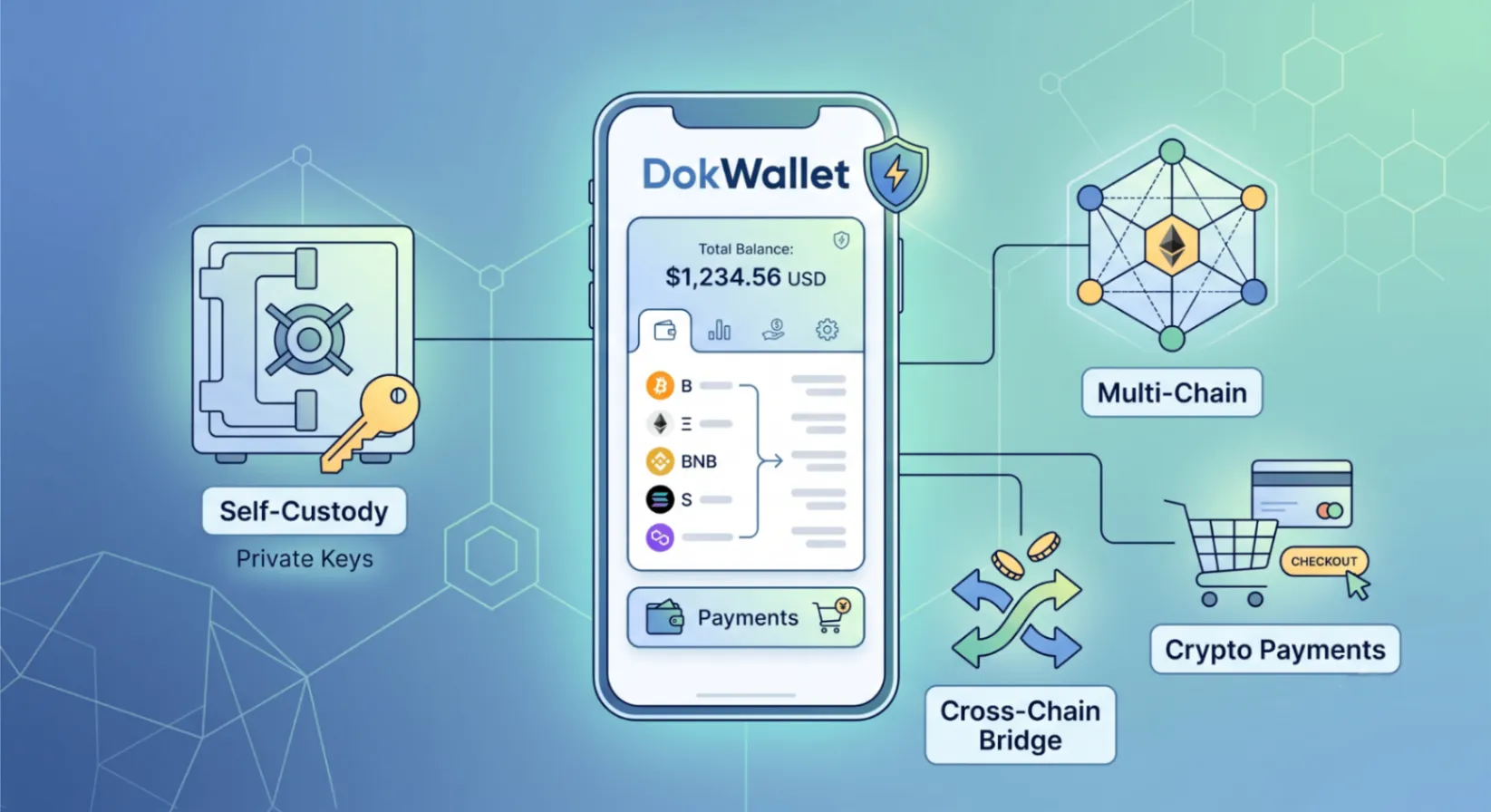
Choosing a crypto wallet means evaluating a long list of overlapping priorities: security, blockchain support, ease of use, and increasingly, payment functionality. Rather than piecing together several specialized apps to cover each need, DokWallet was built as a single, all-in-one crypto wallet designed to handle self-custody, multi-chain management, cross-chain transfers, and everyday payments in one consistent experience. This review walks through every major aspect of DokWallet, and how it compares to the broader landscape of non-custodial, decentralized, and mobile crypto wallets.
Non-Custodial Foundation: Who Actually Controls Your Funds
At its core, DokWallet is a fully non-custodial crypto wallet, meaning private keys are generated and stored directly on your device, never on DokWallet’s servers. This is the same principle behind every decentralized crypto wallet, and it’s the foundation that everything else in this review builds on. Without genuine non-custodial architecture, none of the other features matter, since true ownership of your assets depends entirely on who controls the private keys.
During setup, DokWallet generates a recovery phrase that users must securely back up, following the same essential security practices required by any responsible non-custodial wallet app. There’s no password reset option and no customer support line that can access your funds, by design, since that’s precisely the trade-off that gives you full control.
Multi-Chain and Multi-Asset Support
DokWallet functions as a genuine multi-chain crypto wallet, supporting multiple blockchain networks within a single, unified interface. Rather than requiring separate app installations for each network, DokWallet consolidates holdings into one portfolio view while maintaining accurate, chain-specific address management behind the scenes.
This matters significantly for anyone holding assets across several networks, since it eliminates the need to juggle multiple recovery phrases and separate apps just to get a complete picture of total holdings. As a multi asset crypto wallet and multi blockchain wallet, DokWallet handles the complexity of supporting diverse blockchain architectures while keeping the user-facing experience simple and consolidated. For anyone managing a crypto wallet for multiple coins across different ecosystems, this consolidation is one of DokWallet’s most practical advantages.
Cross-Chain Transfers Built Directly Into the App
Beyond simply holding assets on multiple chains, DokWallet functions as a genuine cross-chain crypto wallet, allowing users to move supported assets between different blockchain networks without needing to navigate external, third-party bridge websites. This integrated approach reduces both the technical complexity and the phishing risk historically associated with manually researching and using standalone bridge protocols.
For users participating in opportunities across different blockchain ecosystems, or simply looking to consolidate scattered holdings onto their preferred network, this built-in bridging functionality is a genuine differentiator compared to wallets that only support holding, not moving, assets across chains.
Mobile-First Design and iOS Experience
DokWallet was designed with a mobile-first philosophy, positioning it as a strong candidate for anyone searching for the best mobile crypto wallet or a reliable mobile crypto wallet app and blockchain wallet app more broadly. The interface prioritizes clear transaction flows, biometric security options, and intuitive network selection to reduce common user errors.
For Apple users specifically, DokWallet functions as a dedicated crypto wallet iOS app, built to integrate cleanly with iOS conventions like Face ID and to meet Apple’s stricter App Store review standards for crypto-related applications, a signal of a more mature, well-maintained product.
Crypto Payments: Sending, Receiving, and Cross-Border Use
DokWallet also functions as a practical pay-with-crypto app, supporting stablecoin transfers designed for everyday payment use cases, from freelance income to peer-to-peer transfers. Combined with multi-chain support, users can choose the network that offers the best balance of speed and cost for a given payment.
This payment functionality extends naturally into cross-border crypto payments, where DokWallet’s stablecoin payment app capabilities let users send and receive value internationally without relying on traditional, fee-heavy remittance infrastructure. For freelancers, remote workers, and businesses with international clients or teams, this positions DokWallet as a genuinely useful financial tool beyond simple asset storage.
Security Practices Worth Highlighting
Beyond the fundamental non-custodial architecture, DokWallet’s approach to security includes on-device private key generation with no server-side storage of sensitive recovery data, biometric authentication options for app access, and clear transaction confirmation flows designed to reduce costly mistakes like sending to the wrong network. These practices align closely with the fundamentals covered in our dedicated crypto wallet security best practices guide, which is worth reading alongside this review for a complete picture of how to use any non-custodial wallet safely.
How DokWallet Compares to Single-Purpose Wallets
Many popular crypto wallets specialize in a single area: some focus purely on security and cold storage, others focus on DeFi integration, and others focus narrowly on payments. DokWallet’s positioning as an all in one crypto wallet means it doesn’t aim to be the single best option in every narrow category, but rather the strongest consolidated option for users who want non-custodial security, multi-chain support, cross-chain transfers, and payment functionality without managing several separate apps.
For users with highly specialized needs, such as institutional-grade cold storage for very large holdings, a dedicated hardware wallet solution may still be worth pairing alongside DokWallet for a portion of long-term holdings. For the vast majority of everyday and active crypto users, however, DokWallet’s consolidated feature set covers the core needs most people actually have.
Onboarding Experience: What to Expect in Your First Session
First impressions matter, particularly for a category of app where a single setup mistake, like failing to properly back up a recovery phrase, can have permanent consequences. DokWallet’s onboarding flow walks new users through wallet creation step by step, requiring explicit confirmation that the recovery phrase has been recorded before allowing access to the main wallet interface. This kind of deliberate friction is a positive signal, not a shortcoming, since it reduces the likelihood of a user skipping a critical security step in the excitement of setting up a new wallet.
Once past initial setup, the main dashboard presents a consolidated portfolio view across supported networks, with clear navigation to send, receive, swap, and bridge functionality. New users can explore the interface risk-free by generating a wallet and reviewing the available features before transferring any meaningful funds, a practice worth following with any new wallet regardless of provider.
Transparency and Ongoing Development
A wallet’s trustworthiness extends beyond its initial feature set into how the provider communicates about updates, security practices, and known limitations over time. Users evaluating any wallet, DokWallet included, should look for clear release notes, responsive support channels, and a visible pattern of addressing user feedback through app updates. An actively maintained wallet with transparent communication is generally a stronger long-term choice than one that goes long stretches without meaningful updates or clear communication about its roadmap.
Who Should Use DokWallet
- New crypto users benefit from DokWallet’s clear onboarding and educational approach to self-custody, reducing the risk of early, costly mistakes.
- Multi-chain and DeFi participants benefit from consolidated portfolio management and built-in cross-chain transfer functionality.
- iOS users benefit from a dedicated, platform-optimized experience built specifically around Apple’s ecosystem and conventions.
- Freelancers, remote workers, and international businesses benefit from integrated stablecoin payment functionality designed for cross-border use cases.
Frequently Asked Questions
Is DokWallet truly non-custodial?
Yes. Private keys are generated and stored entirely on-device, with no server-side access to user funds or recovery data at any point.
Does DokWallet support all major blockchain networks?
DokWallet supports a growing range of major blockchain networks as part of its multi-chain architecture, with new network support added through regular app updates.
Can I use DokWallet for both storage and everyday payments?
Yes, DokWallet is designed to handle both long-term multi-chain asset management and everyday payment use cases, including cross-border stablecoin transfers, within the same app.
Should I still use a hardware wallet alongside DokWallet?
For very large, long-term holdings, pairing DokWallet with a hardware wallet for cold storage remains a sound practice, while using DokWallet itself for active, everyday balances and transactions.
Final Thoughts
DokWallet brings together the core pillars that matter most in a modern crypto wallet: genuine non-custodial security, robust multi-chain and cross-chain support, a polished mobile-first experience, and practical payment functionality, all within a single, consolidated app. For anyone tired of juggling multiple specialized wallets to cover these needs separately, DokWallet offers a compelling, all-in-one alternative worth serious consideration.
To dig deeper into any specific area covered in this review, explore our guides on non-custodial wallet fundamentals, multi-chain wallet management, the best mobile crypto wallet landscape, and crypto wallet security best practices.